On CHOW: BRIBE a hostess - does it work?
Find Articles in:
all
Business
Reference
Technology
News
Sports
Health
Autos
Arts
Home & Garden
advertisement
advertisement

Content provided in partnership with
ProQuest

Transportation Industry

Integrated public transport in Singapore and Hong Kong

Road & Transport Research,  Dec 2003  by Luk, James,  Olszewski, Piotr

Abstract

Integrated public transport has received particular attention in recent years as a means to improve public transport services and reduce reliance on car travel. Cities such as Singapore and Hong Kong already have high modal shares in public transport (63% and 90% of all motorised trips, respectively). The high population densities in these cities naturally help promoting travel by public transport, but the high quality of transport services is also another key factor. High modal shares and good service levels still require extra effort to integrate the services across all modes. This paper describes the activities in integrated public transport in Singapore and Hong Kong. These activities are in the form of physical, network, fare, information and institutional integration. The paper discusses the issues involved, including those related to an ageing population problem. In car-based Australian cities, improving public transport systems alone may not be effective in reducing car travel. The investment required to effect significant modal shift will be high. Apart from good public transport services, Singapore also relies on high car ownership and usage costs and Hong Kong on road congestion and carparking control to maintain a low car-ownership rate. The introduction of complementary measures such as more bus and transit lanes and even congestion pricing may be necessary to reduce car use in Australian cities.

INTRODUCTION

Singapore and Hong Kong are well-known for their high modal shares in public transport trips. Singapore has also successfully introduced congestion pricing since 1975 to reduce car trips to the CBD and maintained high car ownership costs to encourage transit usage (Luk 1999). Hong Kong has a very high urban density and is one of the few cities that can provide a good return on investments in public transport systems and its transit modal share is even higher than that of Singapore. Table 1 summarises some of the basic characteristics of Melbourne, Singapore and Hong Kong with data compiled from year books and various web sites (see References list at the end of the paper).

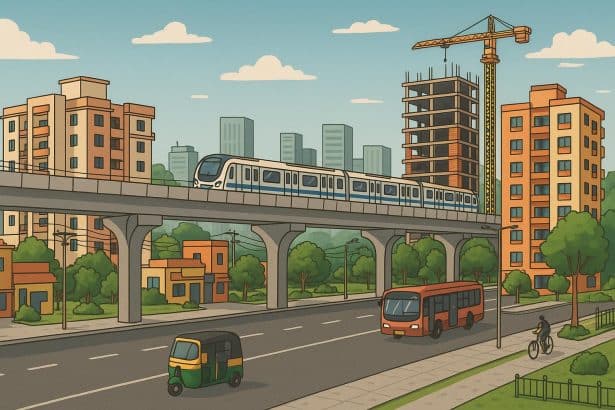
In recent years, integrated public transport has received particular attention in Singapore and Hong Kong as well as in many other cities. There is real effort in improving the connectivity across transport modes so that public transport becomes a viable alternative to car travel, thus reducing road congestion, pollutant emission and other externalities - an objective shared by many large cities. Transport systems have not usually begun from an integrated platform. They tend to evolve over time as population increases, with rail or tram lines radiating from the city centre. This paper describes the measures that have recently been taken to improve the integration of transport services in Singapore and Hong Kong. These two cities are chosen partly because the authors have lived in both cities for some time and are familiar with the issues involved. It is also because of the large investments by both Governments in pursuing better service integration. This paper begins with the definition of integrated public transport and limits the scope of discussion to the transport of passengers; freight transport is excluded. It then identifies the five key measures for transport integration. The Singapore experience is used to illustrate the various measures. Hong Kong has its own set of issues which are described in a subsequent section. A discussion of integrated public transport in the context of an ageing population is also provided.

MEASURES FOR INTEGRATED PUBLIC TRANSPORT

The term 'integrated public transport' (or simply 'integrated transport') is generally defined as a system that provides door-to-door public transport services for passengers (Janic and Reggiani 2001). The term 'intermodal transport' is commonly used for the transport of goods. There are as yet no standard definitions of these terms. The objective of integrated public transport is clear - to achieve a high transit modal share with a seamless service using two or more modes.

Measures for integrating transport services include the following five broad categories (Luk and Olszewski 2001; Luk and Yang 2001; Konopatzki 2002):

(a) Physical integration - the close proximity and ease of access at mode interchanges will greatly enhance public transport services. Walkways should be carefully designed for passengers to change mode. Passengers should be within a short walking distance from their residences to a transit stop.

(b) Network integration - bus and rail systems should be an integrated network in their own right and these separate networks should further complement one another. Feeder services using buses, trams or light rail should be designed to maximise the patronage of the trunk routes. Network integration is closely linked to physical integration and both contribute towards the integration of infrastructure.

(c) Fare integration - a single fare card for multiple transit services will facilitate the transfer between modes. Rebates can be implemented as an inducement for those who transfer from one mode to another.