


Introduction
Ever had this happen: You’re super excited to take your new portable power station camping. You get there, open your laptop ready to work, plug it in… and nothing happens.
Don’t ask how I know.
- Introduction
- What Is USB-C PD and Why Is It Suddenly Everywhere?
- From “It Fits” to “It Works” – What USB-C PD Changed
- 45W or 60W? Let’s Talk Power
- PIFORZ USB-C PD Lineup at a Glance
- Real-Life Scenarios – Which Capacity Works for You?
- Scenario 1: Quick Day Trips
- Scenario 2: Weekend Camping + Remote Work
- Scenario 3: Multi-Day Trips or Home Backup
- Scenario 4: Long Road Trips or Pro Needs
- What’s Next: More Power, Smarter Charging
- Simple Buying Advice
- 1. First, Check Your Device’s Power Needs
- 2. Ports Matter More Than Capacity
- 3. Pick Capacity by Trip Length
- 4. Same Ports Across the Line – Just Pick Your Size
- 5. Think Ahead a Little
- Wrapping Up
When I bought my first portable power station three years ago, I made this exact mistake. I only looked at capacity – thinking “bigger is better” – and didn’t pay attention to the ports at all. Got to the campsite and my MacBook wouldn’t charge at all.
Yeah, that weekend totally killed my “outdoor office” plans. I just watched my laptop battery drain, powerless to stop it.
Later I learned the problem was all about USB-C PD.
What Is USB-C PD and Why Is It Suddenly Everywhere?
Put simply, USB-C PD (Power Delivery) is a fast-charging technology. It lets USB-C ports not just transfer data, but also deliver up to 100W or even 240W of power.
What does this mean for you? It means you can charge your phone, tablet, and laptop all with one cable – and it charges fast.
Over the last few years, USB-C PD has become standard on almost all new gadgets:
- MacBook Pro charges entirely through USB-C
- iPhone 15 series finally switched to USB-C
- iPad Pro, Nintendo Switch, even some cameras now use USB-C PD fast charging
But it took a while for portable power stations to catch up.
Early on, lots of power stations had USB-C ports that were just “for show” – they’d fit, but only put out 15W. Fine for phones, totally useless for laptops. That’s exactly the trap I fell into.
From “It Fits” to “It Works” – What USB-C PD Changed
Back Then: A Mess of Cables
Think back five years. Leaving the house meant packing your laptop charger (that huge brick), phone cable, camera charger, power bank cable… your bag was a mess.
Now: One Cable Rules Them All
USB-C PD changed everything. Now I charge my MacBook, iPhone, iPad, and Switch with the same cable. I just need one charger and one USB-C to USB-C cable when I travel.
What does this mean for portable power stations? Simple – they had to keep up.
That’s why every portable power brand now makes USB-C PD standard, no matter the size. Take the PIFORZ lineup for example:
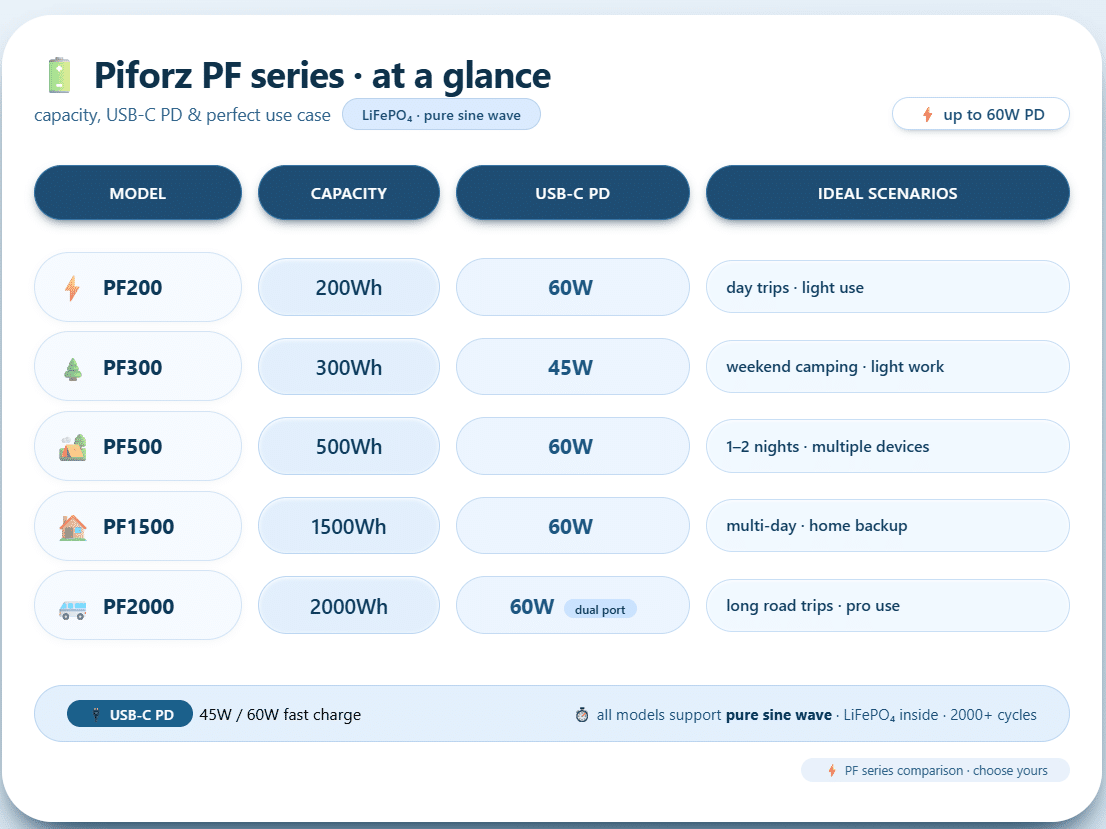
- PF200: 200Wh, perfect for day trips, with 60W PD fast charging
- PF300: 300Wh, a solid weekend camping choice, with 45W PD fast charging
- PF500: 500Wh, the “sweet spot” for two-day trips, with 60W PD fast charging
- PF1500: 1500Wh, great for longer trips or backup at home, with 60W PD fast charging
- PF2000: 2000Wh, built for road trips or pro use, with 60W PD fast charging (two USB-C ports)
See what they all share? Every single one has USB-C ports with PD fast charging.
Whether you grab the lightweight PF200 for daily commutes, use the PF500 for a chill weekend camping, or take the PF2000 on a long RV adventure – you just pick based on “how long you need power.” No more worrying about “will this even work?”
This “one port fits all” approach is the biggest change USB-C PD has brought.
45W or 60W? Let’s Talk Power
People often ask: Is 45W enough? Does 60W really make a difference?
Here’s the deal: For most lightweight laptops, 45W works fine, but 60W just feels better.
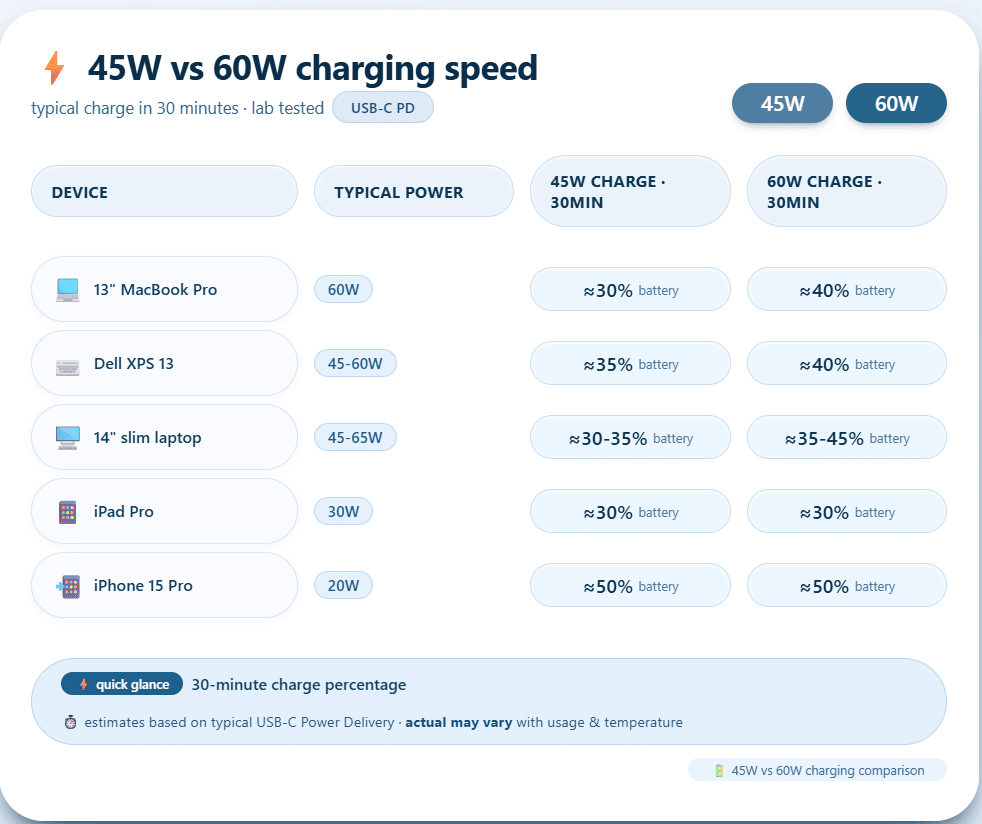
Here’s a quick comparison:
Source: Official charging specs and real-world tests
Basically:
- With 45W, your laptop gets about 30-35% charge in half an hour – enough to watch another episode or join a 30-minute video meeting
- With 60W, you’re looking at around 40% charge in half an hour – that extra 10% means about another hour of light work
Of course, if you’re using a 16-inch MacBook Pro or a powerful gaming laptop, they might need 100W or more. In that case, 60W becomes “slow charging” – it’ll top you up, but don’t expect lightning speed.
That’s why, when picking a power station, always check what wattage your devices need first.
PIFORZ USB-C PD Lineup at a Glance
Bottom line:
- If your laptop doesn’t need much power, or you’re mostly charging phones and tablets, the PF300 with 45W is plenty– plus it’s lighter
- If you have a standard lightweight laptop and want faster charging, go with the PF200, PF500, PF1500, or PF2000 with 60W
- If you need to fast-charge two devices at once, the PF2000 with dual USB-C ports is super handy
Real-Life Scenarios – Which Capacity Works for You?
Specs can get boring. Let’s look at how people actually use these things.
Scenario 1: Quick Day Trips
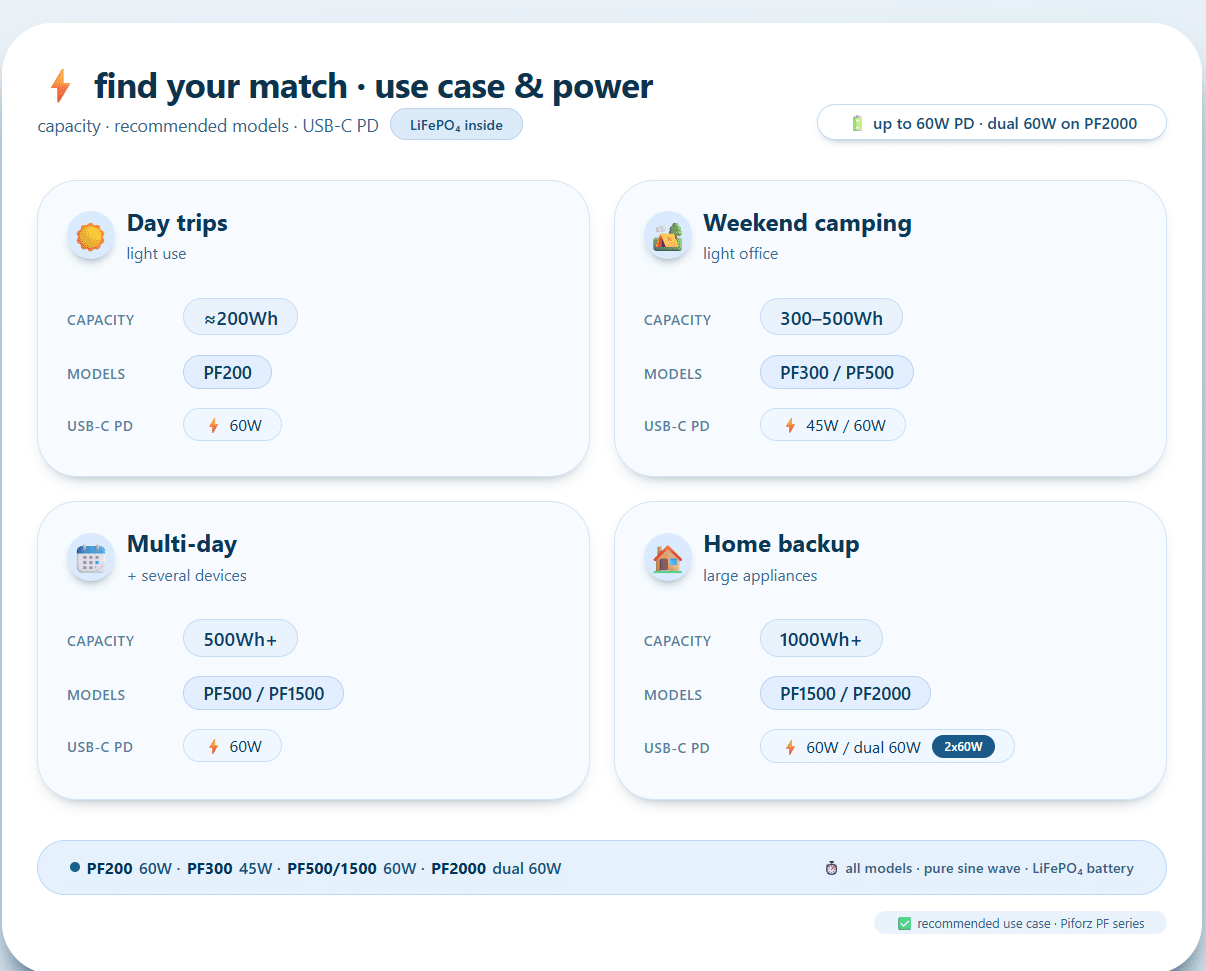
Best pick: PF200 (200Wh, 60W PD)
Headed to the park for the day? You’ll probably do some light work on your laptop, charge your phone and camera a few times. The PF200’s 200Wh easily lasts most of the day, and it’s nice and portable. The 60W PD fast charging keeps your laptop ready – nearly half charge in 30 minutes.
Scenario 2: Weekend Camping + Remote Work
Best picks: PF300 (300Wh, 45W PD) or PF500 (500Wh, 60W PD)
Leave Friday afternoon, head home Sunday evening. You’ll work a bit, take photos, maybe watch a movie on a projector at night.
- PF300 gives you 300Wh – enough if you watch your usage. The 45W PD works fine for standard laptops. Great if you’re on a budget or don’t have many devices.
- PF500 gives you an extra 200Wh, so you can relax – no staring at the battery meter all night. Plus, the 60W PD tops up your laptop faster.
Scenario 3: Multi-Day Trips or Home Backup
Best pick: PF1500 (1500Wh, 60W PD)
Think RV trips, emergency power at home, outdoor worksites. Here, you want “peace of mind” – big capacity, plenty of output. The PF1500 powers all your gadgets and even small appliances. The 60W PD keeps your laptop fully charged, no problem.
Scenario 4: Long Road Trips or Pro Needs
Best pick: PF2000 
If you’re always on the road or need to fast-charge multiple devices, the PF2000’s dual USB-C ports are a game-changer. Charge two laptops at once, or a laptop and a tablet – both fast. Pair it with solar panels for real off-grid freedom.
What’s Next: More Power, Smarter Charging
USB-C PD keeps getting better. The latest version supports up to 240W – enough for pretty much any laptop and even some desktop computers.
This means future power stations might:
- Handle higher wattage: Full-speed charging for 16-inch MacBook Pros
- Smarter power management: Auto-detects devices and prioritizes the ones running low
- Two-way charging: Not just taking power from the station, but giving power back too
Some brands showed off cool concepts at CES. Models with smart screens showing real-time charging status and time left. Semi-solid state batteries with smart algorithms predicting battery health.
But honestly, while all that sounds cool, what most of us really want is simple: plug it in, it works, no thinking required.
Simple Buying Advice
If you’re shopping for a portable power station, here’s what to remember about USB-C PD:
1. First, Check Your Device’s Power Needs
Look up your laptop’s charging specs online:
- For laptops under 60W, any PIFORZ model works (the PF300’s 45W is fine, but 60W feels snappier)
- If you need 100W+, grab a 60W model and accept “slow charging,” or wait for future higher-power options
2. Ports Matter More Than Capacity
You can always stretch capacity by using less power. But if the ports don’t match, you’re just stuck. Good news: all PIFORZ models have USB-C PD fast charging ports, so you’re covered.
3. Pick Capacity by Trip Length
4. Same Ports Across the Line – Just Pick Your Size
From the PF200 to the PF2000, every PIFORZ model has USB-C PD fast charging. So you can choose based purely on how long you’ll be away, without worrying about missing features.
5. Think Ahead a Little
Gadgets upgrade fast. Your lightweight laptop might need 45W today, but could easily need 65W in three years. Getting a little extra power now means your power station lasts longer.
Wrapping Up
Remember the question: Why is USB-C PD changing the portable power market?
Simple answer: Because it makes everything so much easier.
Used to be, you’d pack a bag full of cables and chargers. Now, one cable does it all. Used to be, you’d worry if a power station could charge your laptop. Now, you just check for PD. Used to be, power stations were just “backup gear.” Now, they actually let you work comfortably from anywhere.
As for choosing between power and capacity? PIFORZ made it simple – from 200Wh to 2000Wh, from 45W to 60W, covering everything from day trips to long RV adventures. The ports are all the same. They all fast-charge laptops. You just need to ask yourself one question:
How long are you going? What are you bringing?
Once you know that, you know exactly which one to pick.

