


The international iGaming market is in a seismic structural change. What we are seeing is a shift between the stagnant, asynchronous world of Random Number Generator (RNG) simulation and the active, synchronous world of Live Dealer gaming. This is not a change of content only, but a fundamental change of engineering requirements.
During the times of RNG slots, it was impossible to feel the difference between 500 milliseconds (ms) of delay. A server pre-determined the outcome, and the device belonging to a user was merely a display terminal. Nonetheless, Live Dealer verticals, including blackjack, roulette, and Game Show formats, have created a bi-directional and real-time communication need which cannot be fulfilled by the traditional cloud frameworks.
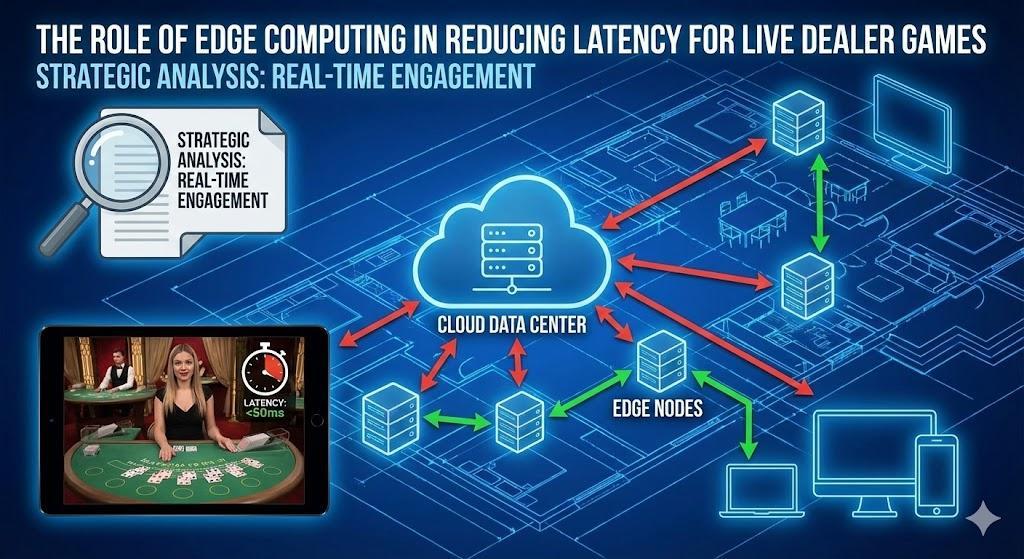
Trust is the commodityforf sale in this high-stakes environment. Any noticeable delay between the studio camera and the screen of the player generates a so-called trust gap, bringing about suspicions of manipulation. This paper offers an architectural and strategy perspective on why the conventional centralized cloud cannot succeed in modern iGaming and how Edge Computing offers the answer.
The Anatomy of the “Trust Gap”
Feedback loops determine the credibility of a virtual casino. In a brick-and-mortar casino, the response is instant: the ball drops, and the money is given. This loop is intermediated by a sophisticated set of encoders, servers, and routers in an online setting.
Empirical findings have shown that the human brain can only sense a response as instantaneous when the response takes place in 100-200ms. In addition to this, there is some delay registered by the brain. This takes two vital forms in live dealer gaming:
- Input Lag: It is the number of seconds between the time when a player clicks on the button “Hit” and the moment the dealer receives the instruction. High input lag forces cause dealers to wait, which disturbs the flow of the game.
- Synchronization Lag: The difference between the data overlay and the video feed. A digital version of the You Win message that comes before the video presents the card kills the suspense. In case it comes later, the player experiences loss of control.
Although the standard latency of TV broadcast (5-10 seconds) is tolerable in passive consumption of television, the interactive component of live casinos requires Real-Time Interactive Streaming (RTIS) of under 500ms latency. This causes a technical divide that cannot be overcome by standard Content Delivery Networks (CDNs), which are optimized to deliver a buffered asset.
The Economic Cost of Latency
The push towards edge computing is as much about economics as user experience. Latency is directly and measurably correlated with Gross Gaming Revenue (GGR).
1. Throughput and Efficiency
An average Blackjack game lasts about 45 seconds. Even a 3-second delay in communication will result in a 6-7% decrease in the number of hands that will be actively dealt per hour. This inefficiency, across thousands of tables in the world, amounts to millions of dollars of revenue that are not being collected.
2. Churn and Flow State
There is no tolerance for lag among digital consumers. E-commerce research indicates that the conversion rates may decrease by 7 percent with a 1-second response time. In iGaming, where conversion is a continuous incoming stream of bets, lag interrupts the flow state of the gambler, causing him to abandon the session.
3. The Missed Opportunity of Micro-Betting
In-play or flash betting – betting on the next card or spin of a ball is the fastest expanding part of gambling. The betting windows in these markets have to be open until the final fraction of a second. High latency pushes casino operators to close the windows early to avoid the past-posting (betting on known results), and proprietors miss money.
The Physics of Latency: Why the Cloud Fails
We have to dismantle a problem to know the solution. The glass-to-glass data packet trip, such as the movement of a data packet between a studio in Riga and a smartphone in São Paulo, takes four steps: Capture, Processing, Rendering, and Transmission.
The very core issue of the standard cloud architecture is its centralization. When a single hyperscale data center (e.g., AWS Dublin) is used to host their game engine to reach a worldwide audience, then the bottleneck is the transmission latency.
To a player in Sydney who is connected to a server in Dublin:
- Physical distance: ~17,000 km.
- Theoretical minimum RTT (fiber): ~170ms.
- Real-world Internet RTT: 300-400ms (due to routing hops and congestion).
With encoding, processing, and last-mile delays, total latency can easily go past 1 second, usually to 3-5 seconds. Even the optimal software will not allow light to travel faster. The physical distance can only be controlled to minimise the transmission latency.
The Edge Computing Paradigm Shift
To address the physics problem, edge computing pushes the computation, storage, and networking resources out into the edges of the internet, physically nearer to the end-user.
In an edge architecture, the Sydney player is linked to an Edge Node in Sydney. The transmission distance will reduce to less than 50 km,m and the network RTT drops to less than 5ms. The edge node is a local proxy. It captures the video stream on a dedicated backbone (without using the public internet) and distributes it on a local basis.
More importantly, this transformation makes the Stateful Edge possible. Whereas normal CDNs are stateless (caching files), iGaming needs the edge to know context: user balance, bet validity, and game state. With active-active geo-duplication available through distributed databases (such as Redis Enterprise or CockroachDB), operators will be able to make session data available in edge nodes. This enables optimistic UI updates, whereby the edge node signs a bet immediately, and this gives the impression of zero latency, signalling asynchronously with the central ledger.
Protocol Evolution: From TCP to UDP
The transport layer, which is the veins of the system, is also evolving. The industry is rapidly moving out of the TCP-based protocols (such as HLS and DASH) to the UDP-based protocols.
WebRTC (Last Mile)
The new standard in the player-facing delivery is WebRTC. WebRTC uses UDP (fire and forget) as opposed to HLS that uses TCP (guaranteed delivery that leads to buffering). Live video is a case where a momentary visual glitch is preferable to waiting 2 seconds to re-read a packet that has been lost. WebRTC will always provide under 500ms latency, which is necessary in real-time interaction.
SRT (First Mile)
In retrieving the video out of the studio, the Secure Reliable Transport (SRT) protocol is being used in place of the old RTMP. SRT was created by Haivision as a variation of UDP, requiring a tunable latency buffer and Automatic Repeat reQuest (ARQ). This enables it to reassemble individual packets that have been lost without stalling the stream so that high-quality 4K ingest can be achieved even with studios in areas with unreliable internet infrastructure.
5G and Mobile Edge Computing (MEC)
Whereas edge computing is taking the server to the city, 5G is taking the network to the device. The combination of these technologies is referred to as Mobile Edge Computing (MEC), and this is the final destination of latency reduction.
5G is not just a faster version of 4G, but it is an architectural difference. The Air Interface Lateness is decreased to less than 1ms.
Moreover, 5G will provide Network Slicing that will enable operators to slice the network. One of the iGaming operators may buy an ultra-reliable low-latency communications (URLLC) slice, which would essentially make it a VIP Premium Connection. In this slice, no internet noise is given preference to allow the traffic to be prioritized and a stream of a VIP player to go through lag-free, even in the case of the highest network load.
Advanced Use Cases: AI and Compliance
The edge unlock functionalities are not restricted to mere streaming, but are low-latency.
Real-Time Computer Vision
Live game frauds need to be detected immediately. Edge AI enables operators to run Computer Vision models (such as YOLO) on edge nodes to make video frame analysis in real time. The system has the ability to identify cards quicker than a human dealer, and it can identify suspicious betting behavior (that would be an indication of card counting) prior to any hand being resolved. It would be too slow to send this data to a central cloud,d but edge processing makes it actionable.
The “Digital Embassy”
Laws on data sovereignty (such as GDPR or state laws in the US) tend to demand that user data stays within particular boundaries. Where edge nodes serve as “Digital Embassies.” A German player can have their bets processed by an operator located physically in Germany, making sure that the local laws are respected, and at the same time have the quickest possible connection.
Conclusion: The Strategic Imperative
Embarking on edge computing in the live dealer ecosystem is not a value addition; it is an absolute must. With increasing demands on the part of players to achieve an instant response, and with gameplay changing to micro-betting and a fully immersive VR (which needs sub-20ms response time to avoid motion sickness), the speed of light is set to become the final adversary.
Only one architectural strategy that manages to avoid this adversary is called edge computing. Operators can cross the so-called Trust Gap, and do so through decentralized cloud, adoption of UDP-based protocols such as WebRTC and SRT, and network slicing on 5G networks. The future of iGaming lies at the edge between the data and the user, and where the game actually comes to life.
