


Organizations that make strategic decisions on imperfect information need structures that increase confidence in what they know and clarify what they do not. Trusted information frameworks tie technical infrastructure, policy, and human accountability into a consistent approach that reduces ambiguity, accelerates decision cycles, and defends against unintended risks. Rather than treating trust as a vague aspiration, these frameworks make trust measurable and actionable so executives can weigh options with a clearer picture of uncertainty and consequence.
The logic of trust-based frameworks
A trusted information framework starts with the premise that information must be assessed along multiple dimensions: provenance, completeness, timeliness, quality, and appropriateness for the decision at hand. Provenance captures where data came from and how it has been transformed; completeness describes coverage and gaps; timeliness addresses freshness and latency; quality examines error rates and validation; appropriateness evaluates whether the data is fit for the business question. Combining these assessments produces a trust score or profile that decision makers can use as a lens, not a blunt instrument. This profile informs whether a dataset enters a planning model, whether supplementary evidence is needed, or whether a decision requires staged implementation and monitoring.
A policy foundation
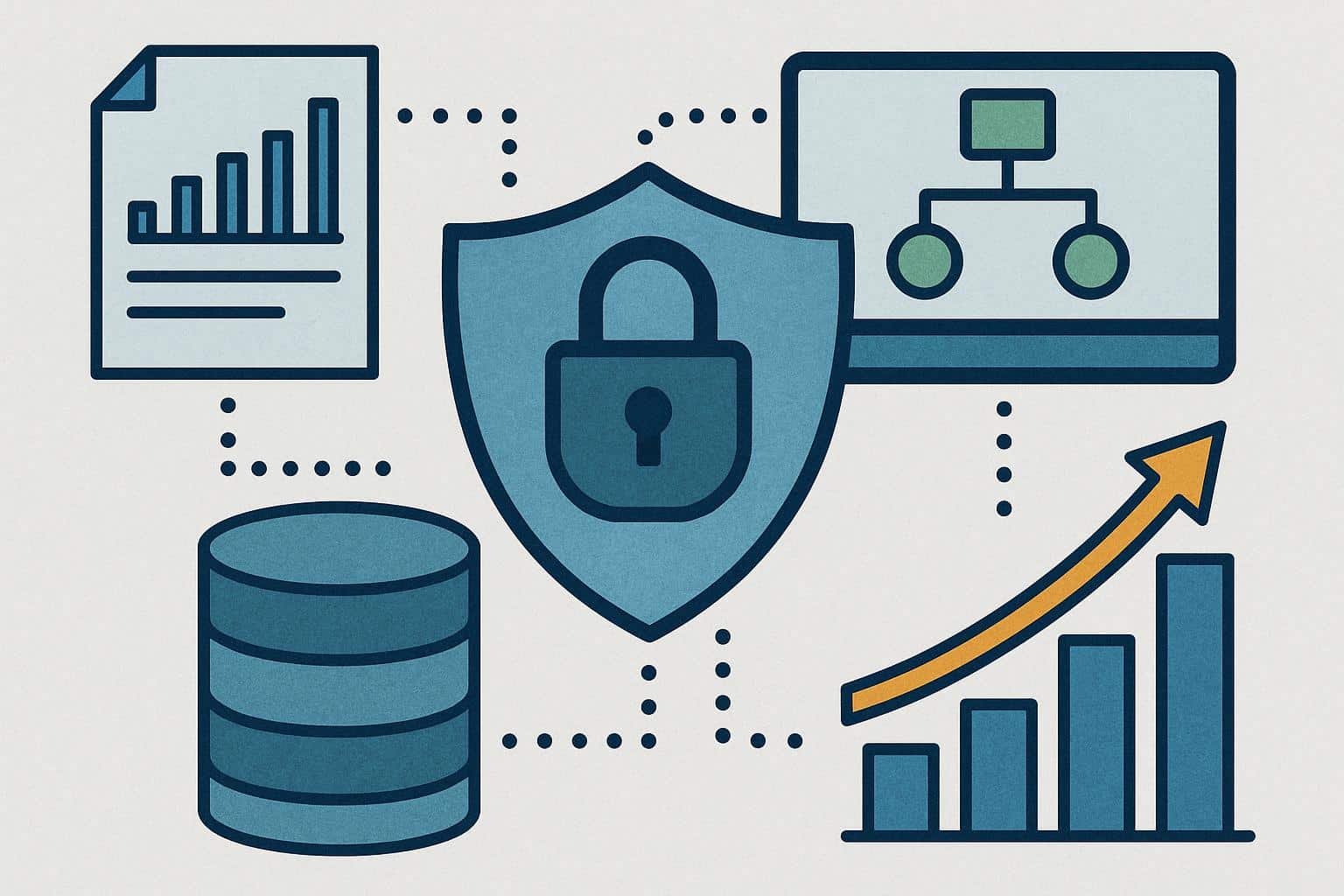
A robust policy foundation relies on data governance to define roles, responsibilities, and enforcement mechanisms that anchor the rest of the framework. Policies identify accountable owners for assets, specify minimum quality thresholds, codify acceptable uses, and describe escalation paths for anomalies. Policies alone are insufficient, however; they must be operationalized through processes and technologies that automate checks, record decisions, and provide transparent audit trails. A policy that names stewards and outlines remediation workflows ensures that trust evolves from obligation rather than occasional heroics.
Technical enablers for trustworthy information
Technical enablers translate policy into repeatable practice. Metadata catalogs and lineage tools make provenance visible, exposing how raw inputs move through transformations to become the metrics leaders consume. Automated validation pipelines enforce quality gates that prevent known data defects from contaminating models and dashboards. Access controls and encryption protect sensitive elements while role-based masking preserves utility for analysis. Observability systems monitor both data flows and the models that consume them, producing alerts when drift or degradation threatens decision use cases. Together, these technologies narrow the gap between what the business expects and what the data actually delivers.
Human factors and organizational design
No amount of tooling will substitute for clear human accountability and the right incentives. Trusted information frameworks require defined stewardship roles, decision-rights maps, and cross-functional councils that represent analytics, security, legal, and business domains. Training is essential; analysts and managers need shared language for trust-related concepts so that a “high-confidence” label means the same thing across teams. Reward structures should recognize not only speed and innovation but also diligence in documentation, reproducibility, and error reporting. Cultural alignment reduces friction when trade-offs must be made between speed and certainty, enabling more nuanced decisions rather than defaulting to overly cautious or reckless choices.
Measuring trust and linking it to outcomes
To influence strategy, trust needs metrics that connect to outcomes. Leading indicators might include percentage of assets with end-to-end lineage, time to detect and remediate data incidents, or the distribution of trust scores across critical datasets. Lagging indicators could measure decision quality, such as forecast accuracy, cost variance versus plan, or the frequency of rework due to data issues. Combining process and outcome metrics creates a feedback loop: measuring where trust is low highlights investments likely to improve downstream performance, and tracking decision outcomes validates whether those investments were effective.
Risk-aware decision processes
Trusted information frameworks embed risk awareness directly into decision workflows. Rather than treating data issues as separate problems, the framework surfaces uncertainty and potential failure modes at the point of choice. Scenario playbooks describe actions for common contingencies, such as partial data outages or model degradation. Decisions that rely on lower-trust inputs can be bound by narrower approvals, shorter time horizons, or staged rollouts. This approach preserves agility while preventing a single flawed dataset from cascading into a damaging strategic error.
Implementing at scale
Scaling a trusted information framework begins with clear, achievable pilots that deliver visible benefit. Select one strategic domain—pricing, supply chain, customer retention—and design a trust profile for its critical information assets. Instrument pipelines to capture lineage and quality metrics, formalize stewardship, and align a small governance body to iterate on policies and thresholds. Use the pilot to build reusable patterns: templates for policy, scripts for validation, and dashboards for trust scores. Gradually expand, learning where automation can reduce manual work and where human judgment remains indispensable. At scale, a composable architecture of shared services—catalog, validation engines, access controls—reduces duplication and accelerates adoption across domains.
Sustaining improvement
A trusted information framework is not a one-time project but a continuous program. Regular audits, tabletop exercises, and post-incident reviews keep the system resilient. Technology refreshes and evolving regulatory landscapes demand that policies and tooling be periodically re-evaluated. Most importantly, leadership must treat trust as a strategic capability: allocate resources for stewardship, champion transparency, and celebrate improvements in decision confidence and business outcomes. When trust is quantified and visible, it becomes easier to make the trade-offs that leadership faces every day.
Final reflection
Trusted information frameworks provide a disciplined way to convert raw inputs into decision-grade intelligence. They do this by aligning policy, technology, and people around a common objective: reliable decisions with predictable risk. Organizations that adopt this approach find that decisions require less second-guessing, that experiments proceed with measured safeguards, and that strategic outcomes are reached with greater consistency. The payoff is not simply cleaner data, but a decision system that leaders can rely on when stakes are high.

