


A single truck sitting idle on the side of an interstate is not just a maintenance problem. It is a business problem with a dollar figure that starts climbing the moment the engine stops turning. The American Transportation Research Institute estimates that unplanned downtime costs commercial fleets between $448 and $760 per hour when factoring in lost revenue, driver wages, cargo delays, and shipper penalties. For a small fleet running ten trucks, one bad week of breakdowns can erase an entire month of profit.
Large carriers absorb these losses across thousands of units and dedicated maintenance departments. But for owner-operators and small fleet owners, the operators who move roughly 90 percent of freight in the United States according to the Federal Motor Carrier Safety Administration, unplanned downtime hits differently. There is no backup truck sitting in the yard. There is no in-house maintenance team on call. When a truck goes down, revenue goes to zero until it rolls again.
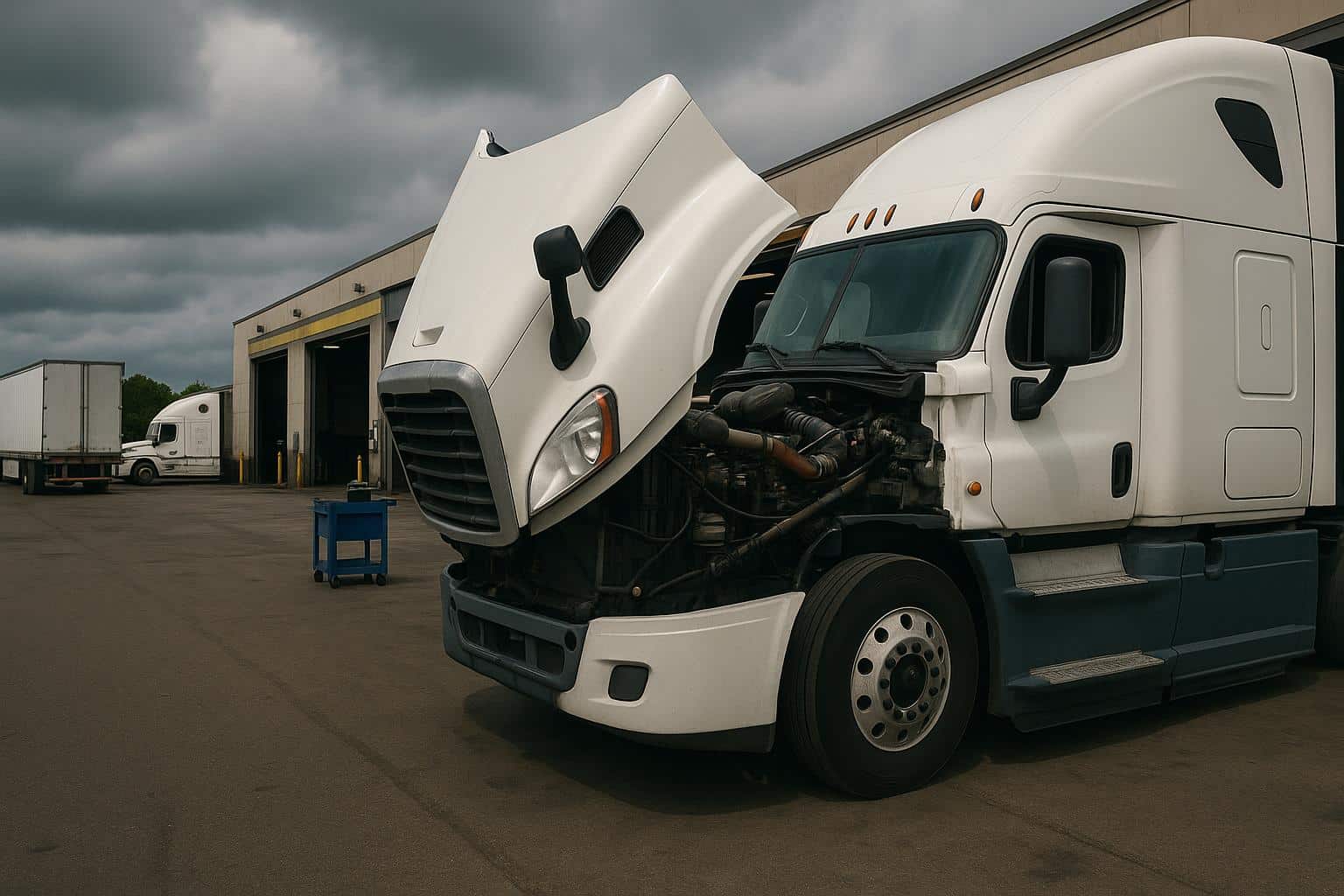
Where the Money Actually Goes
The repair invoice is usually the smallest part of a downtime event. The real financial damage comes from the cascading effects that follow. A missed delivery window can trigger a shipper penalty or, worse, cost the carrier a contract entirely. The driver sitting idle still needs to be paid, fed, and housed if the breakdown happens far from home. If the load is time-sensitive or temperature-controlled, the freight itself may be at risk.
Then there is the opportunity cost. Every hour a truck spends waiting for a repair is an hour it is not generating revenue on the next load. For an owner-operator averaging $2.50 per mile and running 500 miles per day, a 24-hour breakdown represents roughly $1,250 in lost hauling capacity before the repair bill even enters the equation. Multiply that across several unplanned events per year and the numbers become existential for a small operation.
The Repair Search Problem
One of the least discussed factors in truck downtime is the time spent finding the repair itself. When a Class 8 truck breaks down in unfamiliar territory, the driver and dispatcher face a search problem that a generic internet query cannot reliably solve. Not every mechanic listed in a general business directory works on commercial diesel engines. Not every shop that claims 24/7 availability actually answers the phone at 3 a.m. Not every roadside provider carries the diagnostic tools needed for a modern electronically controlled engine.
The result is wasted time calling shops that cannot help, dispatching mobile mechanics who arrive without the right equipment, or towing a truck to a facility that turns out to be the wrong specialty. Each wrong turn adds hours to the recovery timeline. Fleets and owner-operators who use a commercial truck service directory to pre-identify qualified heavy-duty repair providers along their regular routes eliminate the search phase entirely, converting a scramble into a structured response.
Preventive Maintenance Is Not Enough
Every fleet management guide emphasizes preventive maintenance, and for good reason. Disciplined PM schedules reduce roadside failures by 25 to 30 percent, lower total repair costs, and extend equipment life. But preventive maintenance is a risk reduction strategy, not a risk elimination strategy. Tires still blow out from road debris. Fuel injectors fail between service intervals. Electrical gremlins defy even the most thorough inspections.
The gap in most small fleet operations is not the absence of a maintenance program but the absence of a plan for what happens when maintenance is not enough. Operators who build a response protocol before the breakdown happens consistently recover faster than those who improvise under pressure. That protocol does not need to be complicated. It needs three things: a list of verified repair providers organized by location and specialty, a standardized communication process between driver and dispatcher, and pre-negotiated terms with at least one mobile repair service in each corridor the fleet operates.
Mobile Repair Is Changing the Equation
One of the most significant shifts in the heavy-duty repair industry over the past decade is the growth of mobile diesel mechanics. These are independent technicians and small companies that bring diagnostic tools, parts inventory, and repair capability directly to the truck rather than requiring a tow to a fixed shop. For a breakdown on a rural stretch of interstate where the nearest dealer is 90 miles away, a mobile mechanic can mean the difference between a four-hour recovery and a two-day ordeal.
The challenge is finding them. Mobile repair providers are often independent operators who do not appear in traditional business listings. Many rely on word-of-mouth referrals within the trucking community. Platforms that allow drivers and fleet managers to find verified mobile diesel mechanics near any breakdown location are closing this visibility gap, connecting stranded operators with qualified technicians who can reach the truck within hours rather than requiring a costly tow to the nearest shop.
Data-Driven Decisions Replace Gut Calls
Small fleet operators who track their downtime data gain a significant advantage over those who treat each breakdown as an isolated event. By recording the cause, location, duration, and total cost of every unplanned stop, patterns emerge that inform smarter decisions. A fleet that discovers 40 percent of its roadside failures involve tire-related issues on a specific corridor can pre-position tire service providers along that route. An operator who notices aftertreatment faults cluster at a certain mileage interval can adjust PM schedules accordingly.
The most useful metric is mean time to repair, which measures the entire arc from breakdown to wheels rolling again. Reducing MTTR by even one hour across all unplanned events in a year can translate into tens of thousands of dollars in recovered revenue for a small fleet. That reduction rarely comes from faster wrenching. It comes from faster identification of the right repair provider, faster communication of the problem, and faster mobilization of the response.
Building Resilience on a Small Budget
Large carriers invest millions in proprietary maintenance networks, on-site parts warehouses, and dedicated breakdown desks staffed around the clock. Small fleet operators cannot replicate that infrastructure, but they can replicate the logic behind it. The core principle is the same: reduce the time between the moment a truck stops and the moment a qualified technician begins working on it.
For small operators, this means building a personal network of trusted repair providers before the emergency happens. It means saving shop contacts organized by location and specialty rather than searching from scratch each time. It means training drivers to communicate breakdown symptoms clearly so the dispatcher can match the problem to the right provider on the first call. None of these steps require significant capital. They require discipline and a recognition that breakdown recovery is not an afterthought but a core operational capability.
The Competitive Edge of Getting Back on the Road First
In a freight market where margins are tight and shipper expectations continue to rise, the operators who recover fastest from unplanned disruptions are the ones who keep their contracts and build their reputations. A shipper choosing between two carriers of equal price and service quality will choose the one with better on-time performance every time. And on-time performance, in the real world of trucking, is often determined not by how fast a truck runs but by how fast it gets back to running after something goes wrong.
Truck downtime will never be fully eliminated. Mechanical failures are an inherent part of operating complex diesel-powered equipment across millions of miles per year. But the financial impact of those failures is not fixed. It is a variable that operators can influence through preparation, data, and the decision to treat breakdown recovery as a system rather than a series of emergencies. The fleets that figure this out do not just survive. They grow while their competitors are still on hold with the wrong repair shop.

