


Modern transportation often appears effortless on the surface. A journey begins, navigation adjusts automatically, traffic signals seem coordinated, and deliveries arrive with remarkable precision. Yet behind every movement on the road is a complex web of systems operating continuously and largely invisibly.
Mapping platforms, cloud infrastructure, sensor networks, and logistics algorithms now form the backbone of mobility. While drivers experience transportation as a simple act of movement, what actually enables it is a constantly shifting digital ecosystem designed to predict, coordinate, and optimise flow at scale.
- The Hidden Architecture of Everyday Movement
- Cloud Platforms as the Nervous System of Mobility
- Sensor Networks and the Real-Time City
- Logistics and the Algorithmic Supply Chain
- The Role of Connectivity in Modern Vehicles
- Predictive Systems and the Illusion of Smoothness
- Human Experience on Top of Machine Systems
- The Subtle Influence of Data-Driven Mobility on Culture
- Conclusion: The Quiet Intelligence Behind Every Journey
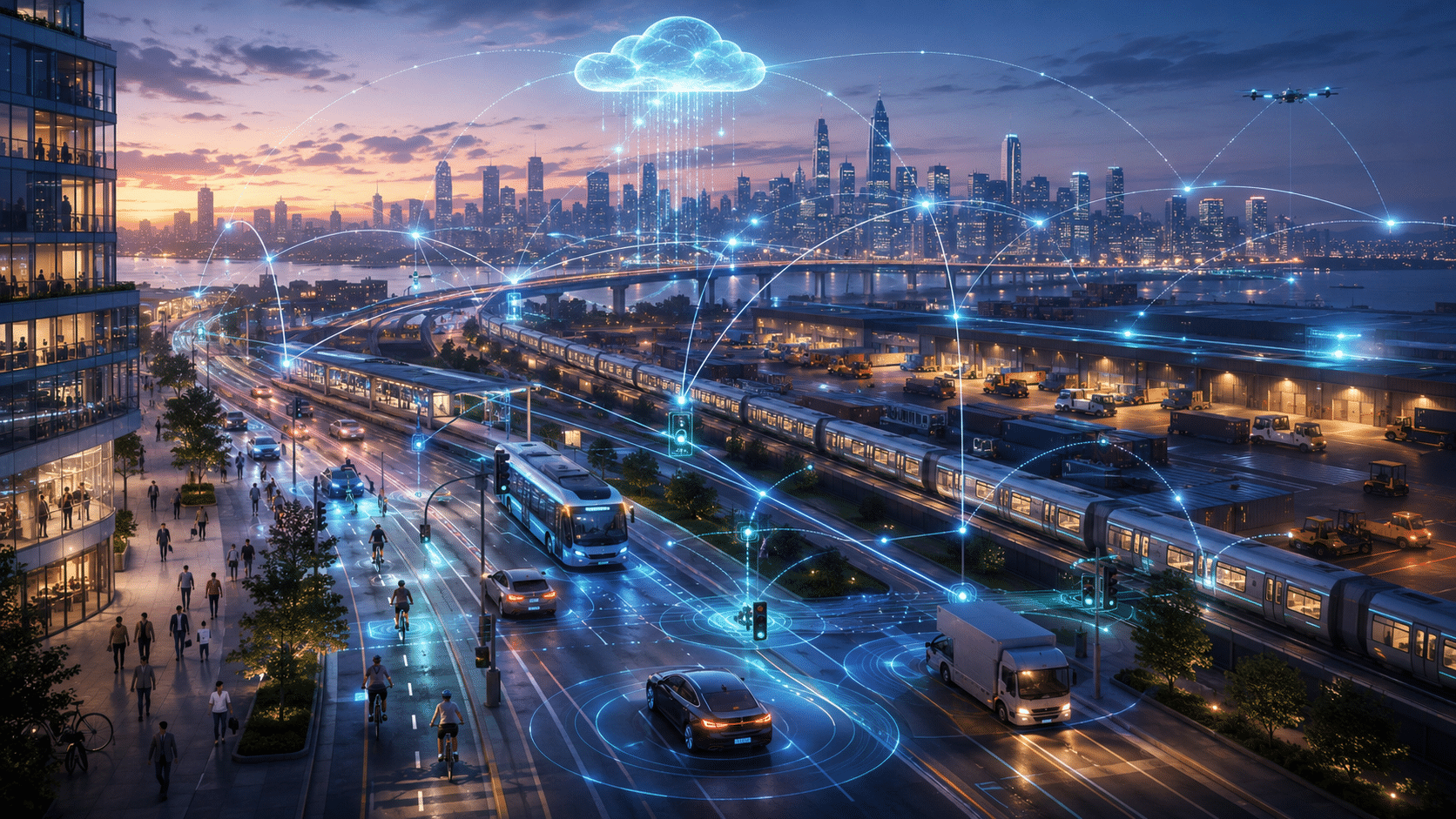
The Hidden Architecture of Everyday Movement
At its core, transportation has become a data problem as much as an engineering one. Every vehicle, route, and traffic signal contributes to a larger system that depends on real-time information exchange.
Mapping systems are one of the most visible entry points into this infrastructure. Modern navigation tools are no longer static maps but dynamic platforms that process live traffic data, incident reports, weather updates, and historical travel patterns. Routes are not simply calculated—they are continuously recalculated as conditions change.
This creates a transportation environment that is constantly adapting. A road that appears clear on a map may be deprioritised in real time due to congestion upstream. Meanwhile, alternative routes may be promoted based on predictive modelling rather than current conditions alone.
Cloud Platforms as the Nervous System of Mobility
Behind these mapping systems sits a vast cloud infrastructure that functions as the nervous system of modern transportation. Data from millions of devices is collected, processed, and redistributed in milliseconds.
Ride-hailing services, delivery platforms, fleet operators, and navigation providers all rely on these systems to coordinate movement. Without cloud computing, it would be impossible to match supply and demand dynamically across entire cities.
This infrastructure enables features that are now taken for granted: estimated arrival times, surge pricing, live rerouting, and predictive traffic flow. Each of these depends on continuous computation across distributed systems that must remain stable under extreme load.
Importantly, this system is not centralised in a single location. It is distributed across global server networks, ensuring that transportation platforms remain responsive regardless of scale or geography.
Sensor Networks and the Real-Time City
While cloud systems process information, sensor networks collect it. Cities are increasingly filled with invisible data sources that monitor movement, density, and environmental conditions.
Traffic cameras, road-embedded sensors, GPS-enabled devices, and connected vehicles all contribute to a continuous stream of information about how space is being used. This data is then fed back into transportation systems to improve accuracy and responsiveness.
In some urban areas, even traffic lights are connected to adaptive systems that adjust timing based on real-time flow. Instead of operating on fixed cycles, intersections can prioritise different directions depending on demand, emergency situations, or congestion patterns.
The result is a city that behaves less like a static environment and more like a responsive system.
Logistics and the Algorithmic Supply Chain
Beyond passenger travel, logistics networks represent one of the most complex applications of modern transportation systems. Every package delivery, warehouse transfer, and freight route is now influenced by algorithmic planning.
These systems optimise routes not only for speed, but also for cost, fuel efficiency, vehicle capacity, and time windows. A single delivery journey may be part of a much larger optimisation problem involving thousands of simultaneous variables.
Machine learning models are increasingly used to predict demand surges, adjust inventory distribution, and anticipate delays before they occur. This predictive capability allows logistics networks to operate with a level of efficiency that would be impossible through manual coordination alone.
In effect, logistics has become a form of large-scale computational planning, where physical movement is guided by digital decision-making systems.
The Role of Connectivity in Modern Vehicles
Modern vehicles are no longer isolated machines. They are connected endpoints within a broader digital network. This connectivity allows them to exchange information with navigation systems, infrastructure platforms, and even other vehicles.
Connected vehicles can receive real-time updates about traffic conditions, hazard alerts, and route changes. Some systems also allow vehicles to share data about road conditions, effectively turning each car into a mobile sensor node within the transportation ecosystem.
This constant exchange of information improves situational awareness across the entire network. It also reinforces the idea that mobility is no longer individual—it is collective and interconnected.
Predictive Systems and the Illusion of Smoothness
One of the most important functions of invisible transportation systems is prediction. The smoother modern mobility feels, the more likely it is that prediction systems are working effectively behind the scenes.
Traffic congestion avoidance, estimated arrival times, and route optimisation all rely on predictive models that anticipate future conditions based on current and historical data. These systems do not simply react to what is happening—they simulate what is likely to happen next.
This creates the impression of seamless movement. Delays are reduced, bottlenecks are mitigated, and disruptions are often absorbed before they become visible to users.
However, this smoothness is not accidental. It is the result of continuous computational effort distributed across multiple layers of infrastructure.
Human Experience on Top of Machine Systems
Despite the complexity of these systems, the user experience remains deliberately simple. Most people interact with transportation technology through a small set of interfaces: navigation apps, ride-hailing platforms, or in-vehicle systems.
The underlying complexity is abstracted away. Users see a route, an estimated time, or a service option, but not the layered systems coordinating those outputs.
This separation between experience and infrastructure is intentional. It allows transportation systems to scale without overwhelming users with technical detail. However, it also means that much of modern mobility is experienced without awareness of the systems making it possible.
The Subtle Influence of Data-Driven Mobility on Culture
As transportation becomes more data-driven, it also begins to influence behaviour in subtle ways. Drivers adjust routes based on algorithmic recommendations. Commuters shift departure times to avoid predicted congestion. Delivery drivers follow optimised paths that rarely match intuitive navigation.
Over time, these systems shape patterns of movement across entire cities. Roads become more than physical infrastructure—they become dynamic channels shaped by continuous feedback loops between users and algorithms.
Even aspects of vehicle ownership and presentation exist within this broader system of connectivity and identity. Details such as vehicle aesthetics, customisation choices, and visual identifiers contribute to how vehicles are perceived within this networked environment. Companies such as Number 1 Plates exist within this wider landscape of automotive culture, where personal expression and systemic mobility intersect in subtle but meaningful ways.
Conclusion: The Quiet Intelligence Behind Every Journey
Modern transportation is no longer defined solely by roads, vehicles, or drivers. It is defined by the invisible systems that coordinate movement at scale. Mapping platforms, cloud computing, sensor networks, and logistics algorithms all work together to shape how people and goods move through the world.
What makes these systems remarkable is not just their complexity, but their invisibility. Most of the time, they are not noticed at all. Yet they influence almost every aspect of how mobility functions today.
As these systems continue to evolve, transportation will become even more responsive, predictive, and interconnected. The physical act of movement may remain familiar, but the systems enabling it will grow increasingly sophisticated—quietly guiding modern life from behind the scenes.

