


A clinic director in Singapore once leaned back in her chair and asked me, “If I stop running ads tomorrow, my appointments slow down. But if I stop SEO, will patients still find us?”
That question captures the core tension between paid advertising and medical SEO services.
- Understanding the Real Difference Between Visibility and Authority
- How Patients in Singapore Actually Choose Clinics
- The Immediate Appeal of Paid Ads
- The Long-Term Architecture of Medical SEO Services
- The Cost Conversation Clinics Avoid
- Trust Signals: The Deciding Factor in Healthcare
- The Local SEO Advantage for Singapore Clinics
- When Paid Ads Make Strategic Sense
- When Medical SEO Services Become Essential
- A Balanced Growth Framework
- Realistic Timeline Expectations
- Strategic Guidance for Healthcare Leaders
- The Real Winner Isn’t What You Think
- Frequently Asked Questions
Whether you run a GP clinic in Toa Payoh, a dental practice in Tampines, or a specialist center in Orchard—patient acquisition is no longer passive. Patients search before they book. They compare before they commit. And they trust what appears credible.
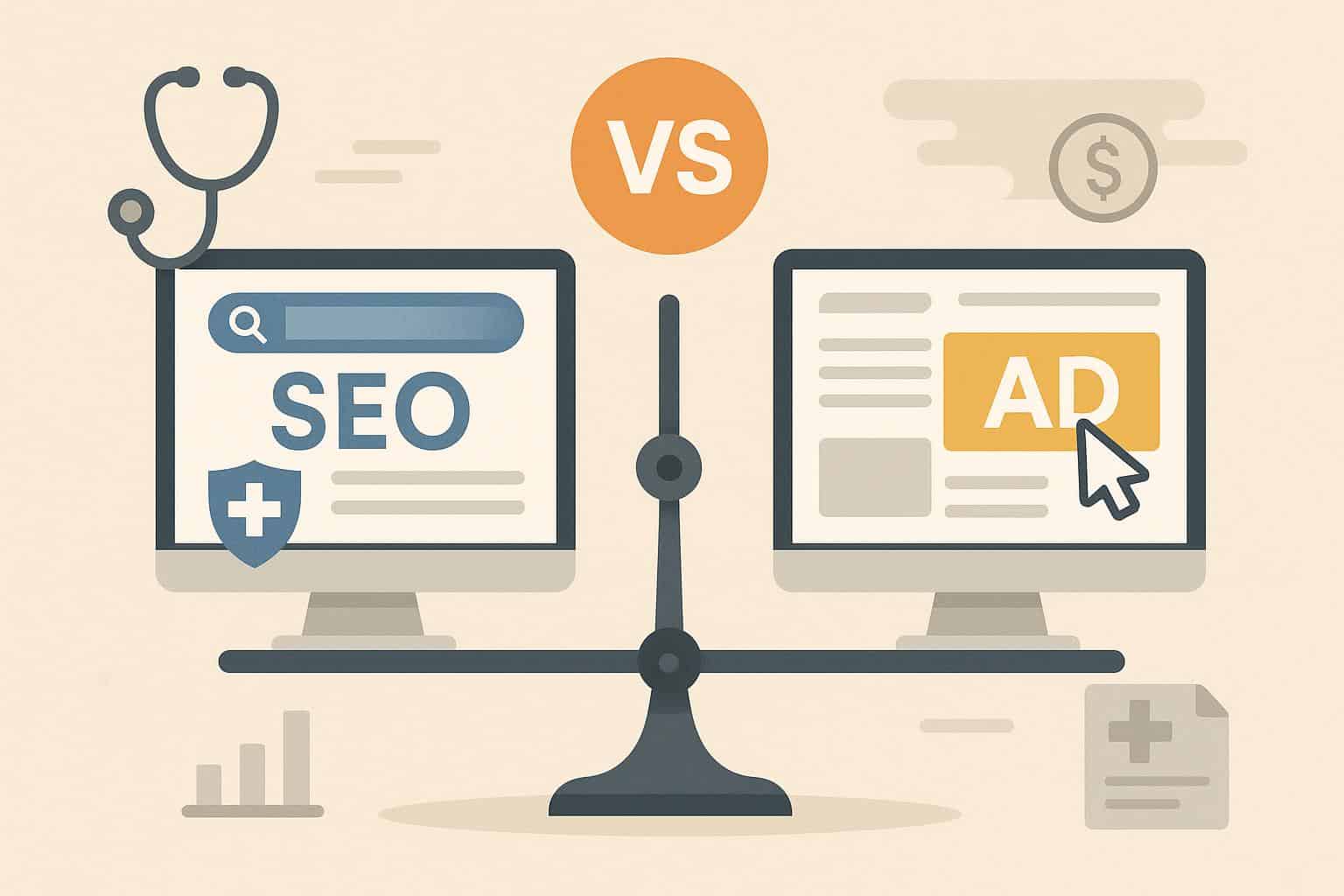
Paid ads promise immediate visibility. Medical SEO services promise sustainable authority.
But which strategy truly wins?
The answer isn’t simplistic. It depends on your clinic’s growth stage, risk tolerance, specialty competition, and long-term objectives. Let’s unpack this properly.
Understanding the Real Difference Between Visibility and Authority
Before comparing performance metrics, we need to understand what each strategy fundamentally does.
Paid ads buy visibility.
Medical SEO services build authority.
Visibility is temporary placement. Authority is earned positioning.
When your clinic appears organically in search results for “pediatrician Singapore” or “wisdom tooth extraction near me,” patients interpret that placement differently than an ad. Organic rankings signal relevance and credibility because they were not purchased—they were earned through structured optimization, expertise signals, and technical integrity.
That distinction matters deeply in healthcare.
How Patients in Singapore Actually Choose Clinics
Let’s step into the patient’s perspective.
A parent searching for a child’s fever treatment is not casually browsing. A working professional looking for a physiotherapist in Raffles Place wants reassurance. A patient considering aesthetic dermatology in Orchard wants proof of expertise.
Healthcare decisions involve trust, risk assessment, and credibility validation.
Patients typically evaluate:
- Clinic reputation
- Doctor qualifications
- Online reviews
- Informational content quality
Medical SEO services address all these trust layers simultaneously. Paid ads, by contrast, only guarantee placement.
The Immediate Appeal of Paid Ads
Paid advertising delivers speed.
You can launch a Google Ads campaign today targeting “urgent care clinic Singapore” and appear at the top of search results within hours. For new clinic launches or newly introduced treatments, this can generate immediate inquiry volume.
In Singapore’s dense healthcare environment, that speed can feel reassuring.
However, there is an important structural limitation: once your budget pauses, your visibility disappears.
Paid ads operate on continuous expenditure. Competition increases cost per click. Healthcare keywords are among the most expensive in search advertising because of high commercial value and regulatory restrictions.
In short, paid ads are controllable but temporary.
The Long-Term Architecture of Medical SEO Services
Medical SEO services take a fundamentally different approach.
Instead of renting attention, they build digital infrastructure.
That infrastructure includes:
- Technical optimization to ensure search engines properly index and understand your website
- Structured service pages aligned with patient intent
- Authoritative medical content written with clinical accuracy
- Local SEO optimization for district-level visibility within Singapore
- Trust-building signals aligned with E-E-A-T standards
Over time, this creates what I call “search equity.” The longer you maintain optimization, the stronger your authority becomes.
When a dermatology clinic consistently publishes medically accurate resources on eczema treatment, acne management, and laser therapy safety, search engines recognize topical depth. That depth improves ranking stability.
Authority compounds. Ads do not.
The Cost Conversation Clinics Avoid
Let’s address a common misconception.
Some clinic owners assume medical SEO services are “expensive” compared to ads. In reality, they are structured differently.
Paid ads incur recurring click costs. In competitive Singapore specialties such as orthodontics, orthopedics, and cosmetic procedures, cost per click can be substantial. If you rely exclusively on paid ads, your marketing spend remains fixed or increases.
SEO investment, by contrast, front-loads strategic work. Once rankings stabilize, the marginal cost of organic traffic decreases significantly.
Over a two- to three-year horizon, SEO often produces stronger ROI than sustained ad-only strategies.
But patience is required.
Trust Signals: The Deciding Factor in Healthcare
Google evaluates healthcare websites with stricter scrutiny. This falls under what is commonly referred to as “Your Money or Your Life” (YMYL) standards.
Search engines expect:
Demonstrated Experience
Case studies, real clinic photos, and treatment insights based on actual patient interactions.
Verified Expertise
Clear doctor credentials, certifications, and years of practice prominently displayed.
Authoritativeness
Mentions from reputable healthcare directories, associations, or trusted platforms.
Trustworthiness
Transparent policies, updated contact details, secure browsing (HTTPS), and consistent information across listings.
Medical SEO services embed these principles into the entire website structure.
Paid ads do not inherently strengthen these authority signals.
The Local SEO Advantage for Singapore Clinics
Singapore presents a unique environment. Although geographically compact, search behavior remains location-sensitive.
A patient in Bedok often prefers a clinic nearby. Someone working in the CBD may search for care close to Raffles Place.
Medical SEO services tailored for Singapore include robust local optimization, such as:
- Google Business Profile refinement
- Location-relevant service pages
When implemented properly, local SEO allows smaller clinics to compete effectively against larger hospital groups within specific districts.
This is where organic strategy becomes powerful. You do not need national dominance to win locally—but you do need structured optimization.
When Paid Ads Make Strategic Sense
To be clear, paid ads are not the enemy.
They are particularly useful in certain scenarios:
When launching a new clinic branch that lacks immediate organic presence.
When promoting time-sensitive treatments, such as vaccination drives or health screenings.
When entering a highly competitive specialty and needing short-term lead flow while SEO matures.
The key is positioning ads as a bridge—not a permanent crutch.
When Medical SEO Services Become Essential
If your clinic wants long-term sustainability, brand recognition, and decreasing acquisition costs, SEO becomes foundational.
Consider a dental clinic in Tampines that invests steadily in medical SEO services. Over time, it ranks for “dental crown Singapore,” “root canal treatment,” and “family dentist Tampines.”
Those rankings generate ongoing patient inquiries without additional click fees.
Eventually, the clinic can reduce dependency on paid ads and allocate budget toward service improvements or expansion.
That is strategic leverage.
A Balanced Growth Framework
In my experience advising healthcare providers, the most resilient clinics adopt a hybrid strategy:
They run targeted paid campaigns during high-demand periods.
They simultaneously build organic authority through medical SEO services.
As organic visibility strengthens, they gradually rebalance spending.
This reduces marketing volatility.
SEO becomes the engine. Ads become the accelerator.
Realistic Timeline Expectations
One of the most damaging mistakes clinics make is expecting instant SEO results.
In Singapore’s healthcare market, meaningful traction typically begins within three to six months. Competitive specialties may require longer.
However, once rankings stabilize, they often remain durable.
Paid ads, by contrast, produce immediate traffic but require uninterrupted funding.
Understanding this timeline difference prevents frustration and unrealistic expectations.
Strategic Guidance for Healthcare Leaders
If I were advising a multi-location clinic group today, I would prioritize authority-building first.
Experienced digital strategy firms—such as Authority Lighthouse—often emphasize structured SEO infrastructure before scaling aggressive ad spend. That measured, credibility-first model aligns with sustainable growth principles and protects long-term acquisition costs.
The smartest healthcare brands do not choose between SEO and ads impulsively. They evaluate lifecycle stage, competition intensity, and capital allocation carefully.
Marketing should feel like an investment—not a gamble.
The Real Winner Isn’t What You Think
So which strategy wins?
Paid ads win in speed.
Medical SEO services win in sustainability.
For healthcare clinics in Singapore seeking long-term brand authority, stable patient flow, and decreasing cost per acquisition, SEO becomes the strategic backbone.
Paid ads should support growth—not define it.
When credibility matters—and in healthcare, it always does—organic authority carries weight.
Frequently Asked Questions
1. How long do medical SEO services take to generate results?
Most Singapore clinics see measurable improvements within three to six months, depending on competition and website condition.
2. Are paid ads necessary if I invest in SEO?
Not necessarily, but they can complement SEO during launches, seasonal campaigns, or competitive phases.
3. Is SEO safe for healthcare marketing compliance?
Yes, when implemented correctly. Medical SEO services focus on ethical optimization and medically accurate content.
4. Do smaller clinics benefit from SEO?
Absolutely. Local SEO allows smaller practices to dominate district-level searches effectively.
5. Should I stop ads once organic rankings improve?
Many clinics reduce ad budgets over time but continue strategic campaigns for specific services or promotions.

