


Most writing about cutting blends starts with a product and works backwards. That gets the interesting part wrong. A cutting blend is a design problem before it is a product: a fixed quantity of oil has to carry several compounds, each with its own ester and its own release rate, arranged so the composite curve does what the formulator intended.
Understanding why those formulations look the way they do is more useful than any list of what is currently on sale — partly because the list changes, and partly because the logic is what tells you whether a particular blend makes sense on its own terms.
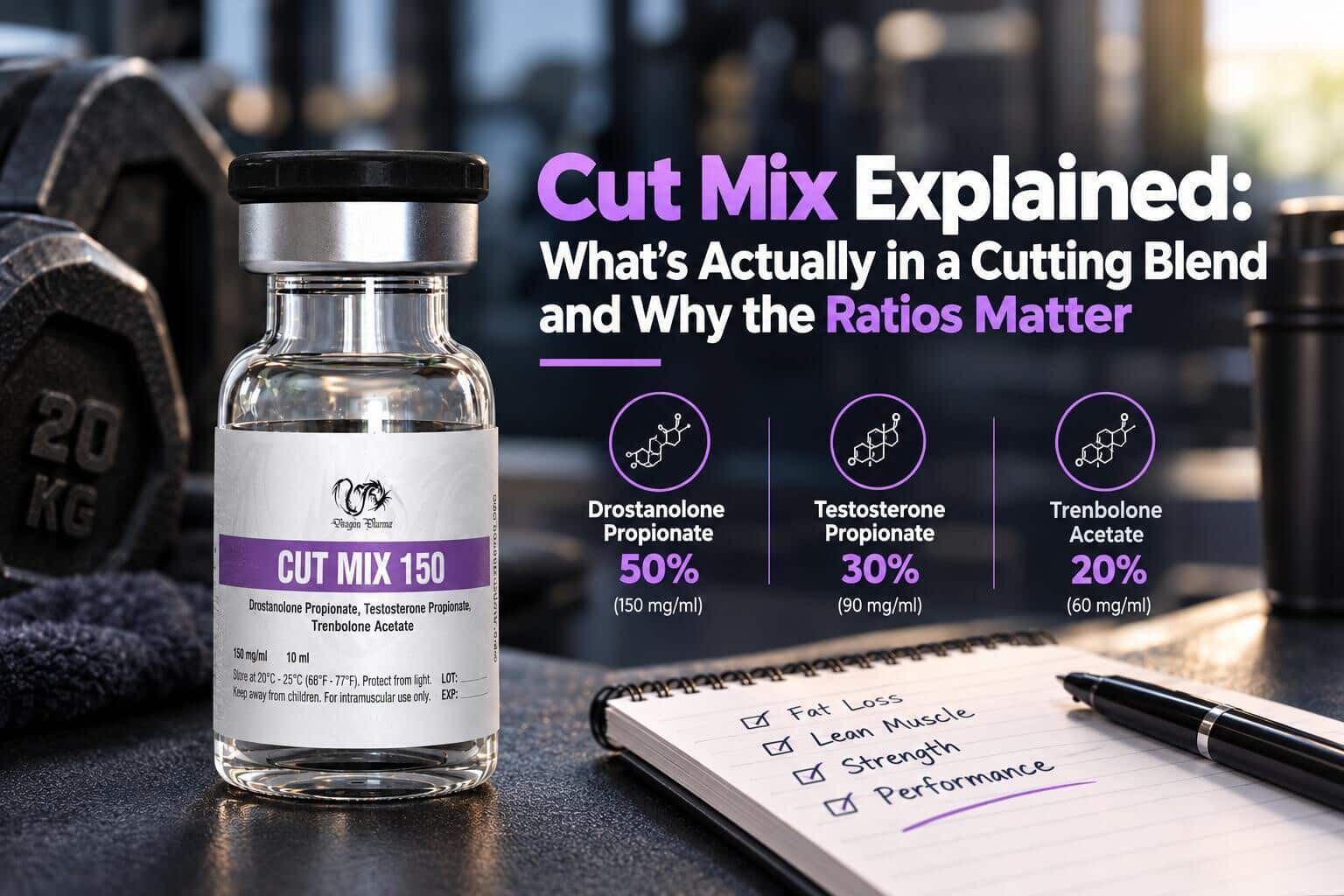
The design problem
Start with the constraint. An oil-based injectable delivers a fixed volume into a depot, and that depot can only tolerate so much fluid before the injection site objects. If the objective involves more than one compound, the options are to inject several times or to combine them in one oil.
Combining has an obvious appeal and an immediate complication: each compound brings its own release behaviour. Testosterone propionate clears in days. Trenbolone acetate behaves similarly. Drostanolone propionate again. Put three short esters in one oil and the depot releases them on roughly parallel timelines, which keeps the composite curve relatively simple — a fast rise and a fast decline, from three compounds rather than one.
That is the classic structure, and the reason it uses short esters almost exclusively is not pharmacological preference but curve management. Short esters in combination behave predictably relative to each other. Mixing a short ester with a long one produces a composite that rises and falls on two different schedules, which is a design choice rather than an accident, and one that belongs to the formulator.
Why these compounds, specifically
The selection is conventional rather than experimental, and each element has a rationale that is worth knowing.
A short-ester testosterone provides the base. It is the reference compound of the class, it aromatises, and its presence means the oestrogenic pathway is represented rather than absent — which matters, because oestrogen is not purely an adverse factor and its complete absence is associated with joint discomfort and unfavourable lipid changes.
A short-ester 19-nor — most often trenbolone acetate — contributes the high-receptor-activity component. It does not aromatise.
A DHT-derived compound adds a third mechanism. It also does not aromatise. Drostanolone propionate is the usual choice, because its ester matches the timeline of the other two, but stanozolol appears in some formulations — an order winstrol online listing is that compound on its own, and it is a useful reminder that the DHT slot in a blend is a design choice rather than a fixed component.
The result is a blend containing exactly one aromatising component and two that are not — which is the structural signature of the entire category, and the thing that determines what the product actually is. A blend is not simply “several compounds”; it is a specific arrangement of aromatising and non-aromatising ones, and that arrangement is the design.
Why the ratio is the product
Here is the part the labels most often omit, and the part that decides everything.
Two blends can carry the same total milligram figure and the same listed compounds and behave completely differently, because the ratio determines how the total is divided. A blend that is predominantly testosterone ester has a different character from one that is predominantly the 19-nor, even at identical concentrations of active material.
The same is true of ester length within a blend. The overall curve is a composite of the individual curves, so a formulation weighted toward short esters produces a fast profile and one weighted toward long esters produces a slow one — from the same headline number.
Which is why “300” on a vial is not a description of a product. It is a concentration: 300 milligrams of active material per millilitre of oil. It tells you how much oil you will handle for a given quantity, and it carries the usual tolerability consequence of higher concentration. It says nothing about what is in the blend or in what proportion, and those are the things that determine behaviour.
The Dragon Pharma’s cutting blends formulations are one example of the category, and the reason to read their composition rather than their number is exactly this. Reading the individual components separately makes the point better still — a buy propionat 100 listing is the base ester on its own, and seeing it alone makes it obvious how much information a blend label compresses into a single figure.
The long-ester interpretation
The same design concept has a slower variant, and the two are frequently confused.
A cut long 300 for sale listing describes the extended version: the same structural idea built on longer esters, at a higher concentration, producing a slower rise and a longer tail. It is not a stronger version of the short-ester product. It is the same design problem solved with a different constraint — fewer administration events at the cost of a slower onset.
That distinction matters more than it sounds, because the two products are often compared as though one were an upgrade. They produce different curves from comparable components. Which one suits a given objective is a question about timing, not about quality.
What a buyer can and cannot check
The uncomfortable feature of this category is that the ratio — the thing that determines the product — is not something a user can measure, and its effects are not separable by feel.
What can be checked is documentation. For a blend, that means an analysis covering each component at its stated ratio from a single sample, with identity confirmation per component rather than a purity figure for the mixture. A certificate covering one component and naming the others only on the label has documented a fraction of the product, and for a multi-component formulation that is not a partial answer.
Three further checks apply. The batch number on the certificate should correspond to the vial in hand. Sterility and endotoxin results should be present for an injectable, with the method stated. And the composition should be declared rather than implied — because where it is not declared, the release behaviour is not verifiable by any means available to the buyer.
The wider injectable category, laid out as a set, is the only way to see what a stated composition looks like when it is done properly — and, by contrast, how little most blend listings actually say.
How the market presents these products
One pattern is worth naming, because it shapes what a buyer is likely to encounter.
Blends are marketed on their numbers. A cutting blend is presented with a concentration, a name evoking an objective, and a composition list that is often partial. The number is the most prominent element and the least informative one; the composition, which determines everything, is frequently the least prominent.
That is not an accident of design. A concentration is a single figure that can be compared across products, so a market that competes on price will gravitate toward the one number that is easy to compare. Ratio, by contrast, requires the seller to disclose what is in the product and in what proportion — which invites a comparison that a vague label avoids.
The practical response is to invert the emphasis. Read the composition first, the esters second, and the concentration as a handling detail rather than a headline. Where the first two are absent, the third is all the product is offering, and a figure on its own describes an oil rather than what is in it.
The ester question inside a blend
One consequence of the design is worth stating plainly, because it is the most common misunderstanding in the category.
A blend is intrinsically less predictable than a single-ester product. Its curve is a composite, fixed at the point of manufacture, and the ratio cannot be adjusted without changing the whole. That is the trade: you gain fewer injections and a designed curve, and you give up control over any single variable.
It is not a defect. It is the nature of the format, and knowing it makes the relevant question obvious — which is not “how strong is this blend” but “which compounds, in what proportion, on which esters”. If a listing cannot answer all three, the product’s behaviour is a matter of trust rather than specification.
The bottom line
A cutting blend is a fixed-ratio formulation in which the ratio, not the total, determines what the product does. The conventional design pairs one aromatising compound with two that do not, uses short esters for curve predictability, and exists in a longer-ester variant that trades onset speed for fewer administration events.
The number on the vial is a concentration and nothing more. The composition is the product, it is determinable only from the label, and it is verifiable only through documentation that covers every component at its stated ratio. Everything else about the category follows from those two facts.

