


The shopping journey used to be easily predictable. Someone read, clicked one link, paged through a couple of pages and bought or left. Today, a large part of that trip takes place in the context of a chat window. A customer asks an employee about the process of choosing a mattress and then what brands they should consider and then what mattress will be affordable and your store may be mentioned in all three steps or not even one of them.
Which is why more teams are looking to measure ai visibility in ecommerce at every stage, rather than simply to see if they’re mentioned somewhere. When brands appear at the bottom of the funnel, they’re missing the moments when shoppers are developing their short list. Let’s see how to measure visibility from the first question to the final sale using an entire-funnel ai search optimization platform.
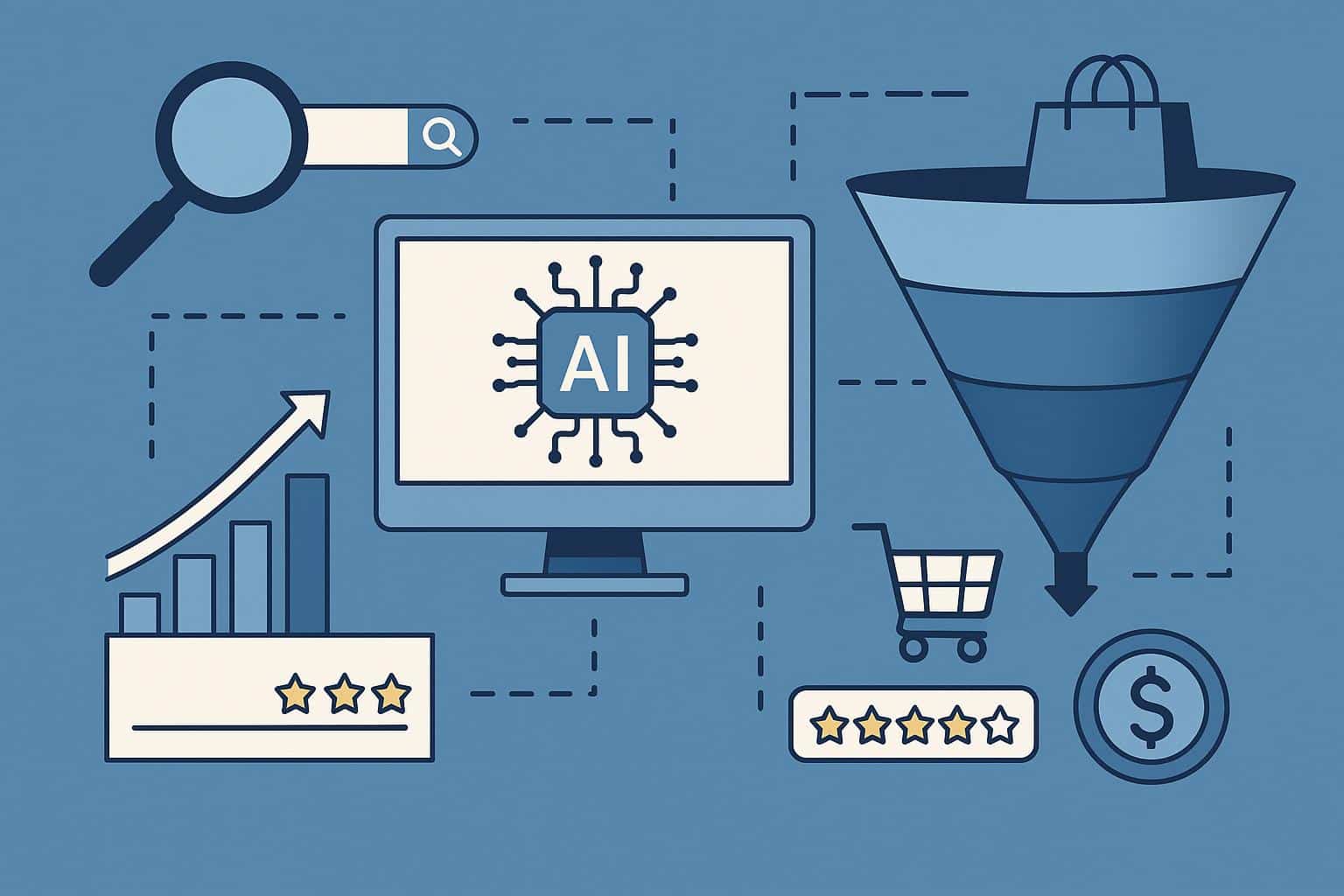
Top, Middle, Bottom: Measuring AI Visibility Across the Whole Ecommerce Funnel
Why One Number Isn’t Enough, and How Yotpo Discover gets us there
But many dashboards simply reduce the visibility of AI to a single score. It’s neat but it conceals the narrative. A brand may be present in the results for “best running shoes under 100” and not for “how to choose running shoes for flat feet. These aren’t the same customers at the same time, and these are different solutions.
Consider the funnel as having 3 wide sections — Awareness, Consideration, and Decision.
There is a different type of prompt, different metrics, and different business meaning for each of them. Separate monitoring lets you know not only if you are visible but where you are losing opportunity.
This is what Yotpo Discover is based on. It also provides a different set of blended scores to measure ai visibility in ecommerce, rather than one score, it tracks each product, each category, and each buying stage of where you appear on ChatGPT, Claude, Perplexity and Gemini.
It provides metrics such as brand mentions, product presence, competitor exposure, answer quality, and funnel coverage, and allows you to fine-tune your prompt according to the brand and funnel stage you’re targeting.
The prompts are based on authentic shopper reviews and Q&A and follow the actual questions customers ask. Yotpo claims to have seen a 20 percent boost in shopper visibility at the awareness level for their customers — but that’s a salesman’s boast, so find case studies for your category. Discovery is currently in early access and it’s designed for brands that have approximately $10M or more in annual GMV.
Stage One: Awareness
Candidates that appear at the top of the funnel are looking around for a problem, rather than a product. Questions they ask include “how to choose a standing desk” or “what should I look for in a good sunscreen? No brand is mentioned so far and this is the time to sow your name for the first time.
Monitor brand mentions in these general learning prompts and record the sources mentioned by the AI when it responds. It’s not always product pages, but it’s usually buying guides, editorial roundups, forums, how-tos, and the like. When you don’t show up, the answer is typically a helpful, honest guide and getting coverage in the sources that people already like.
This is also the point in analytics where a reference will not necessarily be translated into a click, as it is the hardest to read. The best indicator of visibility rate is…you guessed it, your visibility rate. See what percentage of the prompts in the awareness stage mention you and note how this changes over weeks.
Stage Two: Consideration
Now the shopper is shopping. The prompts are even more specific: ‘Brand A vs. Brand B,’ ‘Best standing desks for small apartments,’ ‘Alternatives to a famous competitor.’ This is a very place-dependent situation. The first, second and fifth namesakes get a look.
Some helpful metrics at this stage are your mention rate by comparison prompts, position of your answer in the answer, and competitors who are listed next to or before you. The latter is a common shock to people. The brands that you’re being outsmarted by in the results of AI answers may not be the ones you’re used to seeing. Even if a small direct-to-consumer brand has strong reviews, it can outrank a household name.
But, if you are looking to measure ai visibility in ecommerce in a manner that results in action, you should measure the number of times your brand appears in front of your competitors. Once you know who’s always in the news and which sources support them, you can transform your concern to a list of “to dones.
Stage Three: Decision
Finally, at the lower end of the funnel, consumers are almost ready to make a purchase. They want details such as cost, availability, sizing, return policy, shipping time, “is this worth it? In this answer, the AI must be as correct as possible.
Accurately measure as well as ensure presence. Verify information from assistants on the prices, availability, characteristics and policies of your best-selling items and highlight the incorrect or dated information. If a buyer is directed to a mismatch, he or she loses the deal. Monitor which answer links to the correct product page too – not all pages on which the assistant clicks are necessarily the highest converting page.
Now, tie in visibility with results. Track group AI traffic separately from other traffic sources in your analytics and measure conversion rate, average order value and time to purchase. Numbers from the AI-driven visits are not a cap, but a floor, because some AI visits come without a referral.
The Metrics Worth Keeping
In all three stages, the following short list encompasses most needs:
- Mention rate: Percentage of all tracked prompts with your brand mentioned.
- Position: location of the answer in the answer.
- Sources and URLs: The AI’s sources and URLs.
- Competitors that you are exposed to: those who are in the same line of sight as you or in front of you.
- Answer quality: the accuracy of the information about you.
- Funnel coverage: Represent the extent to which you are visible within awareness, consideration and decision events.
Get your list of prompts organized before you get going! Run each prompt a few times as the AI answers are subject to change from run to run, and use a consistent set so that you can compare the results from month to month.
Where Yotpo Discover fits
The first step is to use a spreadsheet and a handful of reminders to get things going. Software helps as you build your catalog. Currently in early access, Yotpo Discover is based on the funnel approach. It searches your product catalogue and monitors your presence on ChatGPT, Claude, Perplexity, and Gemini—product, category and stage of the buying process. It measures brand mentions, product presence, competitor exposure, answer quality, and funnel coverage, which aligns with the metrics listed above.
The prompts are based on genuine shopper language from reviews, questions & answers and shopper interactions, making them sound like a query. It also brings up “AEO competitors” – brands which may be listed in AI responses before you, even if you haven’t heard of them. And it allows you to specifically target audiences and funnel stages, with brand-specific prompt tuning. But according to Yotpo, their clients see a 20 percent increase in their awareness stage visibility of their products and a 16 percent increase in #1 product placement; that’s the vendor’s result, so ask for case studies in your category.
The appeal in an ai search optimization platform for teams is that measurement and action go hand-in-hand. There are 3 AI agents in Discover: one for drafting briefs and SEO-optimized content from real reviews, one for finding technical fixes and one for mobilizing real reviewers and loyalty communities. Each customer receives an AEO consultant of their own. There’s one caveat: the initial release is available to brands with approximately $10M or more in annual GMV and the smaller brands will be added to a waitlist of some sort. There’s no official price and you’ll have to take a demo.
Turning Measurement into Action
Numbers themselves don’t matter until they affect your actions. A move is indicated at each stage.
If awareness is light, create truly informative buying guides and look for coverage of places that AI engines refer to. Review is poor – make it better, create a fair comparison page, and learn from the competitions that have been beating you. When decision is limited, correct wrong information, bring feeds and structured data into line with your pages, and ensure that cited URLs are easily convertible.
Look at the results every month, select 2-3 actions and repeat. Progress in AI answers changes rapidly; assess over a period of weeks, not days. Progress is actually happening: 10 percent of the prompts had the mention, and 30 percent of the prompts had the mention, which is a significant difference, although this leap doesn’t seem like a show-stopper any given day.
Conclusion
AI visibility isn’t a single number. That is a change in image from the initial enquiry to the eventual sale and the brands that get it are the ones that consider each stage of the process. Create a recurring prompt list, monitor the 6 measurements listed above and associate visibility with traffic and revenue.
If a spreadsheet is not enough, an ai search optimization platform, such as Yotpo Discover or another one, can help unify all the tracking, competitor data and next actions. Continue the practice and you’ll always know where shoppers are finding you and where they aren’t, and what you should fix next. The true measure of ai visibility in ecommerce is a step by step, month by month approach.

