


Concrete grinding projects help you create smooth, strong, and long-lasting surfaces, yet the process can go wrong when small errors build up. Since you want a result that performs well, understand where most issues begin and how concrete grinding solutions prevent them. This blog walks you through the mistakes you must avoid and shows how planning helps you maintain quality across your project.
1. Ignoring the Floor Condition Before You Begin
Before you start grinding, you need to have a clear idea of the condition of your floor. The process will reveal problems that could prevent you from carrying out your work in an even manner. Your gear can’t make contact and produce bad results if you don’t give it a once-over for cracks. Testing and evaluation ensure that the right machine and grinding models are chosen for the concrete slab.
- 1. Ignoring the Floor Condition Before You Begin
- 2. Choosing the Wrong Grinding Equipment or Segments
- 3. Skipping the Grit Progression Steps
- 4. Using the Wrong Speed and Pressure During Grinding
- 5. Forgetting to Manage Dust Properly
- 6. Failing to Prepare the Edges and Hard-to-Reach Spots
- 7. Applying Sealers or Coatings Too Early
- Set Up Your Concrete Grinding Project for Success
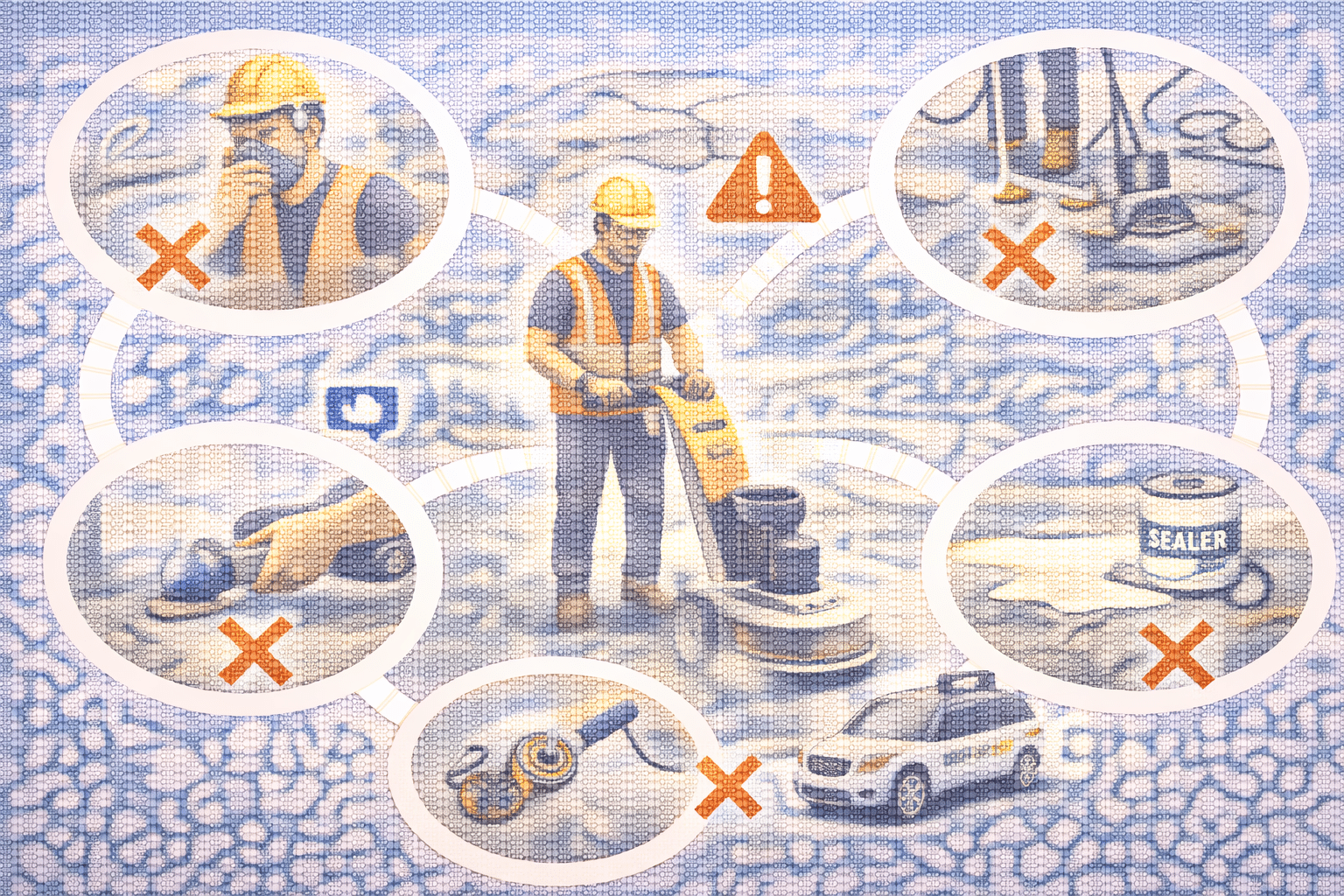
2. Choosing the Wrong Grinding Equipment or Segments
As you get further into your project process, you will find that it does make a big difference in the speed at which the floor will respond. If you use the wrong tooling for the slab, they either take off too much or not enough. When you have the right masonry and diamonds, it provides control to your project, and the grinding path is more manageable, making it easier for you to get predictability in your results.
3. Skipping the Grit Progression Steps
Once you start polishing, use the right progression of grits so that your floor achieves a uniform profile. Skipping grits or moving too fast to higher numbers will also leave scratches that can be easily spotted. To prevent this, check that your grit sequence jumps smoothly from coarse to fine. When you advance incrementally, each pass eliminates the scratches from the preceding one, and your floor looks cleaner.
4. Using the Wrong Speed and Pressure During Grinding
The balance of speed and pressure is what you rely on as you go with your heavy pressure producing deep marks. The same goes for machine speed, which should be a steady pace rather than hurried. When the balance is wrong, the grinder jigs around and produces an unsteady texture. With the right pressure, your equipment runs along more smoothly, and that floor lights up with a quality finish.
5. Forgetting to Manage Dust Properly
Before moving forward, remember that dust management plays a crucial role in producing a safe and successful result because concrete dust affects visibility, tool performance, and air quality. When dust is ignored, it settles back onto the floor and disrupts the grinding pattern, and it can also clog your tooling. Moreover, using the right extraction systems allows your tools to maintain steady contact with the slab.
6. Failing to Prepare the Edges and Hard-to-Reach Spots
Next, you should pay attention to your edges because many projects end up with a polished centre and rough perimeter when edges are not handled properly. These areas require dedicated tools that match the grinder’s results, and skipping them leads to a visible difference in texture. In addition to that, when you blend edges carefully with the rest of the slab, you maintain a uniform look.
7. Applying Sealers or Coatings Too Early
As you wrap up grinding, you might be tempted to go quickly into sealing, but applying coatings prior to the surface being fully prepared can lock in dust or moisture. To prevent this, ensure the floor is cleaned properly and that any dust has settled before using anything on it. Spending the extra time is worth it for a sealer that bonds well, helps your project perform its best over the long haul and looks better longer.
Set Up Your Concrete Grinding Project for Success
When you approach a concrete grinding project with the right awareness, your results improve drastically because you eliminate the errors that cause uneven surfaces. You now understand how equipment choices, surface checks, grit progression, and proper timing shape the quality of your work. With thoughtful steps, your project gains the structure needed for long-lasting success.
