


We’ve all been there: it’s a gorgeous July Saturday in Downers Grove, the grill is fired up, and you step out onto the deck only to realize you’ve made a huge mistake. Your feet are sizzling because those old wood boards have spent all morning soaking up the Midwest sun like a giant sponge. It’s basically “hot lava” out there.
While wood has that classic look, anyone who lives around here knows our summers don’t play around. If you’re tired of the burnt-toe routine and have already started chatting with local deck contractors about an upgrade, you’ve probably heard the buzz about composite. It’s a total game-changer for our local climate—and here’s the actual science of why it stays so much cooler than the old-school stuff.
- 1. It Doesn’t Just “Soak Up” the Sun
- 2. We Can Pick “Cooler” Colors (That Stay That Way)
- 3. No More “Hot Spots”
- 4. Humidity and the “Heat Sponge” Effect
- 5. It Cools Down When the Sun Sets
- Comparison: Composite vs. Wood Decking
- The Honest Truth: Deck FAQs
- “I’ve heard composite decks are basically lava. Is that still true?”
- “Which colors won’t cook my feet during a Fourth of July BBQ?”
- “I’m not ready to rebuild. How do I stop my current deck from burning me?”
- “Is there a ‘coolness’ rating I should look for, or is it all just talk?”
- “Should I just get a concrete patio instead? Is that cooler?”
- The Bottom Line for Homeowners
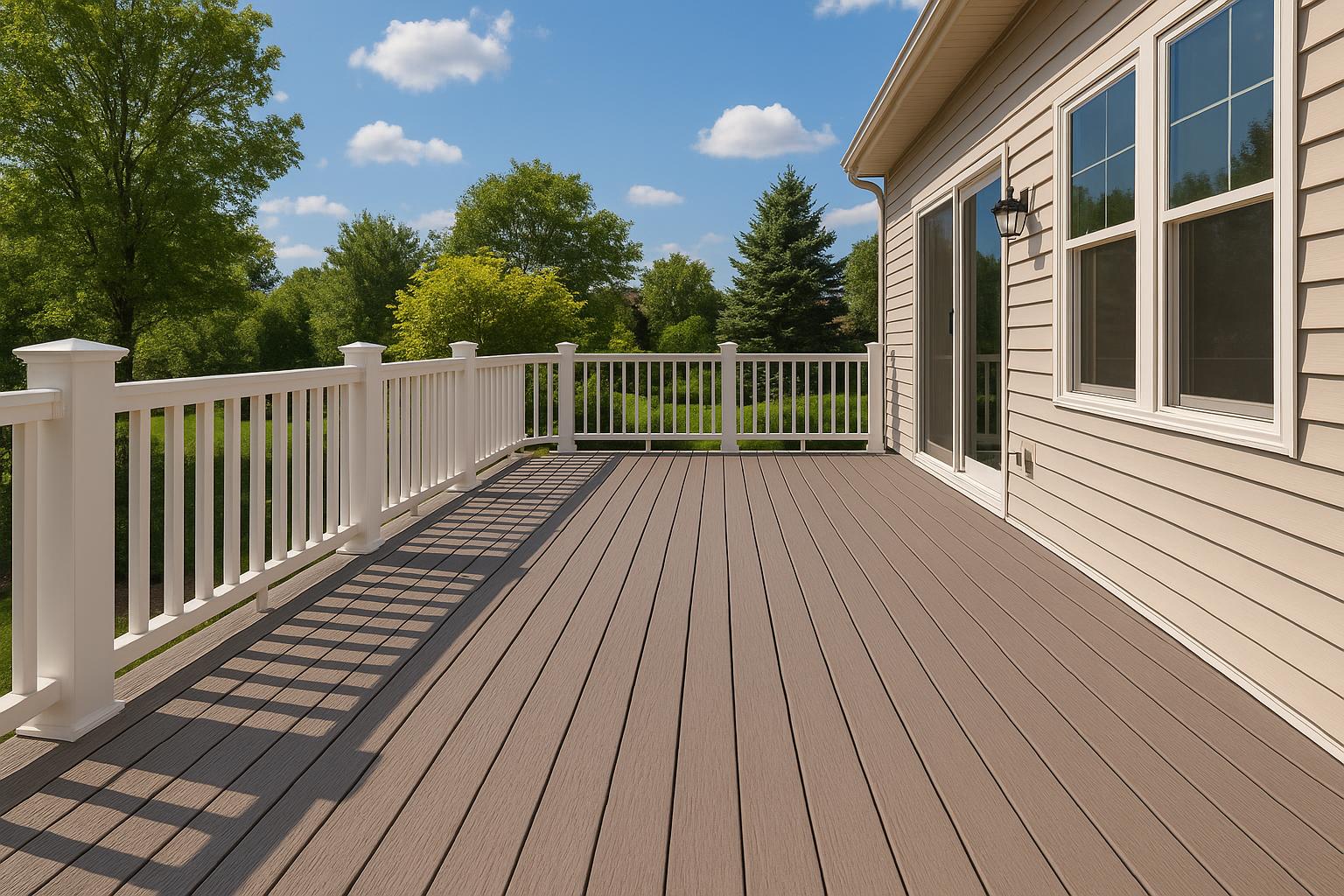
1. It Doesn’t Just “Soak Up” the Sun
Think of traditional wood like a dark asphalt driveway—it just drinks in the heat. Composite boards are engineered differently. Most modern brands are built with heat-reflective technology that actually bounces a good chunk of that solar energy back into the sky rather than storing it right under your toes.
2. We Can Pick “Cooler” Colors (That Stay That Way)
The problem with wood is that it fades, we restain it, it weathers, and it eventually turns into a heat-absorbing dark grey or deep brown. With composite, we get to be strategic. In the Southwest suburbs, where the sun can be relentless, opting for a lighter “driftwood” or “sand” palette isn’t just a style choice—it’s a temperature control choice. And unlike wood, those colors won’t darken over time.
3. No More “Hot Spots”
Wood is unpredictable. One board might be fine while the one next to it—slightly more weathered or resin-heavy—is scorching. Because composite is manufactured with a consistent density, the temperature stays uniform. You won’t get those nasty surprises when walking from the shade of the house into the sunny spots.
4. Humidity and the “Heat Sponge” Effect
If you’ve lived in Downers Grove for more than a week in July, you know that heavy, “soup-like” air we get. Wood is porous, so it literally breathes in all that Midwest humidity. When the sun finally hits those damp boards, it creates this gross, radiating heat right at your feet—it’s like standing on a steamer. Composite is basically moisture-proof. It doesn’t soak up the humidity, which means it stays dry and sheds heat way faster than a water-logged cedar plank ever could.
5. It Cools Down When the Sun Sets
Wood has what the pros call “thermal mass,” but for the rest of us, that just means it’s a giant heat-trap. It’s the reason your deck still feels like a radiator at 8:00 PM when you’re trying to have a quiet drink. Composite is designed to let that heat go the second the sun dips behind the trees. It cools down almost immediately, so you aren’t waiting until midnight for the surface to be touchable again. It actually makes those evening summer hangouts comfortable instead of a sweat-fest.
Comparison: Composite vs. Wood Decking
| Feature | Composite Decking | Traditional Wood (Cedar/Pine) |
|---|---|---|
| Surface Temp | Stays Cooler: Engineered to reflect UV rays and dissipate heat quickly. | Heats Up: Dense fibers act as a “heat sponge,” soaking up solar energy. |
| Reaction to Humidity | Resistant: Doesn’t absorb moisture, so it stays drier and cooler. | Absorbent: Traps Illinois humidity, which can lead to a “steaming” effect. |
| Color Longevity | Consistent: UV-resistant colors don’t darken or fade significantly. | Darkens: Naturally weathers to a dark grey or deep brown, which absorbs more heat. |
| Barefoot Friendly? | Yes: Designed for comfort with modern heat-shield technology. | Risky: Can lead to “hot spots” or splinters as the wood dries out. |
| Evening Cooling | Fast: Releases heat almost immediately once the sun goes down. | Slow: Retains heat for hours, often staying warm well into the night. |
The Honest Truth: Deck FAQs
“I’ve heard composite decks are basically lava. Is that still true?”
Look, back in the day (we’re talking 15 years ago), walking on a composite deck in July was a great way to lose a layer of skin. But the tech has actually caught up. If you’re looking at newer stuff from Trex or Azek made in the last few years, they’ve started using reflective pigments—kind of like how a white car stays cooler than a black one. We’re seeing boards that stay 15 to 25 degrees cooler than the old-school stuff. If your current deck is an ancient heat-trap, swapping the boards for a modern line will save your feet.
“Which colors won’t cook my feet during a Fourth of July BBQ?”
In the Western Suburbs, the sun doesn’t play around. If your backyard is wide open with no trees, stay away from the dark espressos and charcoals. They look sleek in the showroom, but they’re heat magnets.
Go for the light greys, sandy tans, or “weathered wood” looks. Think Trex Island Mist or Azek Coastline. These lighter tones bounce the sun off rather than soaking it up. Save the dark “Mocha” colors for the North side of the house or under a big oak tree where the sun can’t reach them.
“I’m not ready to rebuild. How do I stop my current deck from burning me?”
You don’t always need to tear it down to get some relief. Here’s what actually works:
- Airflow is king: If your deck is closed off at the bottom with solid boards, you’re basically sitting on an oven. Swap that out for some vented lattice so the hot air can actually escape.
- Throw down a rug: A decent outdoor rug in the “walking paths” makes a massive difference.
- Get some shade: Even a cheap sail shade from a big-box store can drop the surface temp by 20 degrees in ten minutes.
“Is there a ‘coolness’ rating I should look for, or is it all just talk?”
There isn’t a big sticker on the box that says “Barefoot Approved,” but there is something called an SRI (Solar Reflectance Index). If you’re at the lumber yard, ask the guy for the SRI numbers. The higher the number, the less of a heat-sponge the board is. If they don’t know what you’re talking about, just remember: if it’s light-colored and feels “plasticky” rather than “rubbery,” it’s probably going to stay cooler.
“Should I just get a concrete patio instead? Is that cooler?”
Honestly? Concrete is usually worse. Have you ever tried to stand on a sidewalk in August? It’s brutal. Concrete and brick pavers hold onto heat forever—they’ll still be radiating warmth at 9:00 PM while you’re trying to enjoy a beer.
A composite deck is elevated, so you’ve got air moving underneath it to help it cool down. A light-colored deck with good airflow will almost always be 20 to 40 degrees cooler than a slab of concrete sitting in the same sun. Plus, you don’t have to worry about the Chicago “freeze-thaw” cycle cracking your deck like it does to every patio in town.
The Bottom Line for Homeowners
At the end of the day, a deck shouldn’t just be something you stare at through the kitchen window because it’s too hot to actually touch. If you’re planning a backyard upgrade here in the Western Suburbs, composite is the way to go—it gives you a surface you can actually live on, even when the Illinois humidity is at its absolute worst.
If you’re ready to stop guessing which boards won’t cook your feet, it’s worth reaching out to the crew at Wolf Spirit Deck builders. They’ve been the go-to experts for local homeowners who want a deck that actually performs under the Chicago sun, not just one that looks good in a brochure.

