


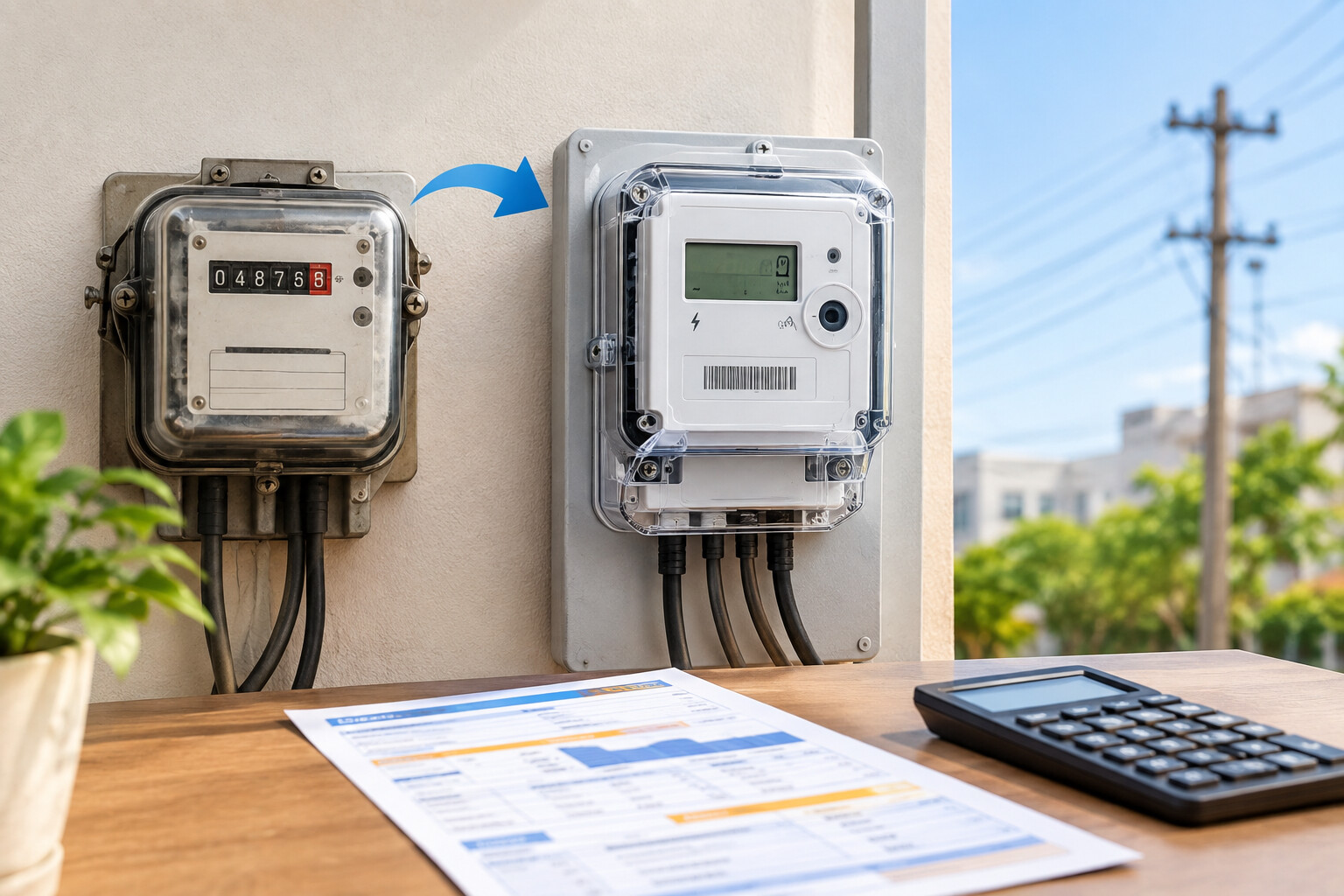
Mahavitaran is replacing domestic meters across Maharashtra with ToD smart meters under RDSS. No consumer charge applies. Here is what to verify before installation and what changes on the bill after.
Mahavitaran consumers across Maharashtra have received 48-hour notices informing them that their existing meters will be replaced with smart meters. Affected districts include Nashik, Pune, Nagpur, Palghar, and Virar. Some returned home to find the swap already done. MSEDCL has informed the Bombay High Court through an RTI reply that consumer consent is not required for installation under RDSS. No charge applies to the consumer for the meter or the swap itself. The central government funds the full cost under the Revamped Distribution Sector Scheme.
For MSEB electricity bill payments, Bajaj Pay, the Bharat Connect payments platform on Bajaj Finance, shows your exact outstanding amount before you confirm, through UPI, cards, or net banking.
What Mahavitaran’s smart meter actually is
Mahavitaran, formally MSEDCL, is Maharashtra’s state electricity distributor founded in June 2005 after being carved out of MSEB. It is rolling out smart meters under the Revamped Distribution Sector Scheme (RDSS). The RDSS targeted 250 million prepaid consumer smart meters nationwide. The scheme’s sanction window closed on March 31, 2026.
Meters being installed are Time-of-Day variants. Each connects directly to MSEDCL’s central server for remote reading. Two contractors manage the Maharashtra rollout: Monte Carlo Ltd in one set of districts and Adani Energy Solutions in others, both under MSEDCL’s oversight.
The meter is free. The installation is free. No payment of any kind is permissible under RDSS guidelines for the hardware or the swap itself.
Consumers applying for a new domestic electricity supply in Maharashtra should note that Mahavitaran installs smart meters as the default meter type for new low-voltage domestic connections in RDSS-covered areas. The eligibility and documentation requirements for an MSEB new connection are handled through MSEDCL’s consumer portal, separate from the RDSS replacement rollout.
The MSEB bill payment process does not change after installation. The same consumer account number applies, and the outstanding amount is fetched live from MSEDCL’s system before any payment is confirmed.
What to check when Mahavitaran replaces your meter
Consumers have specific rights at the point of installation regardless of how much notice they received. Act on each of the following before the contractor leaves the premises.
- Confirm the installer carries authorised MSEDCL identification and a written installation order
- Photograph the old meter’s final reading before it is removed
- Note the new smart meter number and its opening reading — both should appear on the installation record the contractor provides
- Request a written acknowledgement of the swap showing both old and new meter numbers and the date of installation
- If the replacement happened without prior notice, contact your MSEDCL divisional office or the MERC Consumer Grievance Redressal Forum with the new meter number and installation date to obtain the official record
The RTI reply submitted by MSEDCL before the Bombay High Court confirmed a critical gap. Meters had been installed across Maharashtra but their readings were not yet available in MSEDCL’s billing system in all cases. Officials instructed contractors to resolve connectivity issues so remote readings could be used for billing. Until connectivity is confirmed for your specific meter, your bill may be generated through average billing rather than an actual reading. If your first post-installation bill appears to use an average consumption figure, file a written complaint with your divisional office requesting a bill based on the recorded smart meter reading.
What changes on your MSEB bill after smart meter installation
The most visible change is the bill format. A standard Mahavitaran bill shows total units consumed in the billing cycle at a flat slab tariff. A smart meter bill under the MERC multi-year ToD tariff framework for domestic consumers shows consumption split across four distinct time bands.
| Time Band | Hours | Tariff Treatment for FY 2026-27 |
|---|---|---|
| Morning Peak | 7:00 AM to 9:00 AM | 20% premium surcharge on standard rate |
| Solar / Off-Peak Rebate | 9:00 AM to 5:00 PM | 85 paise per unit rebate |
| Evening Peak | 5:00 PM to 12:00 Midnight | 20% premium surcharge on standard rate |
| Normal / Baseline | 12:00 Midnight to 7:00 AM | Standard domestic slab rate |
MERC (Maharashtra Electricity Regulatory Commission) sets the specific rate differentials under its multi-year tariff framework for Mahavitaran domestic consumers. The rebate and surcharge figures above apply for FY 2026-27. Verify the current rate schedule at merc.gov.in before any billing dispute.
A household that uses high-consumption appliances during the 9 AM to 5 PM solar rebate window pays the least per unit. The 5 PM to midnight evening peak is the most expensive window. Shifting washing machines, water heaters, and EV chargers to the solar window or the post-midnight normal band reduces the monthly bill without reducing total consumption.
How to pay your MSEB Bill on Bajaj Finance
The outstanding amount on Bajaj Finance is fetched live from MSEDCL’s system before any payment is confirmed. This is particularly important in the first post-installation cycle, when some bills may reflect average billing pending smart meter connectivity.
Steps to pay your MSEB electricity bill:
- Open the Bajaj Finance app or visit bajajfinserv.in and log in
- Go to Bills and Recharges and select Electricity
- Select MSEB or Mahavitaran from the list of providers
- Enter your Consumer Account Number and fetch your current bill
- Review the exact outstanding amount before confirming
- Choose a payment method such as UPI, debit card, credit card, or net banking and complete the payment for an instant Bharat Connect receipt
Mahavitaran’s smart meter rollout is the largest change to domestic electricity billing in Maharashtra in decades. The meter is free. The bill format changes significantly. The ToD structure rewards households that move high-consumption appliances to the 9 AM to 5 PM solar rebate window and penalises those that concentrate usage in the 5 PM to midnight peak. Consumers who document the installation correctly, note the old meter reading, record the new meter number, and check the first bill for average billing are in the strongest position to catch and resolve any discrepancy before it compounds.

