Rockstar Games and parent company Take-Two Interactive say Grand Theft Auto VI generated $3.79 billion in retail sales through the end of its launch day, a company estimate they are presenting as the largest entertainment launch across any medium. The figure puts the long-awaited game at a commercial scale rarely claimed by a single release, while also raising familiar questions about how video-game sales are compared with film box office and other entertainment measures.
In its announcement, Take-Two described the result as a record and said the game had sold 32.5 million units before release. Reuters, in a report republished by the Borneo Bulletin, said Rockstar characterized the $3.79 billion as retail sales by the end of launch day. The companies’ claim arrives after an unusually long buildup for the sequel to 2013’s Grand Theft Auto V, one of the industry’s enduring blockbuster franchises.

What the $3.79 billion represents
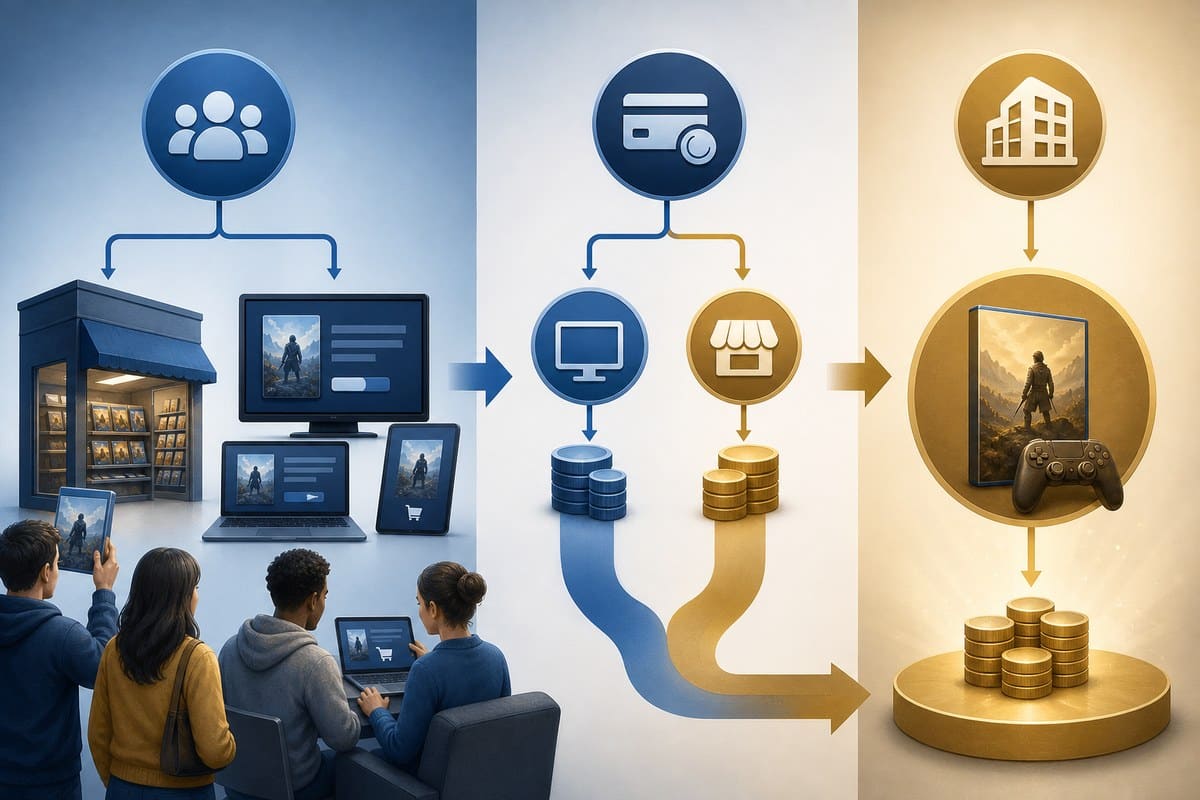
The key term is retail sales. It refers to money spent by consumers purchasing the game, not the revenue Take-Two records after retailers, digital storefronts, platform holders and other participants receive their shares. Nor does the number describe profit. The Daily Star similarly distinguished the reported consumer spending from the publisher’s own revenue.
That distinction is particularly relevant for a launch spread across PlayStation 5 and Xbox Series X|S, where a purchase can travel through several different distribution arrangements before reaching the publisher’s accounts. Retail sales are a useful indication of immediate demand, but they are not a financial-results line item and should not be read as an equivalent of Take-Two’s earnings.
Take-Two’s release frames the $3.79 billion total as based on company estimates. The available reports corroborate that Rockstar supplied the figure, but do not identify an independent auditor or a standardized outside measurement service that has verified the total. ABC News also reported the company’s first-day number and its assertion of a cross-entertainment record in its coverage of the launch.
One important accounting detail remains unresolved. The publisher said 32.5 million units had been sold before release, but the reporting available does not establish whether those pre-release sales are included in the $3.79 billion launch-day total. That uncertainty makes it inappropriate to infer a per-copy price from the two figures or to treat the announcement as a clean count of sales completed only on launch day.
Why the all-media record is difficult to standardize
Take-Two’s description of the launch as the biggest in entertainment reaches beyond games, inviting comparisons with theatrical blockbusters. But the available accounts do not offer a common, independently audited methodology that puts a game’s consumer spending during its first day on the same basis as a film’s ticket sales. Movie box office is generally measured from theatrical admissions over a run that can last weeks or months; game retail sales can include physical and digital purchases, premium editions and pre-release orders, depending on the reporting convention.
The two businesses also recognize income differently. A film’s reported global gross is a measure of ticket receipts rather than studio revenue, while a game publisher’s reported retail sales capture spending before the cuts taken by distributors and platforms. The numbers can illustrate scale, but they are not interchangeable measures of the money ultimately retained by the companies behind each work.
That does not diminish the significance of the reported first-day demand. It clarifies the boundary of the claim: Rockstar and Take-Two are reporting a launch-day consumer-spending estimate and applying their own cross-media record designation. The public reporting supports both as company claims; it does not provide a single ledger against every earlier film, game, album or other entertainment release.
Console demand and the next phase of the release
The early audience was concentrated on Sony’s platform. Sensor Tower estimated that roughly three-quarters of sales at that point were on PlayStation 5, with Xbox Series X|S accounting for the remainder, according to the Reuters report. The split is notable because the launch is currently confined to console hardware, limiting the initial market compared with a simultaneous PC release.
Reuters reported that a PC version is expected the following year. That means the $3.79 billion figure, if it holds as reported, reflects the opening phase of a release rather than the game’s full potential audience. Future sales will be shaped by that later platform rollout, player retention and any additional content, none of which is captured in a first-day retail-sales estimate.
The reporting also placed the game’s critical reception near the top of the modern review scale, with a 99 score on Metacritic. Commercial momentum and critical acclaim do not measure the same thing, but together they explain why the launch has become a broader media-business story: a console game has generated an immediate consumer-spending figure normally associated with the largest global entertainment events, even as the precise cross-media ranking remains the publisher’s own calculation.