Delta Air Lines switched to manual procedures for aircraft dispatch after a technology outage disrupted its weight-and-balance automation on Nov. 22, delaying flights across the carrier’s network and drawing Federal Aviation Administration traffic-management measures around Atlanta.
The failure involved a pre-departure operational system, not the FAA’s air-traffic infrastructure. Delta said crews were using manual workarounds to dispatch aircraft safely while its teams worked to restore the automation. The FAA said the resulting delays were unrelated to FAA air-traffic systems, a distinction that separates an airline technology failure from an air-traffic-control outage.
A manual fallback for a time-sensitive task
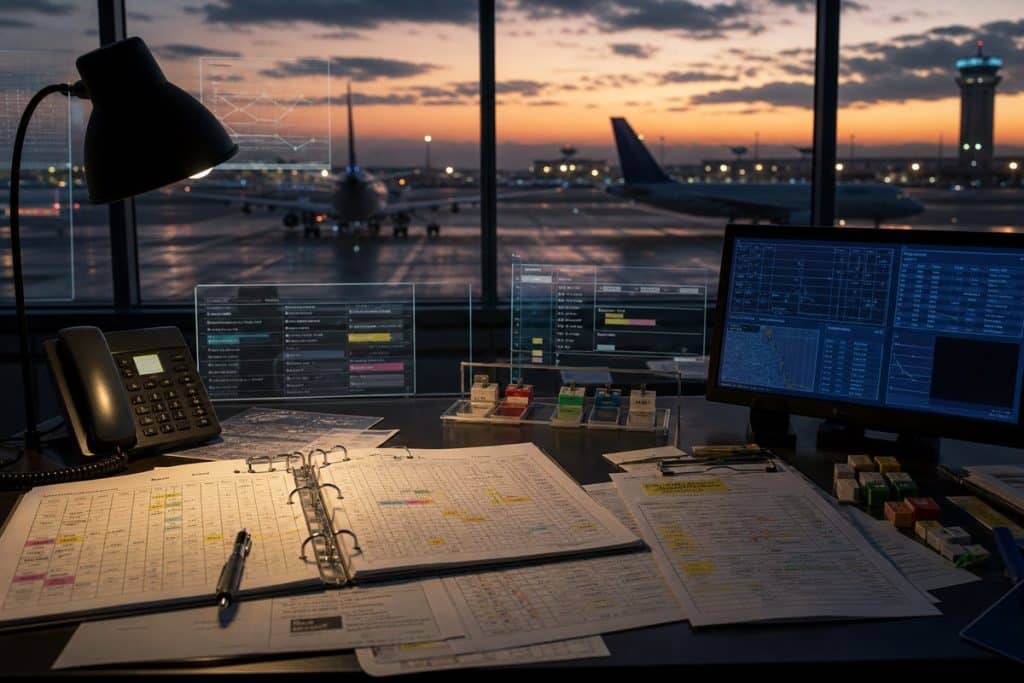
Weight-and-balance work is a routine but consequential part of preparing an aircraft for departure. Airlines must account for the planned load and how it is distributed before a flight can leave. Automation can assemble and process that information quickly; reverting to manual procedures adds work to a process that must be completed for each affected departure.
Delta described the problem as an outage in one of its weight-and-balance calculation systems. ABC7 New York’s report said the carrier was relying on manual procedures as it sought to restore the service. There is no indication in the available reports of an aircraft safety event. The operational effect was delay: a slower dispatch workflow can hold an aircraft at the gate and upset the tightly sequenced arrivals, departures, crews and connections that follow.
Atlanta was the focal point because the FAA identified the affected system as Delta’s weight-and-balance automation at Hartsfield-Jackson Atlanta International Airport, according to The Baltimore Banner. A disruption there can be felt well beyond Georgia as aircraft and crews assigned to later flights arrive out of sequence.
FAA managed Delta traffic, not its own systems
The FAA initially imposed a ground stop for Delta flights bound for Atlanta, then shifted to a ground-delay program, according to reporting on the Atlanta operation. A ground stop prevents affected flights from departing for a destination; a ground-delay program instead meters their departures. Both are traffic-management tools intended to keep arrivals aligned with what an airport and airline operation can absorb.
The measures should not be read as evidence that FAA systems failed. In statements reported by both the Banner and CBS News Baltimore, the FAA said the disruption was not connected to its air-traffic systems. The agency’s role was managing the consequences for Delta’s Atlanta-bound flights while the airline dealt with its own outage.
That distinction is particularly important in an industry where travelers can see the same symptom—an extended departure delay—from very different causes. Weather, airport congestion, air-traffic restrictions, airline staffing and an airline’s internal software can all delay a flight. In this case, the available accounts consistently place the original fault in Delta’s dispatch-related technology.
Delay counts describe different slices of the disruption
The reported totals are substantial, but they are not interchangeable. ABC7 New York reported roughly 700 delayed Delta flights, about one-fifth of the carrier’s schedule, by Sunday morning. The Atlanta-focused report cited FlightAware data showing 364 delayed flights at the airport, alongside FAA delay estimates averaging 57 minutes and potentially reaching one hour and 51 minutes.
Those figures measure different places and moments rather than a running total that can be added together. The 364-flight figure is an Atlanta snapshot; the roughly 700 figure is a network-wide count reported earlier in the day. At Baltimore-Washington International Thurgood Marshall Airport, CBS News Baltimore reported at least 18 delayed Delta flights Sunday afternoon, illustrating how the disruption reached stations outside the hub.
The accessible reporting therefore supports widespread delays and an Atlanta-centered operational problem, but not a confirmed total above 1,000 flights. It also does not independently establish that the underlying automation had been fully restored by the time those reports were published.
Passenger remedies remained tied to individual flights
Delta told CBS News Baltimore that it was rebooking affected customers and providing meal vouchers and hotel rooms when needed. The airline also said passengers whose flights were canceled and who no longer wanted to travel could obtain refunds.
For customers, the immediate issue was whether a delayed aircraft, an incoming crew or a connection would recover as the day went on. For Delta, the more immediate operational task remained restoring the automated system while continuing the slower manual dispatch process. Public reporting confirmed the workaround and the traffic restrictions, but had not provided a verified timetable for full restoration.