


Xiaomi has taken the wraps off its global Xiaomi 17 and Xiaomi 17 Ultra, aiming squarely at buyers hungry for fresh flagship ideas. If you felt recent rivals played it safe, this duo’s camera-first design, big batteries, and top-tier silicon read like an open challenge to the status quo.
Flagship hardware and software across both phones
Both phones share Qualcomm’s Snapdragon 8 Elite Gen 5 for cutting-edge performance and efficiency, backed by Xiaomi’s HyperOS 3. You also get 50W wireless charging, IP68 dust and water resistance, an ultrasonic in-display fingerprint scanner for more reliable reads, and a 50MP f/2.2 selfie camera. The shared foundation signals a no-compromise approach across the line, not just on the Ultra.
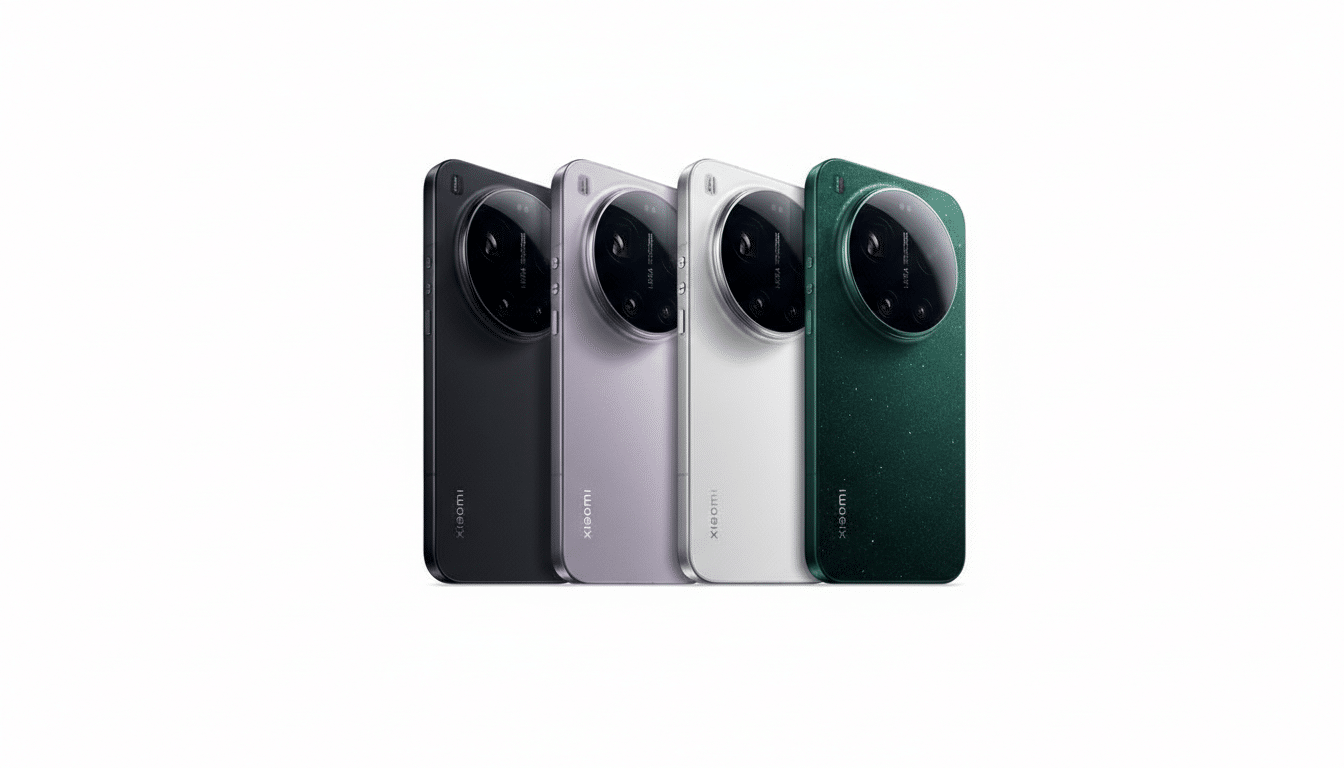
Ultra camera aims for true zoom versatility
The Xiaomi 17 Ultra is built around camera ambition. It pairs a 50MP one-inch main sensor (Light Fusion 1050L, LOFIC) with a 50MP ultrawide (ISOCELL JN5) and a headline-grabbing 200MP variable telephoto (ISOCELL HPE). The tele module offers optical zoom across 75mm to 100mm (about 3.1x to 4.1x) and leverages that dense sensor to deliver a claimed ~17.2x lossless zoom through in-sensor cropping and multi-frame fusion.
Variable periscope zooms have been gaining traction since Sony’s recent implementations, and Xiaomi’s twist is scaling resolution to preserve detail at intermediate focal lengths. It’s a pragmatic trade: the optical range isn’t as wide as some competitors’ 3.5x–7.1x setups, but the 200MP well of pixels gives Xiaomi more room for computational super‑resolution with finer texture and less stair‑stepping at mid‑to‑long zoom.
Video credentials are equally serious: 4K at 120fps with Dolby Vision HDR, 8K at 30fps, and 4K/120 using the ACES standard. Larger sensors and faster readouts matter here—DXOMARK’s lab methodology has long shown that bigger photosites and better stabilization improve low‑light signal‑to‑noise and dynamic range, exactly the territory where one‑inch sensors tend to shine.
The Ultra’s hardware is rounded out by a 6.9‑inch LTPO OLED at 120Hz (2,608 x 1,200) under Shield Glass 3.0, 90W wired plus 50W wireless charging, and a 6,000mAh battery. Notably, the global unit trims capacity from the Chinese model’s 6,800mAh, a likely concession to weight or regulatory harmonization—still substantial for an imaging‑centric flagship.
Xiaomi is also shipping a Leica Leitzphone edition powered by Xiaomi, complete with a rotating dial around the rear camera island. The tactile ring maps to zoom control, evoking a rangefinder‑style workflow that photographers will appreciate.

Standard model goes compact with big battery
The Xiaomi 17 takes a pocket‑friendly tack with a 6.3‑inch LTPO OLED (2,656 x 1,220) while keeping performance identical to the Ultra. It ups wired charging to 100W and supports USB‑PD PPS, improving compatibility and maintaining fast speeds with a wider range of chargers. Wireless charging holds at 50W.
Battery life looks promising: the 6,330mAh cell is actually larger than the Ultra’s pack and significantly bigger than what most compact flagships carry. That capacity, paired with LTPO refresh rate modulation, should translate into excellent day‑two endurance for mixed use.
Camera hardware aligns closely with Xiaomi’s previous compact flagship formula: a triple 50MP setup featuring a 1/1.3‑inch main sensor now at f/1.7 (a touch narrower than the earlier f/1.6), an ultrawide stepping from f/2.2 to f/2.4, and a steady 2.6x 50MP tele. The front camera moves to 50MP at f/2.2. On paper, the slight aperture changes trade a bit of light intake for potentially tighter edge performance and lens uniformity—decisions we’ve seen other brands make as they optimize compact optics.
Pricing, availability, and early market takeaways
The Xiaomi 17 starts at €999 for 256GB, offered in Black, Venture Green, Alpine Pink, and Ice Blue. The Xiaomi 17 Ultra begins at €1,499 for 512GB in Black, White, and Starlit Green. The Leica Leitzphone powered by Xiaomi lands at €1,999 with 1TB.
For shoppers unmoved by incremental upgrades elsewhere, Xiaomi’s pitch is clear: camera innovation without abandoning battery headroom, fast charging, or ingress protection. Counterpoint Research has repeatedly found camera quality among the top purchase drivers in the premium tier, and Xiaomi is leaning into that with a rare combination of a one‑inch main sensor and a high‑resolution variable telephoto.
The open questions now revolve around tuning and consistency—image processing, autofocus reliability at longer focal lengths, and thermal behavior under 4K/120 capture. If Xiaomi nails those details, the 17 Ultra becomes a credible candidate for the camera crown, while the standard 17 quietly offers one of the most battery‑forward compact flagships you can buy.
