


Most business owners know their website isn’t performing. They just don’t know why.
Traffic comes in. Nothing happens. The contact form sits there. The phone doesn’t ring. And somewhere along the way, someone on the team suggests running ads, as if the problem is visibility and not the site itself.
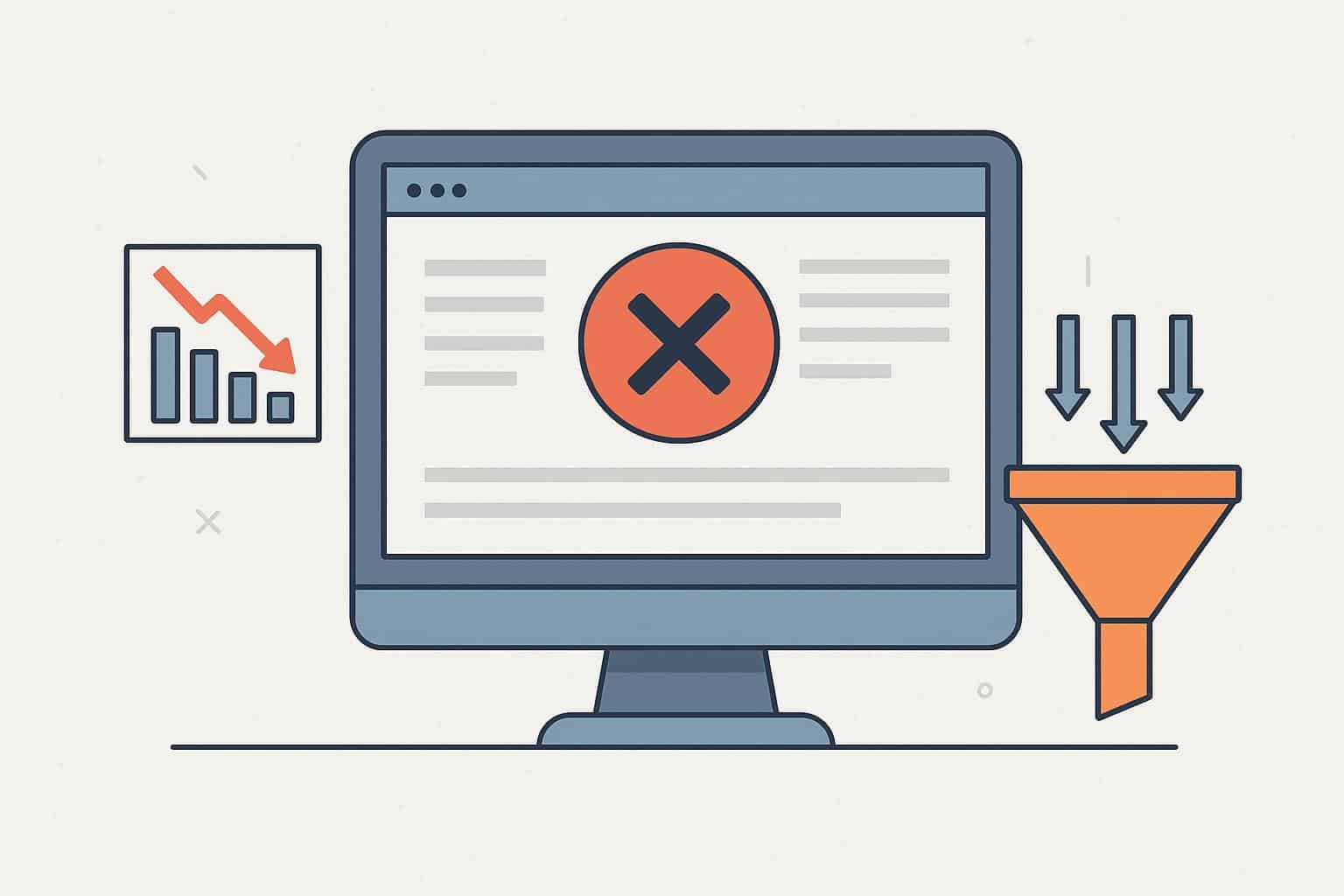
It usually isn’t visibility. It’s what happens after someone arrives.
The Site That Looks Fine and Does Nothing
There’s a specific kind of website that causes the most commercial damage. Not the one that looks outdated or loads slowly. Those get flagged immediately. The dangerous one is the site that looks polished, has a clean layout, and still doesn’t generate a single qualified lead.
I’ve seen it with tech companies. I’ve seen it with consulting firms. The site gets redesigned, everyone signs off, and six months later the founder is asking why nothing changed.
The reason is almost always the same. The site was built to represent the business, not to work for it.
What a Non-Converting Site Actually Looks Like
You don’t need an analytics report to spot one. Here are the signals.
There’s no clear action above the fold. The homepage has a hero image, a tagline, and a “Learn More” button. Where does “Learn More” go? Deeper into the site. The visitor is being walked through a tour, not being invited to do anything.
Every page has the same CTA. “Contact us.” Sometimes it’s “Get in touch.” Same thing. It appears in the top nav, the footer, and occasionally in the middle of a service page. When everything is a call to action, nothing is.
The copy explains what the company does, not what the visitor gets. There’s a meaningful difference between “We provide end-to-end digital marketing solutions” and “You’ll know exactly where your leads are coming from, and why.” The first is about the company. The second is about the client. Most sites are written entirely from the first perspective.
The site doesn’t acknowledge that the visitor has a problem. A person landing on your site is usually in some state of dissatisfaction. Something isn’t working for them. If the site never names that thing, never says “here’s what we’re seeing in companies like yours,” the visitor has no reason to self-identify as a fit.
There’s no next step that isn’t a commitment. The gap between “browsing the site” and “booking a call” is enormous for a first-time visitor. Sites that only offer one conversion point, and make that point a 30-minute sales call, will convert a fraction of what they could.
Why This Keeps Happening
The default briefing process for a website project is built around content, not strategy. The agency or freelancer asks: what pages do you need? What should each page say? What do you want the site to look like?
Those are the wrong first questions.
The right questions are: who is arriving on this site, what are they trying to figure out, and what do they need to believe before they’ll reach out? The design and copy should be answers to those questions. Most of the time, they aren’t.
Founders also tend to conflate credibility with conversion. A site that has good case studies, a clean aesthetic, and clear service descriptions earns credibility. That’s valuable. But credibility does not automatically produce action. A visitor can leave your site genuinely impressed and still not contact you, because they weren’t given a reason to do it right now.
This is the brochure problem. A brochure is designed to be read and set aside. A lead-generating site is designed to produce a decision.
A brochure is designed to be read and set aside. A lead-generating site is designed to produce a decision.
The Fixes That Actually Move the Needle
Getting a non-converting site to work isn’t always a full rebuild. In many cases, it’s a set of targeted changes to the structure and copy.
Replace generic CTAs with specific ones. “Download the audit checklist” converts better than “Contact us.” “See how we handled this for a 40-person consulting firm” converts better than “View case studies.” The more specific the action, the lower the perceived risk.
Add a secondary conversion path. Not every visitor is ready to book a call. A lead magnet, a resource download, or a newsletter signup gives you a way to stay in contact with people who aren’t ready yet. This is traffic you’re currently losing completely.
Rewrite the homepage headline around the client’s outcome, not the company’s capability. This single change is often the highest-impact edit on the entire site. “Web design and development for growing companies” is a capability statement. “Built for companies who’ve outgrown their last site and can’t afford to keep it” is a positioning statement. One of these makes the visitor think “that’s me.”
Use a problem-first structure on service pages. Before you explain what you do, name the situation the visitor is likely in. What are they frustrated by? What’s costing
them? When the site mirrors the internal conversation the buyer is already having, it earns attention.
Make the proof specific. Logos are weak proof. A two-sentence quote with a name and a company is better. A case study with actual numbers is better still. The site that can say “after rebuilding the contact page, a Toronto-based cybersecurity firm saw demo requests increase by 60% over the following quarter” is doing something categorically different from the one that says “we deliver results.”
The Bigger Question
There’s a useful distinction worth making explicit. The difference between a site that represents your business and one that works for it isn’t design quality or even traffic volume. It’s whether the site is built around what your visitor needs to think, feel, and do, or whether it’s built around what you wanted to say.
Most sites are built around what the company wanted to say. That’s not a criticism; it’s the natural outcome of a briefing process that starts with “what do we want people to know about us?” instead of “what does someone need to see here before they’ll trust us enough to reach out?”
The further reading on this distinction, particularly the difference between a digital brochure and a lead-generating website, is worth working through if you’re evaluating your own site right now.

