


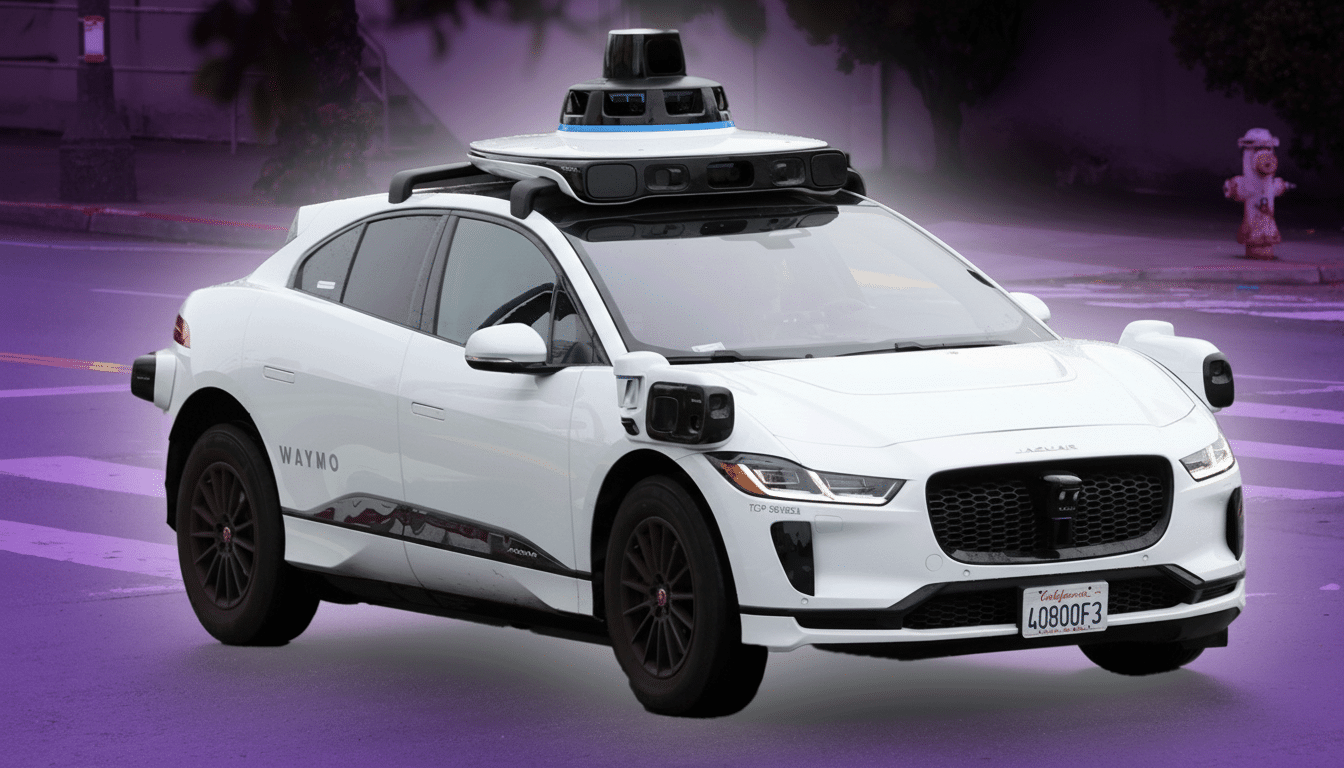
Waymo’s driverless cars are racking up rides — and calling in firefighters and police when they get stuck. A growing trail of incidents shows the company’s robotaxis sometimes need human rescuers to clear emergencies, unblock intersections, or escape chaotic scenes, spotlighting a practical weak point in fully autonomous service at city scale.
One vivid example unfolded near California’s I-280 when a grass fire forced traffic to reverse off the freeway under California Highway Patrol direction. A Waymo tried to navigate the shoulder, faltered, then froze. After remote staff failed to free the vehicle, a 911 call brought in officers to physically move it — the kind of last-mile fix that is becoming uncomfortably common for public safety agencies.
First Responders as the Backup Plan for Waymo’s Robotaxis
City officials in multiple markets say they’ve been pulled into roadside triage for driverless cars. In recent months, first responders have manually steered or relocated Waymo vehicles at least a half-dozen times, including two active crime scenes.
- In Austin, a police officer shifted a robotaxi out of an ambulance path during a mass-casualty response.
- In Atlanta, responders disengaged a Waymo that had rolled into an active scene before company staff retrieved it.
- In Nashville, an officer drove a stuck car out of an intersection.
San Francisco’s emergency management leadership has warned that police and fire crews are increasingly acting like ad hoc roadside assistance — a role they argue is unsustainable. Their concern is less about isolated glitches and more about cumulative operational drag: every minute spent coaxing a robotaxi is a minute not spent on core public safety duties.
Inside Waymo’s Human-in-the-Loop Support Operations
Waymo says its service now delivers more than 400,000 paid rides each week across a fleet of roughly 3,000 autonomous vehicles, an achievement built on years of development and a conservative safety posture. Yet the company openly relies on human help in edge cases via a layered support model.
First are remote assistance specialists who advise vehicles when maps, sensors, and policy logic face ambiguous situations. Waymo has said around 70 people monitor the fleet at any one time, with staffing split 50% in the U.S. and 50% abroad, including the Philippines. The company cites median one-way connectivity latencies of about 150 milliseconds domestically and 250 milliseconds internationally — fast enough, it argues, for timely guidance without direct teleoperation.
That advisory loop isn’t foolproof. The National Transportation Safety Board disclosed that a Waymo in Austin asked a remote specialist to confirm whether a school bus was loading children; the adviser gave an incorrect all-clear and the vehicle proceeded past extended stop signs and flashing lights. No injuries were reported, but the episode underscored the stakes of split-second interpretation in human-in-the-loop autonomy.
For collisions or fast-evolving emergencies, Waymo’s U.S.-based Event Response Team coordinates with 911 and manages post-incident protocols. Separately, a Roadside Assistance unit — which has included third-party contractors such as Transdev — performs “on-scene, direct interaction,” including moving vehicles. The company says it can enable first responders to take control within seconds, though it does not ask passengers to drive.
Public Safety and Policy Scrutiny of Waymo’s Service
At a recent San Francisco hearing on AV behavior during a citywide power outage, officials pressed Waymo on how it will reduce dependence on police and fire for recovery operations. They sought specifics on staffing, dispatch times, and how the company plans to keep disabled AVs from blocking transit lanes, hospital routes, and firegrounds. Waymo did not detail its roadside assistance headcount or intervention frequency but emphasized training and tools for emergency crews.
According to a manager on Waymo’s incident response team, more than 30,000 first responders globally have been trained on interacting with the vehicles and using the handoff mechanism. Public safety leaders welcome training but argue it cannot substitute for dedicated private recovery capacity or better geofencing during unfolding emergencies.
There is also a governance gap. Unlike state-reported “disengagements,” there is no standard public metric for first-responder interventions, average clearance times for disabled AVs, or counts of scenes where an AV impeded emergency operations. Without shared data, cities say it’s hard to weigh net benefits against operational costs borne by taxpayers.
What Waymo Could Change Next to Reduce 911 Reliance
Waymo says it dispatches its own roadside teams and tow partners and is exploring partnerships beyond core operations — it already uses DoorDash gig workers to close doors left ajar, and has floated extending that model.
More consequential steps would include:
- Publishing intervention metrics
- Committing to rapid-response service-level targets
- Expanding dedicated recovery crews during peak hours or severe weather
Technical levers are available, too:
- Tighter geofencing near active incidents
- Priority routing informed by city computer-aided dispatch
- Vehicle-to-infrastructure cues that recognize and yield to ad hoc traffic controls sooner
Each measure reduces the odds that the next edge case becomes an emergency detour for an already-stretched engine company or patrol unit.
Autonomy at scale will always produce rare but consequential corner cases. Waymo’s rapid growth proves demand; its increasing calls to 911 prove the system still leans on human scaffolding. The company’s credibility with regulators and cities may hinge on a simple pivot: demonstrate, with data and staffing, that first responders are no longer the default bailout for stuck robotaxis.

