


Context switching rarely looks like waste from the outside
In a busy insurance team, it often looks like responsiveness: answering a client email, checking a policy detail, updating a spreadsheet, following up with an underwriter, taking a call, reopening a CRM record, then jumping back into a quote that was already half-built.
The problem is not that people are unwilling to work. In many agencies, the problem is that work is scattered across too many places, and every small switch carries a cost.
- Context switching rarely looks like waste from the outside
- Why Small Interruptions Become Expensive
- The Insurance Workflow Is Built Around Friction
- The Contradiction: Busy Teams Can Still Be Operationally Blind
- Why Clients Feel the Cost Before Leaders See It
- Technology Does Not Automatically Solve Fragmentation
- The Real Cost Is Decision Drag
- Reducing Context Switching Starts With Operational Design
- Conclusion
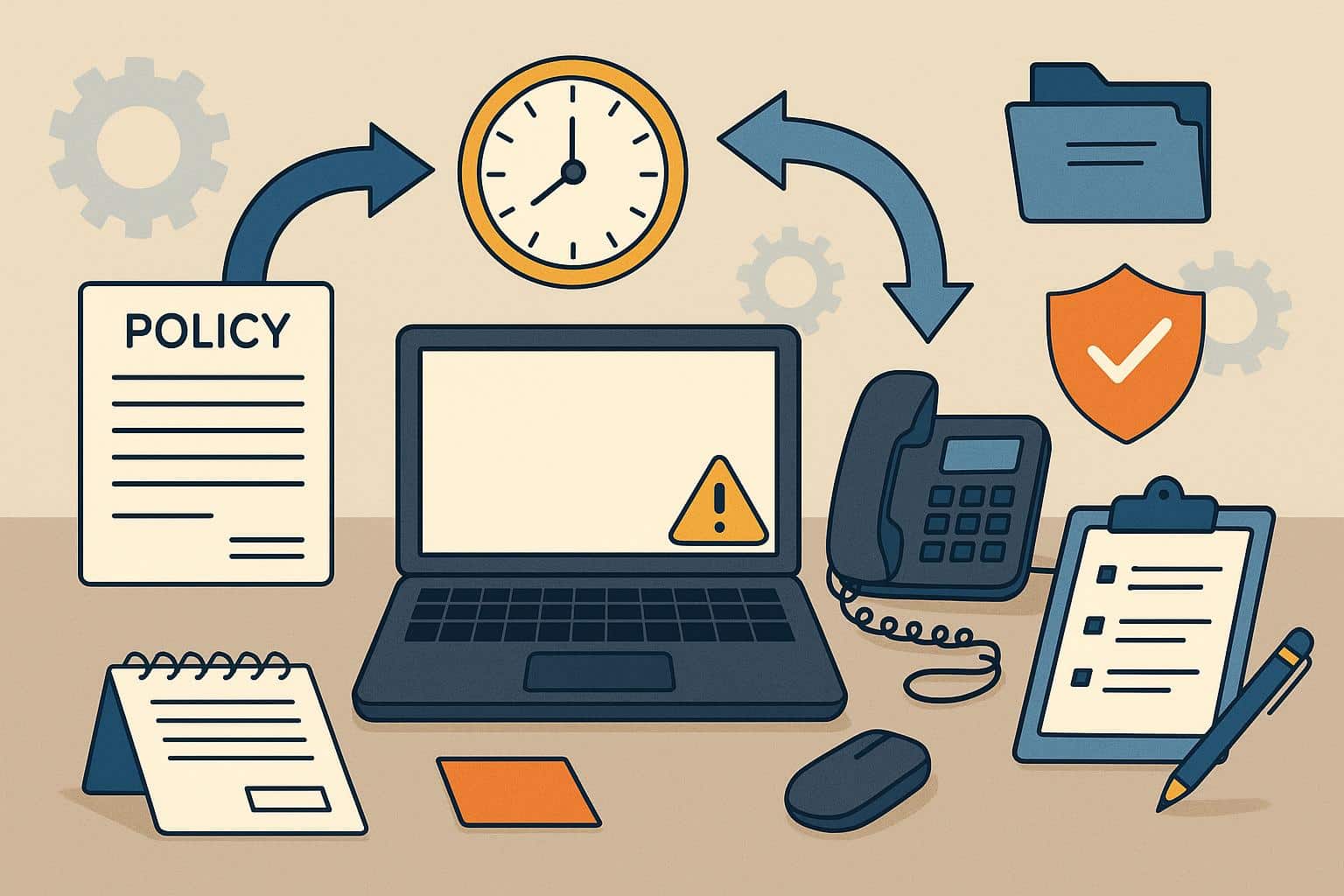
Why Small Interruptions Become Expensive
Research from the American Psychological Association notes that task switching can reduce productive time by as much as 40 percent in some cases. Microsoft’s 2025 Work Trend Index also found that Microsoft 365 users are interrupted, on average, every two minutes by meetings, emails, or notifications.
For insurance teams, that matters because accuracy depends on continuity. A producer cannot properly assess a client’s needs while mentally holding five open loops. A CSR cannot process an endorsement cleanly while switching between email, carrier portals, notes, billing details, and client history.
The hidden cost is not just lost time. It is weakened judgment.
The Insurance Workflow Is Built Around Friction
The typical insurance agency workflow has dozens of handoffs: lead intake, policy review, quote preparation, underwriting questions, renewal reminders, claims updates, certificates, billing questions, compliance notes, and client follow-ups.
Each handoff creates a small risk of context loss.
A client may have already explained their situation to one staff member, but the next person only sees a partial note. A renewal may be technically “in progress,” but no one has a clear view of the last conversation. A producer may think a follow-up happened because the activity exists somewhere, while the CSR knows the actual response is still pending.
This is where context switching becomes more than a productivity issue. It becomes a service consistency issue.
The Contradiction: Busy Teams Can Still Be Operationally Blind
Many agencies mistake activity for control. Everyone is working. Everyone is responding. Everyone is moving between tasks quickly.
But speed across fragmented systems can create the illusion of progress.
A team can be extremely busy and still miss the next best action. They can handle hundreds of small tasks and still fail to see which accounts are at risk, which prospects are cooling, or which renewals need leadership attention.
Context switching hides operational weakness because it spreads the problem across the day. No single interruption feels disastrous. But collectively, they reduce attention, increase rework, and make important client signals easier to miss.
A useful way to frame it is this: the more your team has to remember manually, the less your system is actually managing.
Why Clients Feel the Cost Before Leaders See It
Clients rarely say, “Your internal workflow feels fragmented.” They say things like:
“I already sent that through.”
“I spoke to someone about this last week.”
“Can you check where this is up to?”
“I thought this had already been handled.”
These comments are often symptoms of context failure.
From the client’s perspective, the agency is one entity. They do not care whether information lives in a note, email, spreadsheet, carrier portal, or someone’s memory. They expect continuity.
This is the psychological pressure inside insurance service work: clients expect personal memory from a business that is often operating through distributed systems.
When the system cannot preserve context, staff have to compensate emotionally. They apologise, chase, clarify, and rebuild trust one interaction at a time.
Technology Does Not Automatically Solve Fragmentation
It is tempting to assume that adding more tools will reduce the problem. In practice, more tools can make context switching worse if they do not create a shared operational view.
Harvard Business Review has reported on the heavy cost of toggling between applications, while Asana’s research has found that workers often spend large portions of their time on “work about work,” including chasing updates and switching between tools.
For agencies, the question is not simply, “Do we have software?”
The better question is, “Does our system reduce the number of places people need to look before they can act?”
A modern insurance agency needs workflows that preserve context across the client journey, not just tools that store information after the fact.
The Real Cost Is Decision Drag
The most expensive part of context switching is often decision drag. Staff lose time not because they are lazy, but because every task requires reorientation.
What is the client’s status?
Who last spoke to them?
Is this urgent?
Has the carrier responded?
What is the next action?
Is there a compliance note?
Did someone already promise a timeline?
When answers are scattered, every decision becomes slower. The business starts relying on individual memory instead of operational design.
That is manageable when the agency is small. It becomes fragile as the book grows, staff change, and client expectations rise.
Reducing Context Switching Starts With Operational Design
The solution is not to demand more focus from already stretched teams. It is to design workflows that require less mental reconstruction.
That means clearer ownership, cleaner handoffs, centralised client history, visible next
actions, and fewer disconnected systems. It also means leaders should review where staff lose time between tasks, not just how many tasks they complete.
The strongest agencies do not simply work harder. They reduce the number of unnecessary decisions required to deliver consistent service.
Conclusion
Context switching is easy to underestimate because it hides inside normal work. It appears as a quick email check, a small system lookup, a brief internal message, or a fast client update.
But over time, those switches create real operational cost: slower follow-up, weaker continuity, lower accuracy, and more pressure on staff to remember what the system should already know.
For an insurance agency, reducing context switching is not just about productivity. It is about protecting attention, preserving client trust, and building an operating model that can scale without making every employee the memory bank of the business.

