


The number of connected devices around us keeps climbing, and I keep watching businesses scramble to make sense of it. As of 2025, roughly 21.1 billion connected IoT endpoints were live worldwide, and forecasters expect that number to blow past 39 billion by 2030. Growth at that speed changes what businesses need from a technology partner. Wiring up a working sensor prototype in a lab is one job. Rolling out fleets of connected devices that stay online, secure, and profitable across factories, hospitals, farms, and cities is a very different job.
That is why the choice of an IoT development partner matters more today than it did five years ago. Picking the wrong firm can burn a year of runway on hardware that never ships. Picking the right one can put a connected product in customers’ hands inside a single quarter. In this article, I will share my curated list of the top 10 IoT development companies in the United States for 2026, walk through the criteria I use to compare them, and cover the standards and security frameworks that shape every serious project in this space.
- The State of the IoT Market Heading Into 2026
- What to Look for in an IoT Development Partner
- The Top 10 IoT Development Companies in the United States
- 1. LITSLINK
- 2. Softeq Development Corporation
- 3. Vention
- 4. Losant (a SUSE company)
- 5. Indeema Software
- 6. Biz4Group LLC
- 7. SumatoSoft
- 8. Topflight Apps
- 9. Rapptr Labs
- 10. Mercury Development
- Security and Compliance Standards for IoT Development
- Interoperability and Open Standards for Connected Devices
- How to Get the Most Out of Your IoT Partnership
- Wrapping Up
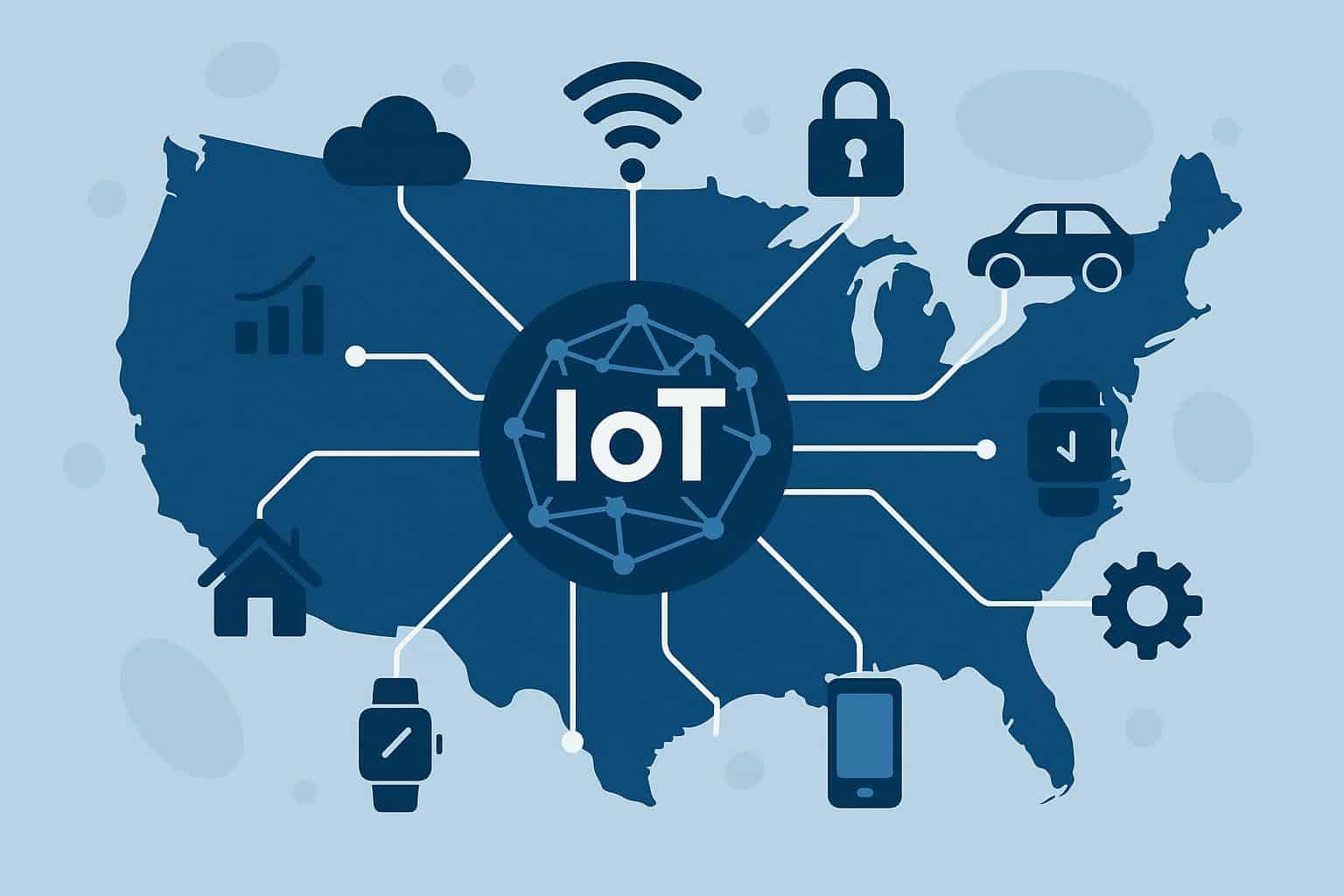
The State of the IoT Market Heading Into 2026
Before we get to the rankings, I want to set the stage. According to the latest research from IoT Analytics, the global count of connected IoT endpoints grew by 14 percent in 2024 to reach 21.1 billion, with forecasts putting the number closer to 39 billion by 2030 and above 50 billion by 2035. Fortune Business Insights valued the global IoT market at 864 billion dollars for 2025 and projected it will cross the 1 trillion mark in 2026. North America keeps the largest chunk of that revenue, with the United States alone holding around 23 percent of global IoT software and services spend, per ABI Research.
What does that mean for the market? A few things. First, the money is real, and enterprises are ready to spend it on serious deployments rather than toy prototypes. Second, most of the growth is now in industrial, healthcare, and smart infrastructure, not consumer gadgets. Third, connectivity is diversifying fast. Wi-Fi still carries about 32 percent of connections, but cellular IoT grew 16 percent year over year, and 5G chipsets are on track to become the fastest-growing sub-segment through 2030. All of this puts new pressure on development partners to know their way around low-power radio, edge compute, and cloud data pipelines at the same time.
What to Look for in an IoT Development Partner
Over the years, I have picked up a short list of things I look for before I ever sign a contract with an IoT firm. If you are evaluating vendors, ask for evidence on each of these, not just marketing copy:
- Firmware and embedded engineering talent, not only cloud and mobile developers
- Real hardware experience with Arduino, Raspberry Pi, custom PCBs, cellular modules, and industrial gateways
- Cloud platform depth across AWS IoT, Azure IoT, and Google Cloud IoT
- Data engineering and analytics skills so telemetry actually gets turned into insight
- A documented security posture aligned with NIST, ISO 27001, and IEC 62443 where relevant
- A track record of moving projects from proof-of-concept to production, not just PoC demos
- Industry vertical experience in the sector you are building for
- A clear plan for over-the-air firmware updates and long-term device support
I also want to see writing samples, code samples, and reference calls with three or more real clients. Any firm that struggles to produce those is a firm I quietly move past.
The Top 10 IoT Development Companies in the United States
I built the list below from public company data, review platforms like Clutch and GoodFirms, and my own conversations with founders who have shipped connected products. To keep it useful, I stuck to firms that either have US headquarters or a strong US office, and that publicly describe IoT as a core discipline, not a side offering. Here is a quick view before we go deeper.
| Rank | Company | US Headquarters | Founded | Core IoT Focus |
|---|---|---|---|---|
| 1 | LITSLINK | Palo Alto, CA | 2014 | Custom IoT software, AIoT, connected devices |
| 2 | Softeq Development | Houston, TX | 1997 | Firmware, hardware, IIoT, embedded systems |
| 3 | Vention | New York, NY | 2002 | IoT platforms, cloud connectivity, AI and ML |
| 4 | Losant (a SUSE company) | Cincinnati, OH | 2015 | Industrial IoT platform, digital twins |
| 5 | Indeema Software | Washington, D.C. | 2014 | IoT product engineering, smart devices |
| 6 | Biz4Group | Orlando, FL | 2003 | IoT, wearables, connected consumer products |
| 7 | SumatoSoft | Boston, MA | 2012 | IoT, AI and ML, SaaS platforms |
| 8 | Topflight Apps | Irvine, CA | 2016 | Healthcare IoT, wearables, mobile |
| 9 | Rapptr Labs | New York, NY | ~2017 | IoT mobile apps, connected experiences |
| 10 | Mercury Development | Aventura, FL | 1999 | Full-cycle IoT, custom device firmware |
1. LITSLINK
I put LITSLINK at the top because the company covers the full picture that most IoT projects actually need. Based in Palo Alto with a second US office in Orlando and engineering teams overseas, LITSLINK has been building connected products since 2014, with real experience in AIoT, smart home integrations, healthcare wearables, and industrial monitoring.
If you need custom IoT development services that pair firmware, cloud, and mobile expertise with modern AI capabilities, this is the firm I would send a friend to first. Their engineers work across MQTT, LoRaWAN, cellular, and Wi-Fi radios. Their DevOps teams have shipped CI/CD pipelines for connected consumer devices at brands like Scotts Miracle-Gro, including smart pots and outdoor irrigation systems.
Their AI unit builds AIoT models for predictive maintenance, anomaly detection, and real-time device intelligence. LITSLINK is also transparent about pricing, delivery cadence, and post-launch support, which is rare in this space and worth a lot on a multi-year connected product roadmap.
2. Softeq Development Corporation
Softeq is one of the most established custom development shops in the country. Founded in Houston in 1997 by Chris Howard, the firm has quietly grown into a full-stack partner covering hardware, firmware, embedded, IoT, and cloud work. Softeq is ISO 27001, ISO 9001, and ISO 13485 certified, which matters if you are planning medical or safety-critical devices. The firm has been on the Inc. 5000 list of the fastest-growing US private companies five years running, and its client roster includes Verizon, Epson, Microsoft, Lenovo, AMD, Disney, Intel, and NVIDIA. If your project starts with a printed circuit board question rather than a cloud question, Softeq deserves a call.
3. Vention
Vention, formerly known as iTechArt, is headquartered in New York City and has grown into a global software engineering group with 3,000 or more developers across 20-plus offices. Vention offers dedicated IoT teams that pull from AI, ML, data analytics, DevOps, and cloud specialists on the same bench. That means when your connected device project ships a firmware update on Tuesday and needs a data pipeline change on Wednesday, both can come from the same partner. Vention has been public about its work with connected-beverage brand Bevi and with a range of industrial and healthcare IoT clients.
4. Losant (a SUSE company)
Losant was founded in Cincinnati in 2015 and was acquired by open-source enterprise software company SUSE in February 2026. The team is focused on Industrial IoT and offers a low-code IoT application enablement platform used by Verizon, Warner Bros. Discovery, and Hewlett Packard Enterprise. Losant was recognized in the 2025 Gartner Magic Quadrant for Global Industrial IoT Platforms. If you need less of a services engagement and more of a platform to run millions of endpoints, Losant is worth a serious look.
5. Indeema Software
Indeema Software is a Washington-based IoT specialist that has been building connected products since 2014. The team focuses on IoT firmware and hardware, IoT mobile apps, smart home and smart building platforms, and full-cycle product engineering. Indeema is known for early involvement in projects, which means their engineers help clients through concept validation, prototype fabrication, and pilot rollout, not just software delivery. Blockchain and C++ specialists on their bench have also been valuable for clients building IoT products in fintech-adjacent verticals like asset tracking.
6. Biz4Group LLC
Biz4Group has been serving IoT and connected wearable clients from Orlando, Florida since 2003. The company offers end-to-end IoT development covering products, services, connectivity, and wearable device integrations. Biz4Group is a strong choice for consumer IoT and healthcare wearables where the mobile companion app has to feel polished. They also do a lot of AI-plus-IoT integration work now, which reflects where the market has moved.
7. SumatoSoft
SumatoSoft is a Boston-headquartered custom software firm founded in 2012 with a strong IoT and AI/ML practice. The team is composed of senior engineers with an average of over ten years of experience, and the firm is known for structured agile delivery and a heavy focus on IoT for logistics, agriculture, and industrial monitoring. Public clients include Toyota and Evolv. SumatoSoft is a good fit for organizations that want a long-term development partner rather than a project-based vendor.
8. Topflight Apps
Topflight Apps is based in Irvine, California and was founded in 2016 by Joe Tuan. Their sweet spot is healthcare IoT and mobile: connected clinical sensors, remote patient monitoring, and wearable health devices. Public work includes Stanford Medicine, Merck, and Walker Tracker, an employee wellness platform later acquired by TerryBerry. Topflight is HIPAA-compliant by default and comfortable with FHIR and HL7 integrations, which are big wins if you are building any connected medical device in the US market.
9. Rapptr Labs
Rapptr Labs is a New York-based development firm founded around 2017. Their IoT work focuses on the mobile app side of connected products, with strong experience shipping companion apps that talk to Bluetooth, Wi-Fi, and cellular devices. Rapptr has been recognized by AVIXA Xchange and other US industry publications for their IoT mobile app work, and they run projects as a 100 percent US-based team.
10. Mercury Development
Mercury Development is a full-cycle software company founded in 1999 in Aventura, Florida, with a US headquarters and additional development centers in Eastern Europe. The team has been doing IoT work for over two decades, with a strong track record in custom device firmware, cross-platform companion apps, and cloud data pipelines. Public clients include FitBit, HSBC, Thomson Reuters, and Mercedes-Benz. Mercury is a good pick for founders who want a lower-cost partner with deep experience across web, mobile, IoT, and cloud all in one place.
Security and Compliance Standards for IoT Development
If you are building a connected device that will be sold in the US, security is not optional. The NIST Cybersecurity for IoT Program publishes the guidance that federal agencies, product manufacturers, and buyers reference when evaluating IoT device cybersecurity. Two documents you should know are NIST Special Publication 800-213 (IoT Product Cybersecurity Guidelines for the Federal Government) and NIST Internal Report 8259 (Foundational Cybersecurity Activities for IoT Product Manufacturers), both revised in 2026. NIST is also behind the US Cyber Trust Mark, a consumer-facing certification for IoT products that meet a baseline set of security requirements.
The rules matter for two reasons. First, if you plan to sell to any federal or state agency, your IoT product will be measured against SP 800-213 and its catalog document 800-213A. Second, buyers in regulated verticals like healthcare, energy, and defense increasingly ask for NIST alignment as a prerequisite. Any IoT development partner you consider should already be building with these frameworks in mind, and should be able to show you the mapping between your product controls and the relevant NIST requirements. If the answer to that question is a blank stare, keep shopping.
Interoperability and Open Standards for Connected Devices
Beyond security, the other big topic in IoT for 2026 is interoperability. Nobody wants to buy a smart building where the HVAC will not talk to the lighting or the security cameras. That is why bodies like the IEEE IoT Initiative matter. IEEE curates working groups on IoT architecture, protocols, and edge computing, and publishes standards used all over the connected products world. Development firms that follow IEEE guidance tend to build products that play nicely with existing infrastructure years down the line, which saves money on integrations and lowers the total cost of ownership for enterprise customers.
You will also see references to Matter, Thread, Zigbee, MQTT, LoRaWAN, and OPC UA in serious IoT proposals. A capable partner should be comfortable with at least two of those depending on the deployment context, not stuck on the one they know best.
How to Get the Most Out of Your IoT Partnership
Once you have picked a partner, you can still burn budget by running the project badly. I like to see a discovery workshop up front where the vendor’s hardware, firmware, cloud, and product teams meet the client’s stakeholders in the same room (real or virtual) and agree on a rollout plan for the first six months. From there, I recommend a staged approach: a working prototype in weeks one through eight, a small pilot with real users in weeks nine through sixteen, and only then a fleet rollout with a full monitoring and update pipeline. Skipping the pilot is where most connected product plans quietly die. Test in the field, learn, iterate, and only expand once your update path is proven.
Wrapping Up
The IoT market crossed a real threshold last year. It stopped being a novelty and became critical business software that has to work every day, at fleet scale, in the field. The firms on this list know how to build for that reality.
LITSLINK sits at the top because the team combines firmware, cloud, mobile, and AI capabilities under one roof, plus a decade of shipped connected products behind them. The other nine firms all bring something worth a phone call. My advice: shortlist two or three, run a paid discovery workshop with each, and pick the one whose engineers ask you the hardest questions. That is almost always the partner who will ship the best product in the end. If you are getting a connected product off the ground in 2026, do not wait. Reach out to a shortlist this week and start the conversation.

