


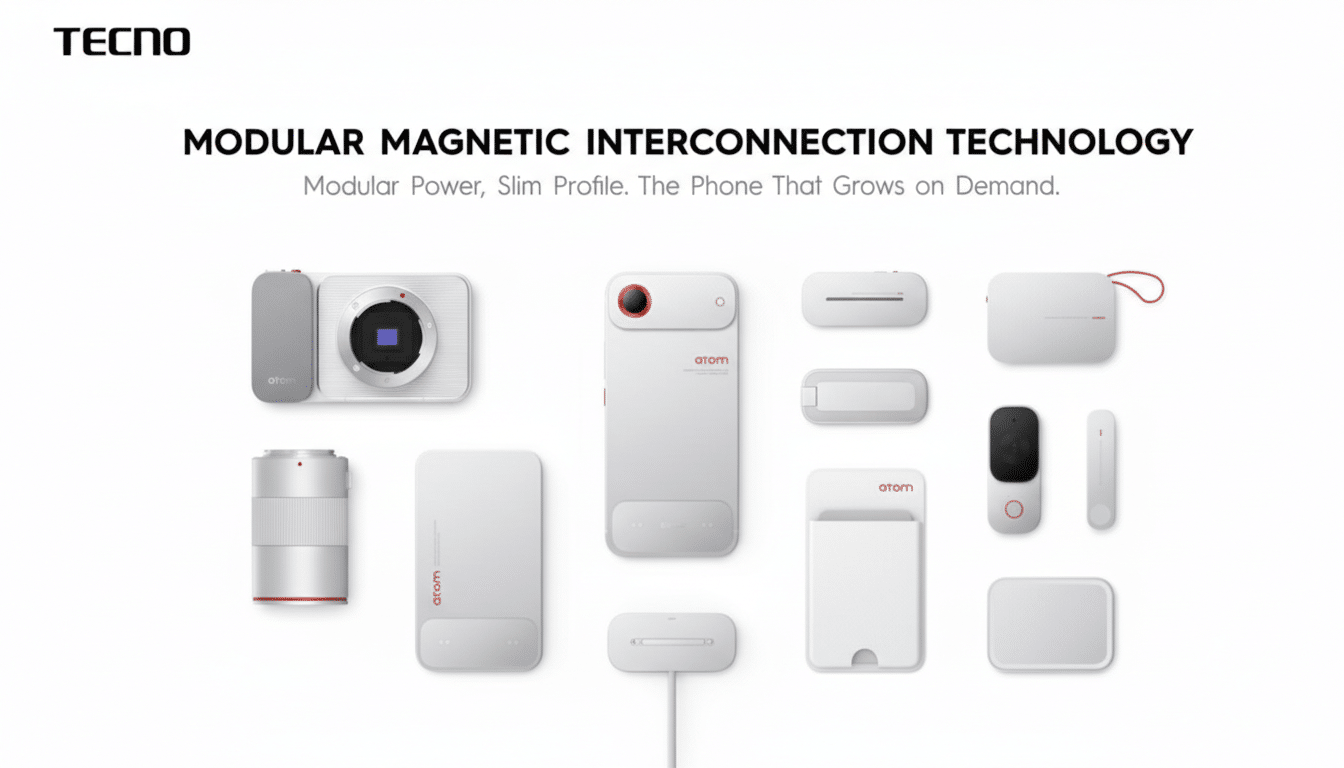
Tecno just turned the idea of a modular phone from a fiddly science project into something playful and immediate. On the show floor at MWC Barcelona, the company demoed a concept handset with what it calls Modular Magnetic Interconnection Technology, letting users snap add-ons onto the phone—and even onto other modules—with a click and instant recognition.
What Tecno Demonstrated at MWC Barcelona
The prototype starts as an ultra-thin, stripped-back device. From there, magnets and a high-speed connector do the heavy lifting. In live demos, a second battery latched on and immediately showed extended capacity, a clip-on speaker began pumping audio, and a camera module handoff was recognized without a reboot. Crucially, you can stack modules on modules—think battery plus speaker, or battery plus upgraded camera—creating an on-the-fly kit tailored for travel, gaming, or shooting.

There’s nothing new about magnets on phones—MagSafe and Qi2 have normalized that—but Tecno’s trick is data and power flowing through a stack, not just power into a single accessory. That stackability makes this feel less like an accessory system and more like a platform.
Why This Modular Approach Matters for Users
Modularity tackles three pain points: battery life, audio, and imaging. Being able to slap on a second cell for a weekend trip is more practical than carrying a power bank and cable. A bolt-on speaker can turn a hotel room into a watch party. And a larger sensor or lens module could give creators serious flexibility without hauling a separate camera.
There’s also a sustainability angle. The UN’s Global E-waste Monitor reports that the world generated about 62 million metric tons of e-waste in 2022, with less than a quarter properly collected and recycled. A viable modular ecosystem could extend the useful life of a core device by letting owners upgrade or replace only what they need. That lines up with policy winds, including the EU’s new battery rules targeting user-replaceability by 2027 and expanding right-to-repair initiatives in multiple regions.
How It Compares With Past Modular Phone Efforts
Phone makers have tried this before. Google’s Project Ara chased a fully swappable architecture but never shipped. LG’s G5 offered a slide-out “Friends” bay and fizzled after one generation. Motorola’s Moto Mods worked well—magnets plus pogo pins and a robust pinout—but the ecosystem stalled when new flagships stopped supporting the backplate standard. Fairphone takes a different, repair-first approach, with internal modules designed for longevity rather than hot-swappable accessories.
Tecno’s concept borrows the best bits: the no-fuss magnetism of Moto Mods, the user-serviceable ethos of Fairphone, and the familiarity of MagSafe-style attachment. The genuinely new twist is stacking. If Tecno can maintain adequate bandwidth and power distribution across multiple layers while keeping modules thin, it could dodge the “cool demo, awkward in real life” trap that hurt earlier efforts.
The Engineering Hurdles No One Can Ignore
Stackable modules are only compelling if they feel invisible in use. That means fast handshakes, secure latching, and minimal bulk. Data and power have to pass through multiple interfaces without bottlenecks. Thermal behavior matters too: add-on batteries and camera blocks can trap heat, and a multi-module sandwich will challenge radio performance unless the antenna design is smart.
Then there’s the economics. Ecosystems live or die by breadth and longevity. Users will expect a catalog beyond batteries and speakers: camera upgrades, pro audio interfaces, gaming grips, maybe a thermal cooler. Third-party support is essential, and that requires a published spec, stable dimensions across generations, and a commitment to keep the connector alive for years. The cautionary tale is clear—Moto Mods drew praise but faded when platform continuity wavered.
What Success Would Look Like for Tecno’s Phone Concept
The playbook is straightforward: guarantee multi-year compatibility, seed developers with reference designs, and anchor the lineup with two or three hero modules that solve everyday problems. If Tecno can promise that a user’s battery pack or camera module will work with the next phone, it instantly makes the investment feel safer. Partnerships with audio brands or imaging specialists could accelerate trust and quality.
Analysts have noted that smartphone upgrade cycles have stretched to three or more years in many markets. A modular path that elongates utility—add a day-long battery now, a better camera next year—could dovetail with that trend and create recurring accessory revenue without churning the core device.
Bottom Line on Tecno’s Magnetically Stackable Phone
Plenty of companies have promised modular phones; Tecno is the first in a while to make it look effortless. The magnet-and-stack demo is more than a party trick—it sketches a product strategy that could appeal to travelers, creators, and anyone tired of carrying bricks and dongles. It’s still a concept, and the hard work lies ahead: standards, durability, RF tuning, and a real ecosystem.
If Tecno follows through with open specs and multi-year support, this could be the rare modular experiment that sticks. If not, it will be another flashy footnote from Barcelona. For now, the hands-on story is simple—and promising: snap, stack, and you’re on your way.
