


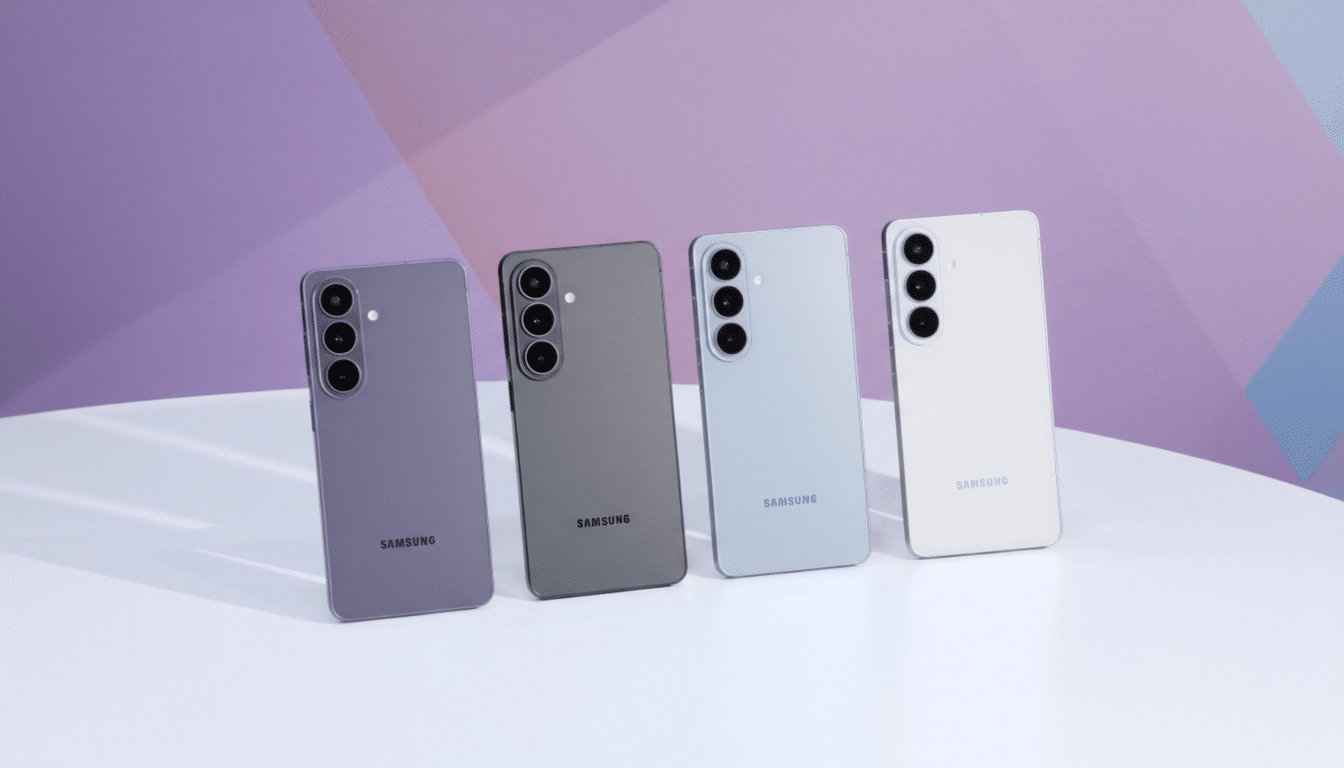
Samsung has confirmed that the Galaxy S26 series will not offer a flicker-reduction or DC-like dimming option, keeping the phones on pulse-width modulation for brightness control. For users sensitive to PWM flicker, that decision could make the new flagships uncomfortable at lower brightness, where flicker effects typically intensify.
Company representatives indicated the S26 lineup’s display behavior is unchanged from recent models and clarified that the new Privacy Display feature, which narrows viewing angles, does not alter the dimming method. Based on prior measurements of Samsung’s OLED panels, the series is expected to maintain a PWM frequency around 480Hz—a figure many sensitive users find challenging compared with newer high-frequency implementations from competitors.
What PWM Dimming Means And Why It Matters
PWM controls screen brightness by rapidly switching pixels on and off. At low brightness, the on–off duty cycle produces deeper amplitude changes and more pronounced flicker. While most people do not consciously perceive this, a subset reports eye strain, headaches, or nausea—especially when using phones in dim environments where PWM effects are strongest.
Standards bodies have long weighed in on flicker risk. The IEEE recommended practice for modulating current in LEDs (IEEE 1789) suggests higher modulation frequencies—well into the kilohertz range—to reduce potential adverse effects. Clinical literature on exact prevalence is limited, but migraine and photophobia are common; the American Migraine Foundation estimates migraines affect roughly 12% of the population, and flicker is a known trigger for some sufferers. For these users, a jump from sub-kilohertz PWM to multi-kilohertz can make a tangible difference in comfort.
S26 Display Behavior Mirrors Recent Samsung Flagships
Independent lab tests on recent Samsung OLED phones have consistently found PWM frequencies near 480Hz at lower brightness. Outlets such as Notebookcheck have documented these values across multiple generations. Samsung’s confirmation that dimming behavior remains unchanged strongly implies similar flicker characteristics on the S26 series.
The addition of a Privacy Display does not modify how brightness is driven. It restricts side-angle visibility to protect on-screen content but leaves the underlying PWM waveform and amplitude behavior intact. In other words, users who struggled with prior Samsung flagships at low brightness levels should expect a comparable experience here.
Rivals Are Raising PWM Frequencies On Flagships
Several manufacturers now market high-frequency PWM as a comfort feature. HONOR popularized ultra-high PWM rates, touting 3,840Hz and even 4,320Hz modes on devices like the HONOR 90 series and Magic6 line. Xiaomi has pushed 1,920Hz on recent flagships, while OnePlus and OPPO devices frequently include DC Dimming or Flicker-Free toggles that reduce PWM reliance at certain brightness ranges.
It’s worth noting that not every premium phone has made the leap. Current iPhone Pro models have been measured around the 480Hz mark as well, illustrating that the market is split: some brands prioritize color stability and brightness control with legacy PWM implementations, while others accept trade-offs to deliver multi-kilohertz flicker profiles or DC-like modes for sensitive users.
What Sensitive Users Can Do To Reduce PWM Discomfort
If you are PWM-sensitive and considering the Galaxy S26, test the phone in person at very low brightness. Pay attention to eye strain within a few minutes of use, especially when viewing high-contrast content in a dim room. Because flicker amplitude typically eases at higher brightness, one workaround is to keep the hardware brightness higher and use Android’s Extra Dim or reduce white point tools to curb perceived luminance, though results vary by individual.
Enabling dark mode, lowering screen contrast, and avoiding stark white backgrounds can also lessen perceived discomfort. Refresh rate settings (such as 120Hz) do not fix PWM flicker, and blue light filters target color temperature rather than modulation, so neither is a direct remedy. For some, phones offering DC Dimming or PWM at 1,920Hz–4,320Hz provide more consistent relief.
Why Samsung’s Approach To Display Dimming Matters
From an engineering perspective, Samsung’s consistency maintains predictable color accuracy and luminance control across scenarios, a priority for display fidelity. However, the lack of a user-facing flicker-reduction option leaves accessibility on the table, especially as competitors increasingly treat high-frequency PWM and DC-like modes as differentiators.
Testing houses, ophthalmology groups, and standards organizations continue to emphasize that higher modulation rates and reduced flicker amplitude are key levers for comfort. Even a settings toggle would give sensitive buyers agency to choose a trade-off profile—slightly different color behavior in exchange for fewer flicker artifacts—when they need it.
Bottom Line For Buyers Concerned About Screen Flicker
With no flicker-reduction setting and an expected ~480Hz PWM frequency, the Galaxy S26 series may not be ideal for users prone to PWM-related eye strain. If display comfort is your top priority, shortlist devices with DC Dimming or multi-kilohertz PWM, and verify comfort with hands-on testing. Samsung’s latest offers powerful hardware and new privacy features, but on the flicker front, it stands pat while rivals push ahead.
