


When you walk into a factory or a big distribution center you are hit with a lot of things happening at the same time. Forklifts are moving fast through the aisles. Horns are going off every time they come to a place where they meet. People are always walking around. However, without proper forklift tracking in place, you are likely missing the massive financial drain hiding in plain sight.
If you stop looking at the motion and start looking closely at the forks, you will uncover a silent leak. A shocking percentage of those vehicles are driving back and forth across your massive concrete footprint completely empty.
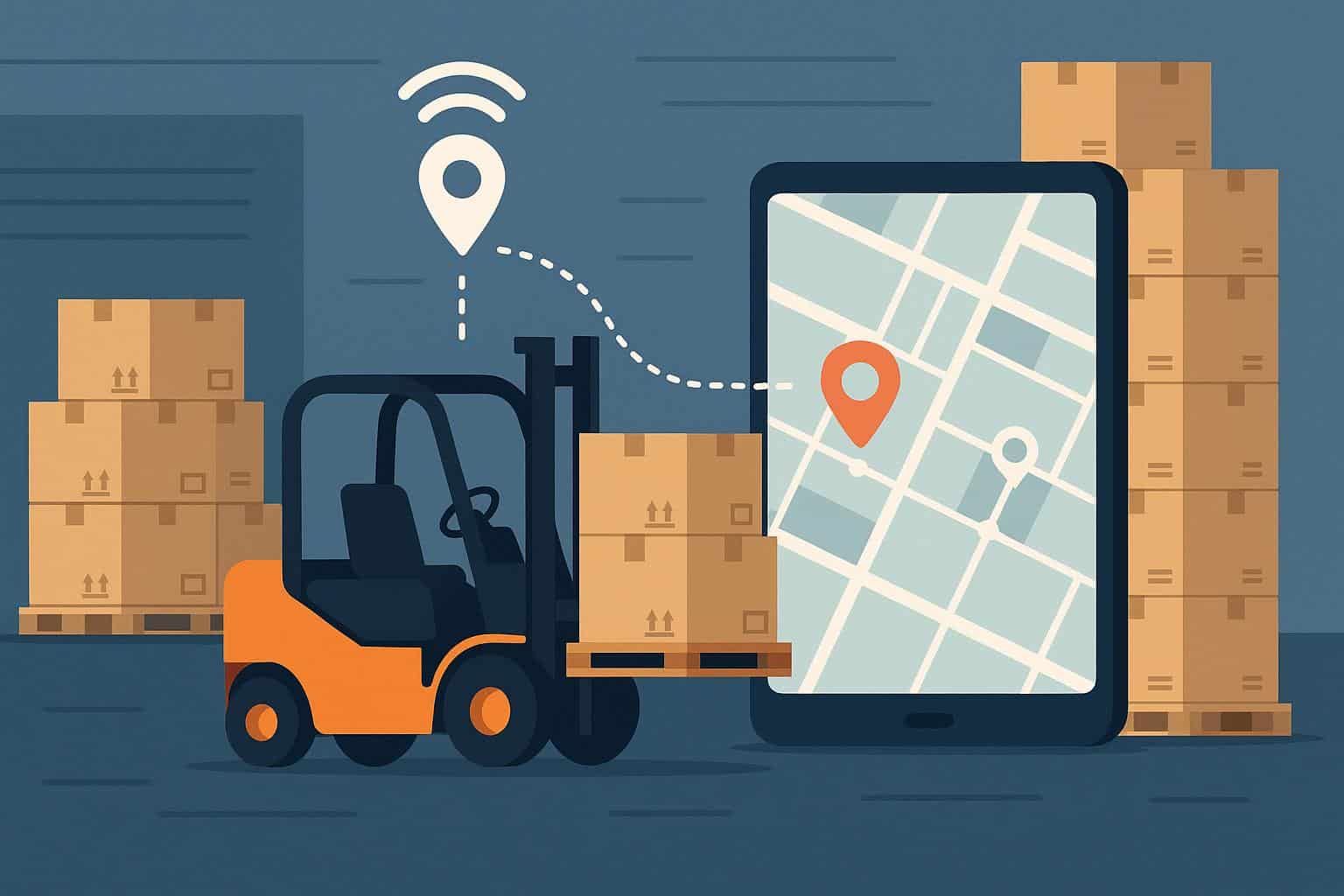
In the logistics industry, this is known as ‘deadheading’ or empty travel. It happens when an operator drops off a pallet at the outbound dock and then drives all the way back across the building to the receiving staging area without picking up a return load. While deadheading feels like a necessary part of the job to the driver, from a financial perspective, it is pure operational waste. It is a hidden leak in your Return on Investment (ROI) that you can easily plug once you actually see it.
How Empty Travels Impact Forklift ROI
The financial drain of deadhead miles compounds incredibly fast. It is not just about the time it takes to drive from point A to point B.
Forklifts Burning Fuel for Zero Return
Every time a forklift travels empty, it is burning expensive battery charge or liquid fuel to move nothing but its own counterweight. You are accumulating hard wear and tear on the tires, mast, and hydraulics, pushing the vehicle closer to its next preventative maintenance bill without generating a single dollar of revenue to offset the cost. Most importantly, you are paying a fully burdened hourly wage to an operator to basically act as an empty taxi cab.
If your facility operates a fleet of fifty forklifts across three shifts, and your operators spend just 30% of their driving time deadheading, the math gets ugly. You are essentially paying for fifteen full-time operators and fifteen expensive machine leases every single day to move absolutely zero freight.
Forklifts Congestion Creating Further Blockers
Beyond the direct fuel and labor costs, empty trucks destroy your floor’s overall throughput by creating artificial congestion.
Down a narrow aisle, a forklift hauling nothing is just as much of a physical roadblock as one carrying a full pallet. When half the drivers in that lane are just ‘deadheading’ back to the start of a run, they aren’t just moving air they are actively choking the flow for everyone else trying to shift high-priority stock. This forces your productive operators to slow down, wait at intersections, and miss their cycle time targets.
Why Traditional Forklifts Telematics is Insufficient
Operations managers often think they have a handle on their fleet efficiency because they review telematics reports provided by their leasing company. They look at the engine hours, see that the fleet is active for 85% of the shift, and assume the operation is running lean. This is why digital twin-powered real-time forklift tracking data is the best bet.
Where Does Traditional Forklift Tracking Data Fail
Standard telematics data is incredibly deceptive. An hour meter only measures mechanical activation. It proves the key was in the ignition and the operator was pressing the pedal. It cannot distinguish between an operator aggressively moving critical cross-dock freight and an operator taking the long, empty scenic route back to the breakroom.
To actually spot the waste, you have to move beyond mechanical data. By accurately tracking forklift activity, you shift the perspective entirely. You stop asking, “How long was the engine running?” and you start asking, “Where was this vehicle, and was it actually doing valuable work?”
How Real-Time Spatial Intelligence Cuts Loss
You cannot fix a routing problem until you can visually prove it exists. This is where deploying modern spatial tracking completely changes the game.
By utilizing sub-meter technology like Ultra-Wideband (UWB), you turn your physical floor into a highly accurate digital twin. The system monitors the exact X,Y coordinates of every single vehicle in real time. When you layer this spatial data with load-sensing technology or tight integration with your Warehouse Management System (WMS), the invisible waste suddenly becomes undeniable.
Visualizing the Spaghetti Diagram
You can instantly generate visual “spaghetti diagrams” that show the exact travel paths of your fleet. You will immediately see the thick red lines of empty travel cutting straight across your facility. You can definitively measure that a specific operator drives three miles a shift loaded, but four miles a shift empty, stripping away all the guesswork.
Real-Time Digital Twin Data Benefits ‘Task Interleaving’
Once your spatial data exposes the exact locations and volume of your deadhead miles, you can start reclaiming that hidden revenue. The ultimate goal is to implement intelligent task interleaving.
Task interleaving is the process of combining tasks to ensure a vehicle is almost always carrying a load. If an operator drives a pallet of finished goods from the end of the manufacturing line to the shipping dock, they should not drive back empty. The system logic should automatically route them to pick up a pallet of raw materials near the shipping dock that needs to go back to the manufacturing zone.
Advantage of Location-Intelligent Routing
Without highly accurate spatial data, task interleaving is incredibly difficult to coordinate because the WMS doesn’t know exactly where the driver is physically located when they finish their drop-off. With sub-meter tracking, the system knows the driver is sitting exactly at Dock Door 12 and instantly pings their tablet with a pickup task sitting just 20 feet away at Dock Door 14.
Need of the Hour: RTLS Digital Twin Tracking
Hardware vendors push tags, and leasing companies push more trucks. But you didn’t get into supply chain leadership to manage bloated equipment leases. You need an intelligence layer that actually enforces operational discipline and translates raw spatial data into automated workflows. We supply the operational insights, not just the hardware. LocaXion delivers the complete execution solution your facility needs to eliminate deadheading, optimize task interleaving, and permanently protect your ROI.

