


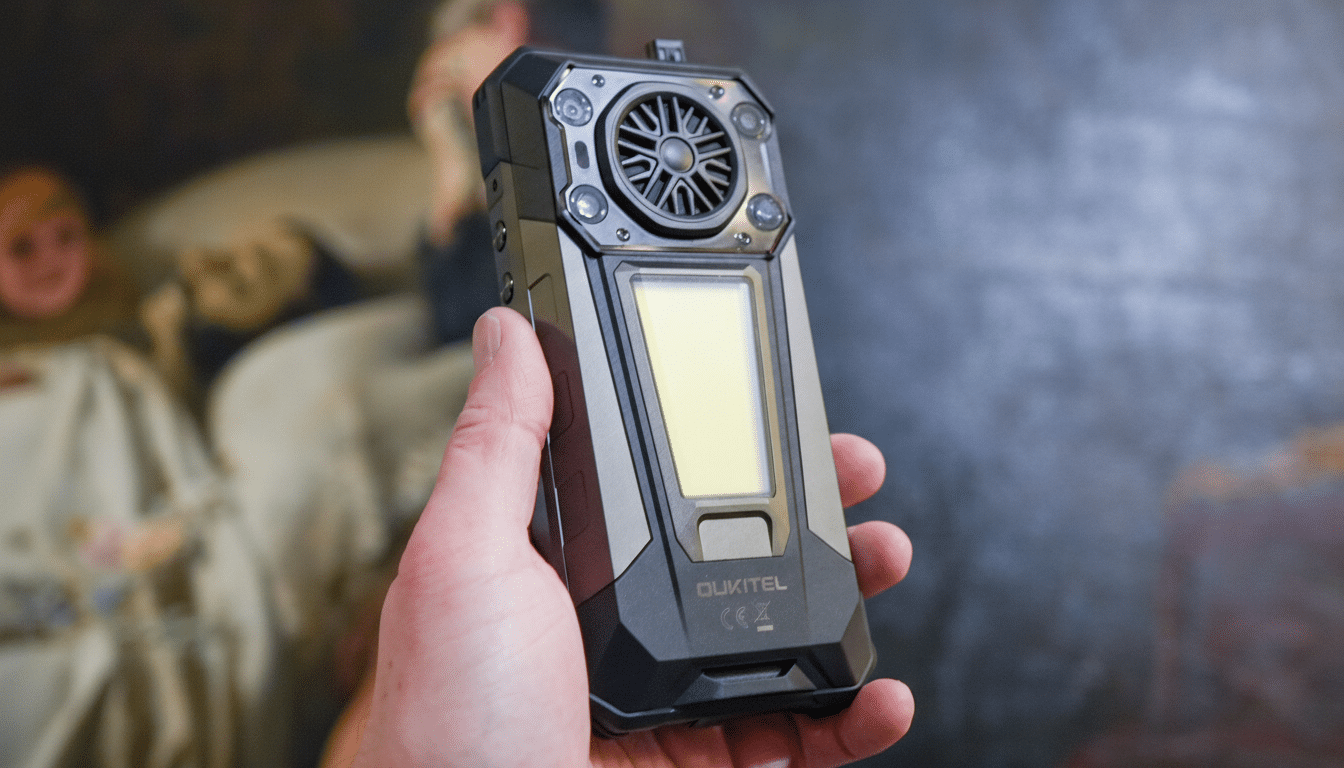
If I had to stock a single handset for the end of the world, I’d pick the Oukitel WP63. It’s unapologetically rugged, weird in all the right ways, and purpose-built for when the grid goes dark. Between a colossal 20,000mAh battery, an integrated ultra-bright camping light, a built-in USB-C cable for charging other gear, and even a software-controlled heating element that can ignite tinder, the WP63 reads like a survival checklist turned into a phone.
A Power Bank That Also Happens To Be A Phone
Battery is the headline here. At 20,000mAh, the WP63 carries roughly 300% more capacity than a typical 5,000mAh smartphone. In practical terms, that means multi-day runtime with headroom for offline maps, messaging, and navigation—without rationing the screen. It also doubles as a power station: the integrated USB-C cable lets you top up earbuds, flashlights, radios, or even nurse a laptop in a pinch, without digging for adapters that always get lost when they matter most.
- A Power Bank That Also Happens To Be A Phone
- Integrated Light And Fire Capabilities On Board
- Built To Be Abused And Keep Working In Harsh Conditions
- Hardware That Favors Field Use And All-Day Endurance
- What It Leaves Out For Preparedness-Minded Buyers
- Context In The Rugged Market And Competing Models
- Verdict Ready For The Worst Situations And Scenarios

That built-in cable is a small but consequential design choice. In emergency planning, fewer separate parts mean fewer failure points—a principle echoed in preparedness guidance from agencies like FEMA. The WP63 embraces that simplicity, turning your phone into a one-piece lifeline you can toss into a go-bag and trust.
Integrated Light And Fire Capabilities On Board
Most phones have an LED flash. The WP63 has a bona fide back-mounted camping light engineered for area illumination—far larger and brighter than a standard camera flash. Whether you’re setting up camp, repairing gear after dark, or signaling in poor visibility, that extra output can be the difference between adequate and effective.
Then there’s the conversation piece: a compact, software-triggered heating element tucked into the chassis. Think of a miniaturized, modern take on a car lighter that can spark tinder or light a camp stove igniter when matches are wet. It’s not a toy—use it responsibly, never near fuel vapor, and avoid activating while charging—but in foul weather or high wind, an onboard ignition source is exactly the kind of redundancy survival instructors advocate.
Built To Be Abused And Keep Working In Harsh Conditions
Durability ratings aren’t marketing fluff on this slab. Oukitel cites IP69 protection—meaning resistance to high-pressure, high-temperature water jets under IEC 60529—and MIL-STD-810H testing, the United States Department of Defense standard for environmental stress, including drops, vibration, and thermal shock. Company reps even claim the phone can survive a 100-foot fall; while that’s a dramatic figure best verified by independent labs, the reinforced corners and chunky bumper design make it feel more like a tool than a gadget.
A quick real-world drop from waist height onto a hard show floor left the device unbothered—no cracked glass, no mystery reboots. That’s the kind of mundane resilience that matters when you’re scrambling over rock, in rain, or with cold hands.
Hardware That Favors Field Use And All-Day Endurance
The WP63 pairs a 6.7-inch display with a 120Hz refresh rate at 720p. On paper, that resolution seems modest, but there’s a sensible trade-off here: lower pixel density helps battery life, and high refresh keeps maps and UI motion smooth when you’re panning, zooming, and switching apps outdoors. Under the hood is a Unisoc T8200-class chipset aimed at dependable, efficient performance rather than benchmark glory—appropriate for navigation, offline media, messaging, and camera tasks that actually keep you safe and oriented.
This is also very much a “bring everything with you” chassis. It’s thick, heavy, and confidence-inspiring in hand, the kind of hardware you don’t baby. You’ll want a sturdy belt clip or pack sleeve; once you accept the weight penalty, the payoff is endurance and capability few phones can match.
What It Leaves Out For Preparedness-Minded Buyers
There’s no satellite messaging here, a feature that’s trickling into higher-end rugged phones and some mainstream flagships. If two-way satellite SOS is mission-critical for you, Oukitel steers that capability to other models, and you may want a dedicated satellite communicator anyway. Also, recharging a 20,000mAh pack from empty takes time—plan around it with a compact solar panel or a high-output power bank when assembling your kit.
Context In The Rugged Market And Competing Models
Rugged smartphones have matured into a steady niche serving field services, logistics, and remote work, a trend tracked by firms like IDC and Counterpoint Research. Competitors have flirted with massive cells—the Ulefone Power Armor 13 hits 13,200mAh and Doogee’s V Max pushes beyond 20,000mAh—but the WP63’s mix of a built-in cable, high-output light, and on-device ignition is unusually focused on real off-grid tasks rather than specs for their own sake.
Verdict Ready For The Worst Situations And Scenarios
If preparedness is your priority, the Oukitel WP63 makes rare sense. It trades polish for purpose, stacking stamina, lighting, charging, and ignition into a single, abuse-tolerant brick that shrugs off the elements. It won’t win thin-and-light awards, and it skips satellite, but as an apocalypse-ready companion you can rely on when conditions get ugly, it’s the phone I’d throw into the pack and never think twice.
