


Nvidia says the inflection point for autonomous driving has finally arrived. Capping a keynote that featured a walking, talking Olaf robot built on Jetson and trained in Omniverse, CEO Jensen Huang framed the company’s latest platform and model stack as the “ChatGPT moment” for vehicles, signaling that end-to-end, promptable autonomy is moving from demos to deployment.
Why Nvidia Says The ChatGPT Moment Has Arrived
Just as large language models made complex tasks accessible through natural instructions, Nvidia’s new driving models aim to let developers guide vehicle behavior with clear prompts and policy constraints. The pitch: faster iteration, richer edge-case learning, and transparent guardrails that can be audited, rather than opaque heuristics buried in code.
- Why Nvidia Says The ChatGPT Moment Has Arrived
- New Foundation Models for Physical AI from Nvidia
- Robotaxis Move From Pilots To Platforms Worldwide
- Edge AI Meets 5G For Real‑World Learning
- Pushing AI Into Orbit With Space-Ready Edge Computing
- A Unified Data Factory For Safety In Autonomy
- What To Watch Next As Promptable Autonomy Scales
The Olaf demo wasn’t about cute banter; it was a proof-of-concept for “physical AI”—systems that perceive, reason, and act in the real world. In this view, cars are robots with specific objectives, and autonomy advances when perception, planning, simulation, and data flywheels are tightly coupled.
New Foundation Models for Physical AI from Nvidia
Nvidia introduced three cornerstone models designed to shrink the sim-to-real gap and boost decision quality:
- Cosmos 3 generates high-fidelity synthetic worlds and scenes so robots and vehicles can practice against rare and messy conditions without risking real-world safety.
- Isaac GR00T N1.7, an open reasoning vision-language-action model for humanoids, generalizes across tasks and tools, with Nvidia saying it is viable for commercial deployment.
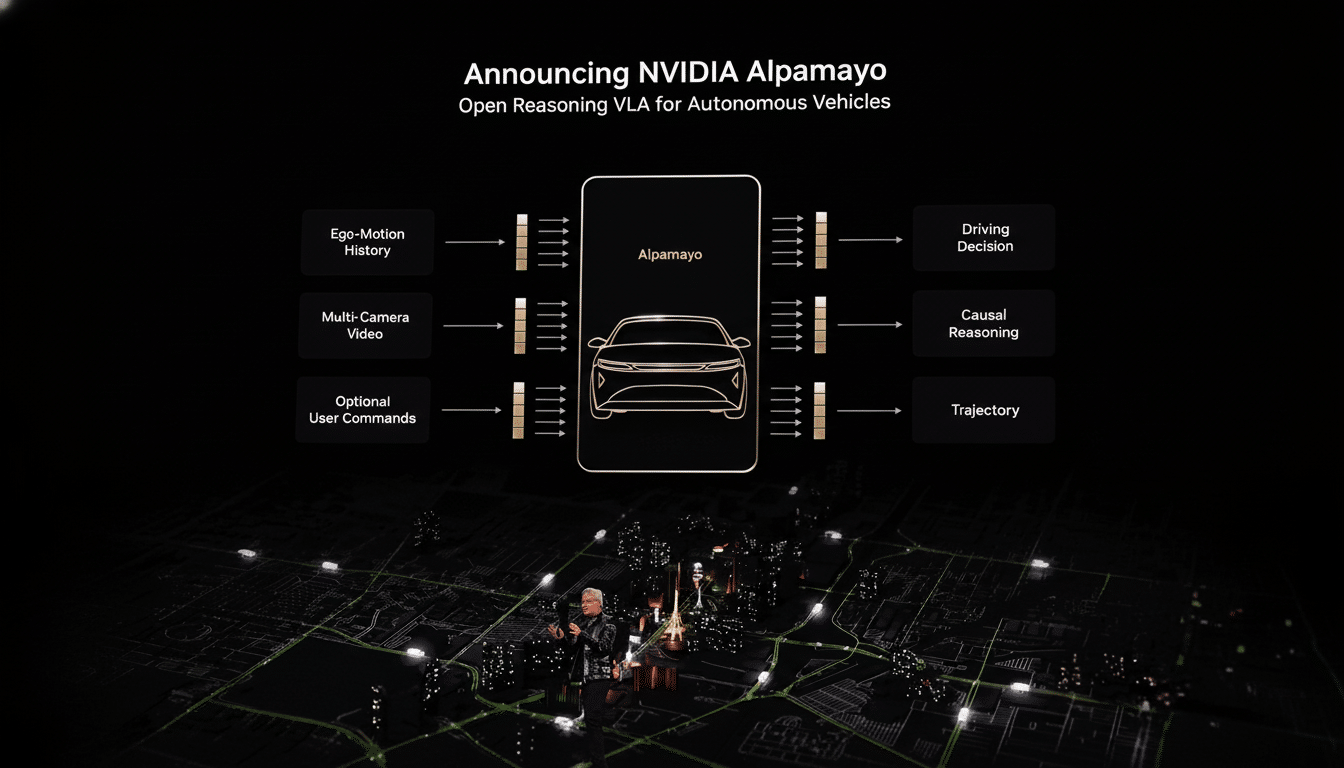
- Alpamayo 1.5, a promptable VLA for autonomous driving, ingests driving video, ego-motion history, navigation guidance, and natural-language prompts to produce explainable trajectories and policy-compliant maneuvers.
The through line is programmability. Instead of hand-tuning every scenario, developers can use prompts to create safety guardrails (“slow for obstructed crosswalks,” “prefer right-lane merges”), then verify how the model translates those instructions into steering, braking, and path planning.
Robotaxis Move From Pilots To Platforms Worldwide
Nvidia is expanding its work with Uber to launch a fleet of autonomous vehicles powered by Drive AV software. The company says the rollout spans 28 cities across four continents, with Los Angeles and San Francisco among the first markets, and is built on the Drive Hyperion hardware stack, Alpamayo open models, and the Halos operating system.
Automakers—including BYD, Hyundai, Nissan, and Geely—are also joining a robotaxi initiative that already counts GM, Mercedes, and Toyota. The focus is training and validating vehicles toward SAE Level 4, where the system handles all driving within defined domains. Crucially, the stack is designed for scale: shared models, shared safety tooling, and consistent telemetry feeding back into training loops.
Edge AI Meets 5G For Real‑World Learning
To keep autonomy learning from stalling when vehicles leave pristine test tracks, Nvidia is partnering with T-Mobile and Nokia on AI‑RAN infrastructure that turns 5G networks into distributed AI computers. The goal is to move perception and inference closer to where data is generated, trimming latency and allowing vehicles and robots to operate across crowded cities and remote zones without saturating backhaul.

Edge deployments also matter for municipalities and utilities. Nvidia says traffic systems, inspection drones, and field robots are already using digital twins and localized AI to optimize timing plans, spot hazards, and accelerate repairs—use cases that benefit from low-latency inference and continual data collection.
Pushing AI Into Orbit With Space-Ready Edge Computing
Nvidia outlined a space computing roadmap that brings AI inference to orbital data centers, geospatial intelligence, and autonomous space operations. Platforms such as IGX Thor and Jetson Orin target power‑efficient processing aboard satellites, while the Vera Rubin initiative is positioned to orchestrate AI workflows between Earth and space. The message is consistent: edge AI doesn’t stop at the edge of the atmosphere.
A Unified Data Factory For Safety In Autonomy
Data is the gating factor for safe autonomy. Nvidia’s Physical AI Data Factory Blueprint is an open reference architecture to automate data generation, augmentation, and evaluation. Built to leverage the Cosmos world models, it synthesizes diverse edge cases—black ice, occluded pedestrians, emergency vehicles behaving unpredictably—and couples them with reinforcement learning, scenario replay, and rigorous validation.
Nvidia says Uber is already using the Blueprint to accelerate autonomous driving development, while Skild AI is applying it to general‑purpose robotics. By standardizing pipelines and quality metrics, the company aims to cut the cost and time of building physical AI that can explain and justify its actions—an area regulators and safety assessors have increasingly emphasized alongside SAE and NHTSA guidance.
What To Watch Next As Promptable Autonomy Scales
If Nvidia’s bet pays off, the big shift won’t just be more capable models—it will be a new development workflow. Promptable driving policies, omnipresent simulation, and edge‑to‑cloud learning loops could let fleets iterate weekly instead of seasonally, and give cities and operators transparent levers to encode local rules and preferences.
The Olaf robot may have stolen the show, but the real story is infrastructure: a vertically integrated stack for physical AI that spans chips, models, networks, data factories, and partners. That breadth is what turns a keynote soundbite into an actual platform—and, potentially, into safer, more reliable autonomy on real streets.
