


A new Android app called Nearby Glasses is stirring debate over “luxury surveillance,” promising to notify you when someone close by is wearing Bluetooth-enabled smart glasses. Built to surface who around you might be outfitted with eyewear capable of recording or live-streaming, the tool taps into a growing public unease about always-on cameras in everyday spaces.
How Nearby Glasses Alerts Work And What They Detect
Nearby Glasses scans the airwaves for Bluetooth Low Energy (BLE) advertising beacons that most modern wearables emit. Each broadcast can include a manufacturer’s unique identifier assigned by the Bluetooth Special Interest Group, allowing the app to flag brands commonly associated with camera-equipped eyewear from companies like Meta, Oakley, or Snap. Users can also add their own manufacturer IDs, expanding detection to other wearables or experimental camera devices.
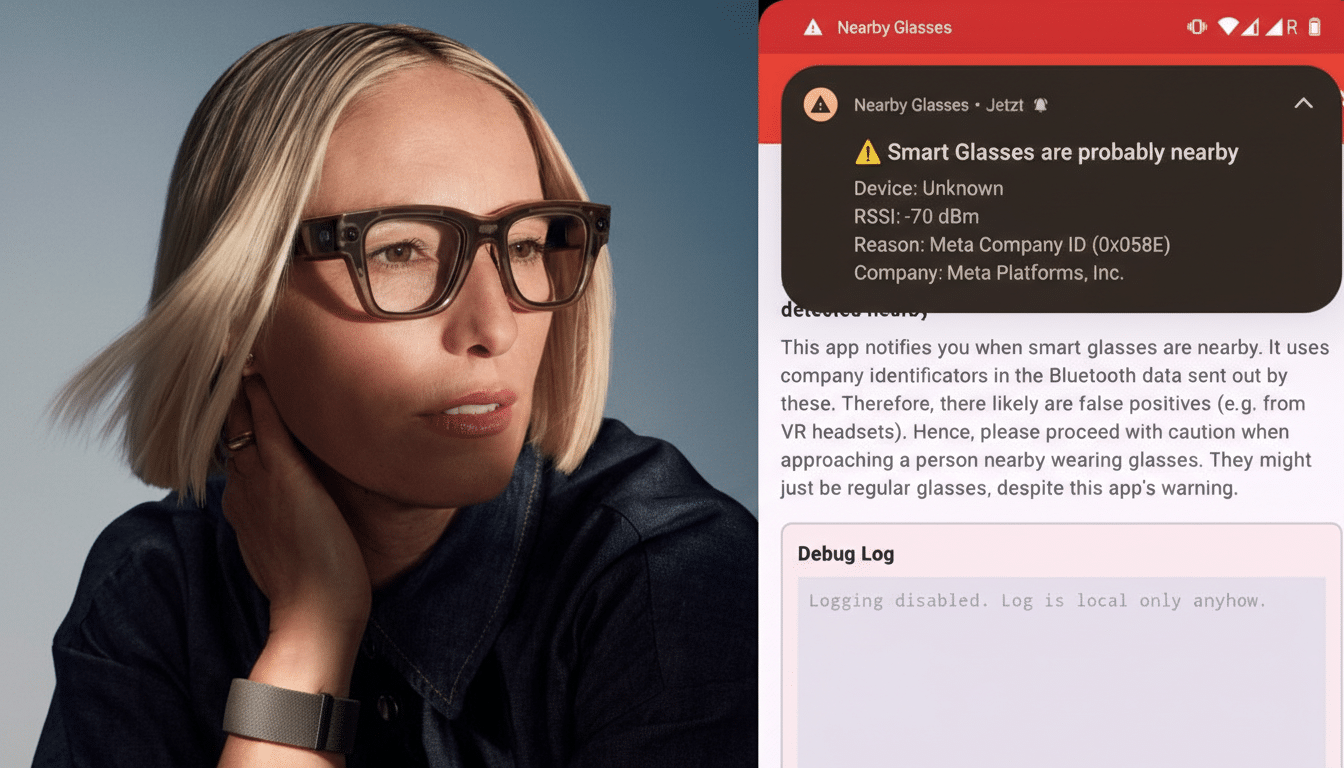
The approach is straightforward but nuanced. BLE broadcasts often persist even when devices rotate or randomize their MAC addresses for privacy, because the manufacturer field still needs to identify the device family for pairing and features. That makes passive detection feasible in crowded settings—transit hubs, stadiums, or cafes—without pairing to anything. It’s essentially a privacy countermeasure that looks for digital “exhaust” the devices already emit.
There are caveats. The same manufacturer ID might span multiple products, so a nearby alert could reflect a VR headset or smartwatch rather than glasses. The developer acknowledges false positives are possible and emphasizes the app can’t tell if a camera is actually recording—only that a device from a specific maker is within range.
Why Bystander Privacy Is Back In The Spotlight
Wearable cameras have a history of backlash. A decade ago, bars and movie theaters banned early head-mounted cameras amid fears of covert filming. Today’s smart glasses are smaller, more stylish, and often indistinguishable from prescription frames, making silent recording far harder to spot. Digital rights groups like the Electronic Frontier Foundation and the ACLU have warned that bystanders rarely have meaningful notice or a chance to opt out, even in sensitive contexts such as clinics, schools, or places of worship.
Regulators are paying attention. Europe’s Irish Data Protection Commission previously pressed a major smart-glasses maker to prove that its recording indicator light was prominent enough to inform people nearby. Consumer advocates have also questioned whether a tiny LED—often easy to obscure—is sufficient for consent in public and semi-public spaces.
Journalistic investigations have documented real-world misuse, from law enforcement deployments to harassment, bolstering calls for stronger safeguards. Against that backdrop, Nearby Glasses positions itself as a practical tool for people who want situational awareness without confronting every passerby wearing opaque frames.
Adoption Trends And The Scale Of The Challenge
Even modest growth in camera-equipped eyewear can have an outsized visibility problem because Bluetooth devices are nearly ubiquitous. The Bluetooth SIG’s market updates estimate billions of Bluetooth devices ship annually worldwide, saturating public spaces with wireless chatter. While only a sliver of those are smart glasses, the category is being actively pushed by major platforms integrating voice assistants, livestreaming, and multimodal AI features—capabilities that heighten bystander concerns.

Venue policies are evolving in parallel. Casinos, concert halls, gyms, and testing centers frequently prohibit recording wearables outright; some workplaces now include smart-glass bans in bring-your-own-device policies. The app’s developer says interest is coming from people navigating exactly these gray areas, where social norms are shifting faster than formal rules.
Limits You Should Know Before Relying On It
Nearby Glasses is currently Android-only. That matters: iOS limits background scanning and app access to Bluetooth metadata, which could restrict a comparable iPhone app’s functionality. Even on Android, results depend on device makers not suppressing or encrypting the relevant advertising fields, and on the glasses actually broadcasting while worn. Some models reduce broadcasts when idle or not actively paired.
Signal strength can hint at proximity but not direction, and urban environments can generate a flurry of alerts. Adding broad manufacturer IDs may flood your screen with notifications for unrelated devices, which is why the app encourages selective filters. Critically, the app cannot detect non-Bluetooth cameras or hidden analog devices; it’s a transparency aid, not a surveillance detector in the traditional sense.
What Companies And Policymakers Might Do Next
Device makers typically point to on-frame LEDs, audible cues, and companion app prompts as sufficient notice. Privacy advocates argue for stronger measures: unmistakable recording indicators, hardwired lights that can’t be disabled in software, and platform-level policies limiting bystander capture. Some researchers have floated a standardized “camera-in-use” beacon—akin to airplane ADS-B—for all wearable sensors, enabling both consumer awareness apps and venue infrastructure to respond in real time.
Standards bodies could play a role. A Bluetooth profile signaling camera state, vetted by the Bluetooth SIG and adopted across manufacturers, would let third-party tools distinguish passive wearables from active recorders, reducing false positives. Regulators could also require demonstrable bystander notice and consent for certain contexts, building on guidance from European data protection authorities and national consumer agencies.
The Bigger Picture On Wearable Cameras And Privacy
Nearby Glasses is less a silver bullet than a barometer of public sentiment. As AI-enhanced eyewear spreads, the default invisibility of sensors is colliding with long-standing social norms about consent. A simple alert—someone near you may be wearing camera-ready glasses—hands some control back to bystanders. Whether the next step is smarter standards, better design, or new rules, the message is clear: seeing the sensors is the first step to deciding how to live with them.
