


NASA’s first full-scale planetary defense test didn’t just jostle a moonlet. A new peer-reviewed analysis shows the Double Asteroid Redirection Test, or DART, nudged the entire Didymos–Dimorphos system in its orbit around the sun—evidence that a kinetic impact can measurably steer a natural object in space.
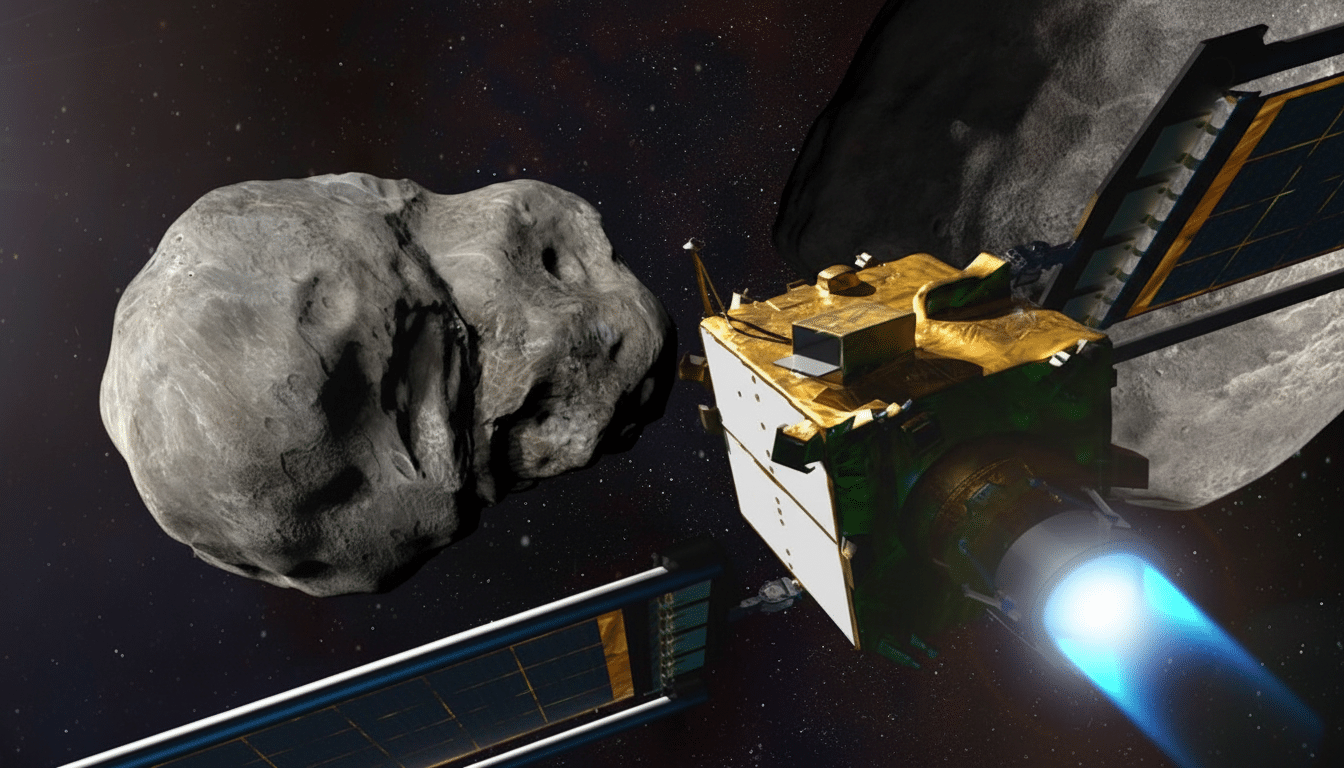
The $330 million spacecraft slammed into Dimorphos, a roughly 170-meter-wide satellite of the larger asteroid Didymos, in September 2022. Astronomers quickly confirmed the moonlet’s orbital period around Didymos shortened by 33 minutes, a headline achievement. Now, researchers report the system’s heliocentric motion was also altered—a more subtle but strategically vital outcome for future deflection campaigns.
A Nudge That Moved Two Worlds in Their Solar Orbit
The new measurements, published in Science Advances, indicate the impact changed the binary system’s speed along its solar orbit by under two inches an hour. That is minuscule on human timescales, but over months to years, such tweaks compound into meaningful trajectory shifts—exactly what planetary defenders want if given sufficient warning.
Critically, the push to the whole system wasn’t delivered by the spacecraft alone. Ejecta blasted off Dimorphos during the collision escaped the pair entirely, carrying momentum with it and giving Didymos–Dimorphos an extra kick. Analyses suggest this debris roughly doubled the net impulse beyond what the spacecraft’s mass and closing speed could supply by themselves, underscoring the leverage of striking a loosely bound target.
The physics help explain why the system-wide change is small. Didymos, likely the denser body, outweighs Dimorphos by an estimated factor of about 200. Redirecting the pair’s solar path therefore demands far more momentum than altering the moonlet’s local dance around its primary—precisely what DART demonstrated in two complementary ways.
How Scientists Measured The Tiny Shift in Speed
Detecting a speed change of mere centimeters per hour requires patience and precision. Teams used planetary radar, optical telescopes, and a series of stellar occultations—brief instances when the asteroid passes in front of a distant star—to refine the asteroids’ positions over years. By comparing post-impact observations to pre-impact orbital solutions, researchers teased out the faint signature of a heliocentric nudge.
Occultation timings are especially powerful for small bodies like Didymos (roughly 780 meters across), letting astronomers pin down location and silhouette with kilometer-level accuracy from Earth. Combined with radar ranging and light-curve studies, the technique builds a cohesive picture of how the system moved before and after the strike.
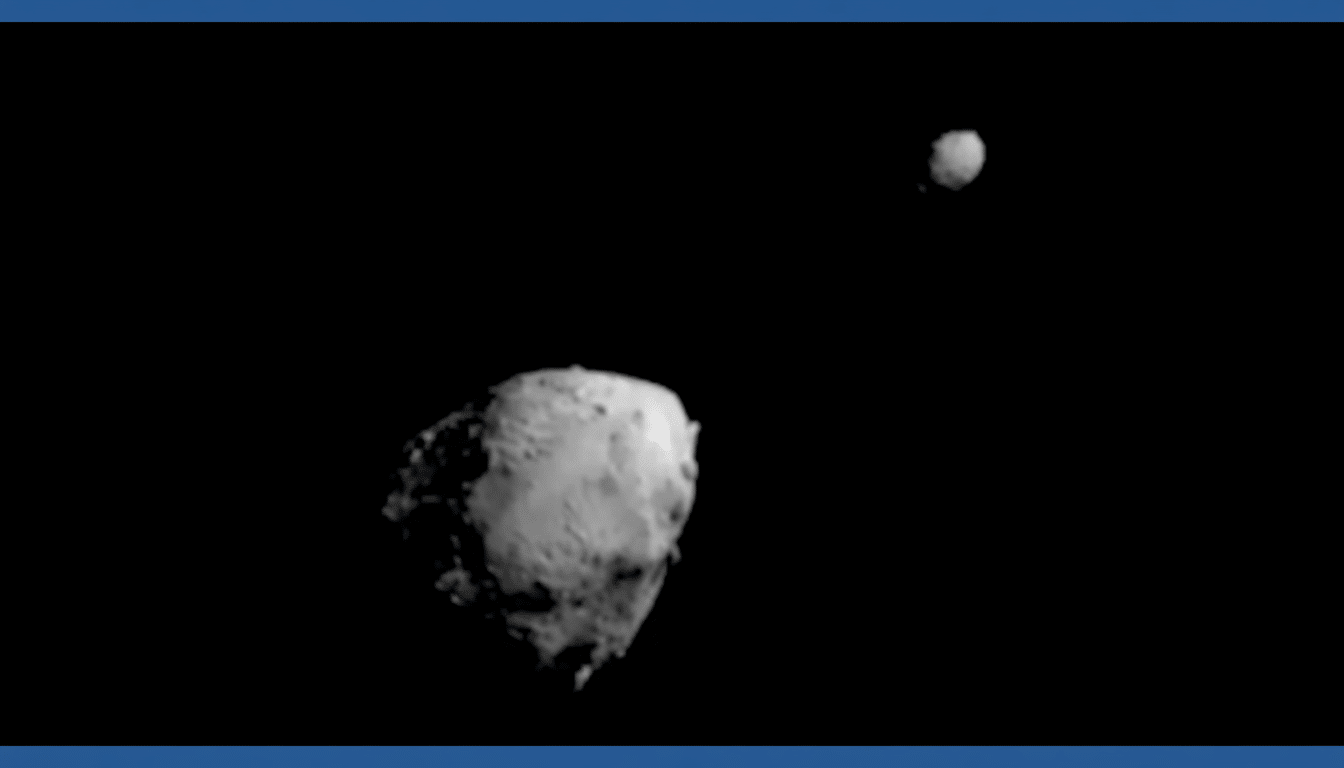
The data also sharpen our understanding of asteroid internal structure. Independent studies indicate Dimorphos is a low-density, rubble-pile object, while Didymos appears more compact. That contrast fits with the leading formation scenario: Dimorphos likely coalesced from material shed by its larger partner long ago, making it particularly susceptible to momentum multiplication from escaping ejecta.
Why This Matters For Planetary Defense Planning
There is no known asteroid on course to hit Earth, but history shows that even relatively small impactors can be destructive. In 2013, a 20-meter object exploded over Chelyabinsk, Russia, producing a shockwave that injured about 1,600 people. Deflection is a game of early action: a tiny course change years in advance can translate to a planet-saving miss distance.
DART’s outcome validates the kinetic-impactor playbook championed by NASA’s Planetary Defense Coordination Office and collaborators at Johns Hopkins Applied Physics Laboratory, which led spacecraft development. It complements ongoing discovery work: NASA reports that roughly 95% of the largest near-Earth asteroids (1 kilometer and up) have been found, and its upcoming NEO Surveyor infrared mission is designed to accelerate the hunt for smaller, city-killer–class objects toward the congressional goal of cataloging 90% of those 140 meters and larger.
Equally important, the mission delivered real-world engineering and operations lessons: targeting a dim, moving object millions of kilometers away; autonomously guiding to impact; and coordinating global observatories to capture before-and-after states. Those playbooks will be reused if a threat is ever identified.
Next Up: ESA’s Hera For Close-Up Inspection
The story now moves from telescopes to up-close forensics. The European Space Agency’s Hera spacecraft is en route to perform a detailed survey of both asteroids, map the DART crater, weigh Dimorphos, and probe its interior with companion CubeSats. Those measurements will anchor models of momentum transfer, help calibrate the ejecta’s contribution, and refine how many spacecraft—and what kind of impact energy—would be required in future scenarios.
For now, the bottom line is both simple and profound: a car-size spacecraft, guided by precise navigation and a lot of math, changed the motion of a natural celestial object. The Didymos–Dimorphos system remains safely far from Earth, but the DART experiment has given humanity something new—evidence that if we see a hazardous asteroid coming with enough lead time, we can do something about it.

