


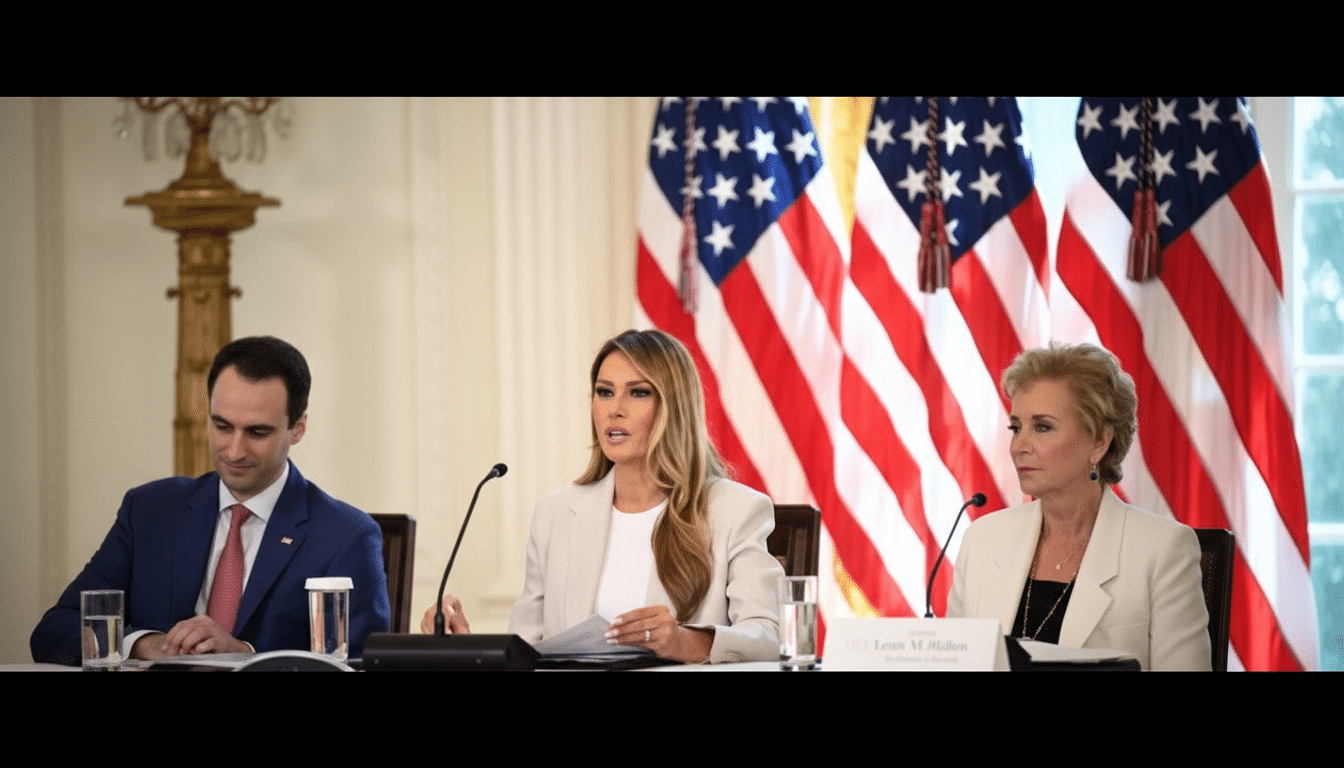
First Lady Melania Trump is pushing an audacious idea for American education: a humanoid robot in the home as a full-time tutor. At a White House summit on educational technology, she appeared alongside a lifelike machine built by Figure AI and sketched a future in which an always-on “humanoid educator” named Plato delivers personalized lessons across subjects without ever losing patience.
A Showpiece Robot and a Bold Pitch for Education
The rollout blended spectacle and policy. The sleek robot briefly addressed attendees before exiting, underscoring the First Lady’s message that advanced AI and robotics could deliver high-quality instruction to any living room. The event, part of her Fostering the Future Together initiative, convened global education and tech figures and coincided with the administration’s separate tech advisory push featuring high-profile Silicon Valley executives.
- A Showpiece Robot and a Bold Pitch for Education
- What the Vision Promises for AI Robot Tutors
- Where Edtech Actually Stands in U.S. Classrooms
- Robotics Reality Check for Home Tutor Deployment
- Privacy, Safety, and Equity Questions for Robot Tutors
- The Politics of a Robot Teacher in Public Education
- What to Watch Next as Robot Teaching Pilots Emerge

Trump framed the concept as universal access to the classics and STEM alike, tailored to each learner. The pitch leaned on familiar edtech promises—individual pacing, mastery learning, rich feedback loops—now wrapped in a humanoid form factor that could, in theory, interact like a tireless, endlessly adaptable teacher.
What the Vision Promises for AI Robot Tutors
In this scenario, Plato would synthesize the latest large language models with speech, vision, and motion, turning curricular content into interactive dialogue, hands-on demonstrations, and real-time assessment. The First Lady argued that consistent, personalized coaching could strengthen critical thinking and close opportunity gaps for students who lack access to high-quality instruction.
The administration has also praised private experiments such as Alpha School, a network piloting AI-driven, self-paced curricula. Education Secretary Linda McMahon has highlighted these models as pathways to job-ready skills, signaling a policy appetite for more private-sector involvement in K–12 innovation.
Where Edtech Actually Stands in U.S. Classrooms
Today’s classroom AI is powerful but far from a humanoid home teacher. Schools are testing AI tutors from organizations like Khan Academy and Carnegie Learning, while districts explore automated feedback and lesson planning to reduce teacher workload. Early pilots show promise in areas like writing support and math practice, but outcomes vary widely across contexts and student groups.
Global bodies urge caution. UNESCO’s guidance on generative AI in education recommends human oversight, strong data governance, and age-appropriate use. The OECD has warned that technology alone does not improve learning and can exacerbate inequities without careful design and support. In the U.S., research summarized by the Annenberg Institute at Brown finds that high-dosage human tutoring remains one of the few consistently high-impact interventions.
Robotics Reality Check for Home Tutor Deployment
Humanoid robotics is advancing—Figure AI, Sanctuary AI, and others have shown dexterous prototypes and industrial pilots—but reliability, safety, battery life, and cost are significant hurdles for home deployment. Even state-of-the-art systems struggle with open-ended environments, unpredictable user behavior, and the need for fail-safe operation around children.
Education requires more than fluent conversation. A robot teacher would need robust cultural competence, developmental sensitivity, and a deep understanding of pedagogy. It would also have to handle the messy reality of learning: distraction, frustration, and social-emotional support. These are challenges current models only partially address.
Privacy, Safety, and Equity Questions for Robot Tutors
Turning the home into a classroom managed by an AI robot raises complex legal and ethical issues. Student data falls under frameworks like FERPA and COPPA in the U.S., which limit how children’s information can be collected, used, and shared. Continuous audio and video capture for tutoring could create expansive datasets with sensitive biometric and behavioral traces.
Safety standards would be essential. UL 3300 provides a baseline for service robot safety, and NIST’s AI Risk Management Framework offers guidance on model oversight and incident response. Translating those into defensible, child-centered guardrails—covering content moderation, hallucinations, physical interaction, and parental controls—would be a prerequisite for any real-world pilots.
Equity also looms large. Access to reliable broadband, quiet space, and caregiver support remains uneven. If robot tutors require costly hardware and subscriptions, early benefits could accrue to affluent families, widening gaps the initiative aims to close.
The Politics of a Robot Teacher in Public Education
The First Lady’s showcase signals a broader policy stance favoring market-driven edtech. Supporters see a chance to leapfrog outdated systems and personalize learning at scale. Skeptics—teachers’ groups and many district leaders among them—argue that sidelining educators risks eroding professional judgment and the social fabric of schooling, where peer interaction and mentorship matter as much as content.
There is room for middle ground. Districts already use AI to extend teacher capacity through targeted practice, instant feedback, and data diagnostics. A pragmatic path would test AI tutors as complements—especially for homework help and after-school support—while keeping certified educators at the center.
What to Watch Next as Robot Teaching Pilots Emerge
Key signals include whether the White House backs pilot funding tied to clear guardrails, how companies like Figure AI define education-grade safety and reliability metrics, and whether independent evaluations—by groups such as RAND or MDRC—are baked into early trials. Procurement standards that mandate transparency, bias testing, and opt-out rights would indicate serious intent beyond the photo op.
The idea of a robot homeschooling your child is no longer pure science fiction. But moving from stage demo to trusted teacher will require more than a charismatic prototype. It will take rigorous evidence, robust safeguards, and a commitment to supporting human educators rather than replacing them.

