


Venture capitalists are drawing a sharper line around what they will not fund in AI software. After two years of frenzied dealmaking, leading investors say the bar has moved beyond flashy demos and thin UI layers toward products with deep workflow ownership, proprietary data advantages, and durable unit economics. In short, anything that looks easy to copy or automate away is falling off the term sheet.
The shift is a product of both abundance and maturity. With open models and tooling lowering the cost of building, differentiation now rests less on access to models and more on product depth and distribution. CB Insights estimated that generative AI startups raised more than $20B in 2023, while Gartner has projected widespread enterprise adoption of genAI by mid-decade. That scale brings scrutiny: investors have seen what sticks and what stalls.
- The End of Thin AI Wrappers for Superficial Workflows
- Horizontal Tools Without Data Moats Falter
- AI Software Pricing Models Face a Pragmatic Reality Check
- Integrations Cease to Be a Moat as Protocols Commoditize
- What Still Wins Investor Conviction in AI-First Software
- The Playbook for AI Founders Building Durable Moats Now
The End of Thin AI Wrappers for Superficial Workflows
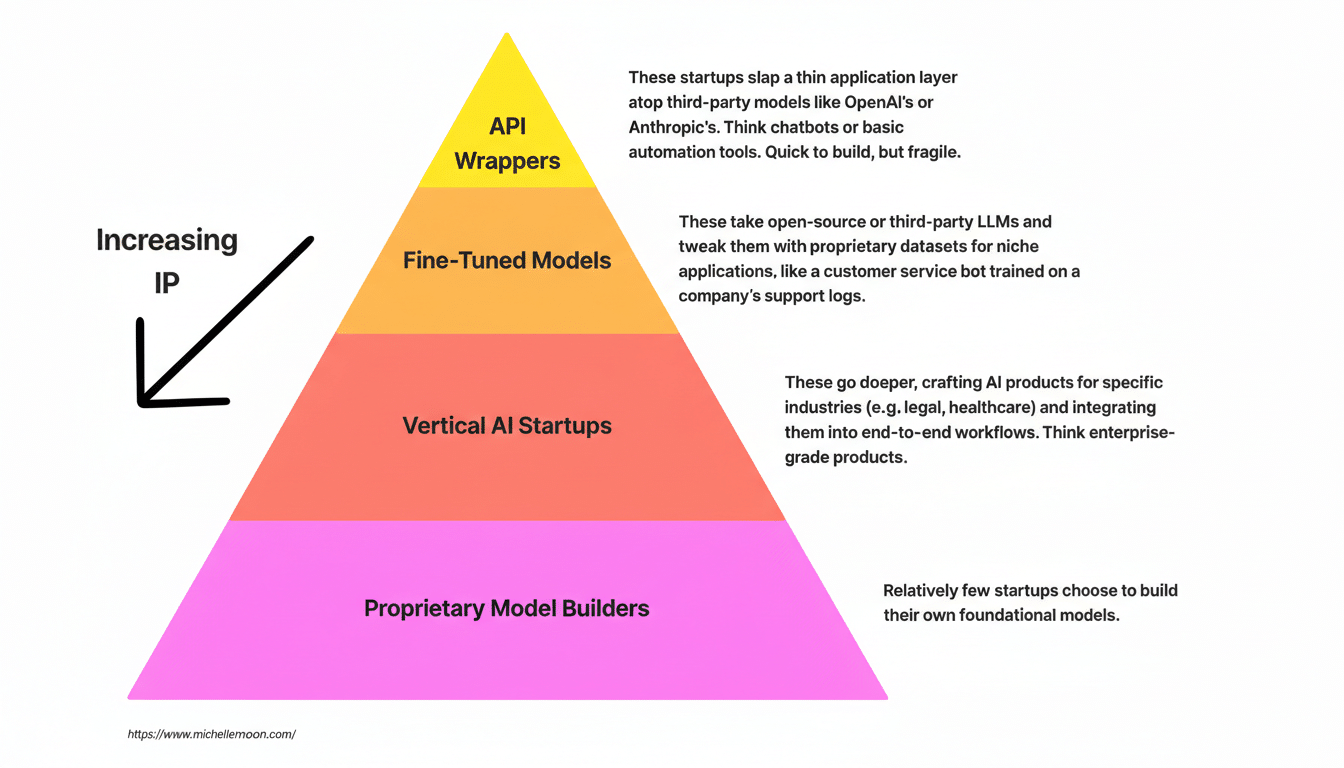
“Thin” workflow layers that sit atop foundation models—basic copilots, surface-level analytics, light project management, and generic productivity add-ons—are no longer resonating. As investors like Aaron Holiday of 645 Ventures have noted, if a task can be executed by a general-purpose agent with minimal context, it does not constitute a moat. UI polish and light automation are table stakes; they are not, by themselves, a business.
Igor Ryabenky of AltaIR Capital has pointed out that massive codebases do not equal defensibility either. The cost of replication has dropped; speed, focus, and adaptability matter more than lines of code. That reality has pushed “cloneware”—basic CRM and project-management lookalikes, or AI wrappers around public APIs—out of favor because strong AI-native teams can rebuild them quickly.
Horizontal Tools Without Data Moats Falter
Abdul Abdirahman at F-Prime underscores a common filter: horizontal software without proprietary data or embedded process knowledge is a tough sell. Investors now expect privileged access to unique datasets, data rights, or in-product loops that accumulate differentiated context over time. Think clinical coding tools trained with consenting health-system data, or industrial maintenance platforms fed by exclusive sensor telemetry and failure logs.
Ownership of the “job to be done” also matters. Jake Saper at Emergence has argued that the market is bifurcating between products that control the developer or operator’s workflow and agents that directly execute tasks. As agentic systems handle more of the execution, products reliant on human stickiness alone face headwinds—unless they embed themselves so deeply into mission-critical processes that switching becomes risky.
AI Software Pricing Models Face a Pragmatic Reality Check
Rigid per-seat pricing looks increasingly brittle for AI-heavy apps, where usage and inference costs can swing widely. Many investors favor consumption-based models that align price with delivered value and allow customers to start small before scaling. This is not just fashion: Bessemer’s research has shown that usage-based software companies tend to post higher net dollar retention than their seat-based peers when product value maps cleanly to usage.

Margin math is under the microscope. a16z and other firms have warned that inference “taxes” can compress gross margins for application-layer startups. Teams that can manage model choice, cache intelligently, and route workloads to cheaper providers without quality loss will fare better. Clear payback periods and disciplined LTV/CAC, not just top-line growth, are back in vogue.
Integrations Cease to Be a Moat as Protocols Commoditize
Being the “connector” is rapidly commoditizing. With Anthropic’s Model Context Protocol, OpenAI’s Assistants API, and popular orchestration frameworks reducing integration friction, stitching models to databases, SaaS tools, and internal systems is simpler than ever. What once differentiated a startup—dozens of native integrations—now looks like a utility.
This has knock-on effects for categories like workflow automation and task coordination built for human handoffs. As agents learn to plan and execute multi-step processes, coordination layers that only shuttle tasks between people lose strategic value. Investors are asking whether a product orchestrates outcomes end-to-end—or merely rearranges work.
What Still Wins Investor Conviction in AI-First Software
Capital is rotating toward AI-native infrastructure, vertical SaaS with proprietary data, systems of action that complete tasks inside systems of record, and platforms embedded in regulated or high-stakes workflows. Examples include safety and governance layers, vector and retrieval infrastructure tuned to domain-specific semantics, evaluation and observability tooling, and applications deployed inside a customer’s VPC with robust audit trails.
Depth and measurable ROI are nonnegotiable. McKinsey has estimated multi-trillion-dollar productivity gains from genAI, but investors now want that value localized: fewer tickets, faster claim cycles, higher conversion, lower unit costs. Gartner’s enterprise adoption forecasts add confidence, yet the winners will be those that convert adoption into durable habits inside daily workflows—and defend them with data, distribution, and compliance advantages.
The Playbook for AI Founders Building Durable Moats Now
- Secure advantaged data. Structure partnerships and in-product loops that lawfully accumulate proprietary context, and prove that more usage makes the model and outcomes better.
- Own the outcome. Build where you can complete the job inside systems of record, not just suggest the next click. Instrument value with time-to-value, error-rate reduction, and dollar impact that finance leaders can verify.
- Design for resilience. Architect for model swap, inference cost control, and policy compliance; adopt usage-aligned pricing; and avoid “integration moats” that open protocols can erase overnight.
The takeaway is blunt: the easy money for thin AI SaaS has dried up. Investors are writing checks for depth—data moats, workflow ownership, and products that deliver outcomes, not demos.
