


Intravenous vitamin C (IVC), most commonly administered as sodium ascorbate, has been extensively investigated for its biochemical and physiological effects in conditions characterized by oxidative stress, inflammation, and immune dysregulation. Unlike oral supplementation, intravenous administration bypasses intestinal absorption limits, enabling transient plasma concentrations that are not achievable through dietary intake alone. This distinction has prompted growing scientific interest in IVC as a research topic across oncology, critical care, metabolic disease, and immune health (1).
Importantly, this article presents an evidence-based overview of the current scientific literature and does not propose clinical use or therapeutic recommendations.
- Pharmacokinetics and Bioavailability of Intravenous Vitamin C
- Redox Biology and Mechanistic Insights
- Pro-oxidant Effects and Cellular Selectivity
- Immune and Inflammatory Modulation
- Intravenous Vitamin C in Critical Illness and Sepsis Research
- Oncology-Focused Research on Intravenous Vitamin C
- Cardiovascular and Endothelial Considerations
- Neurological and Neurodegenerative Research Context
- Metabolic Health and Inflammatory Disorders
- Safety Considerations in Research Settings
- Summary
- Disclaimer
- References
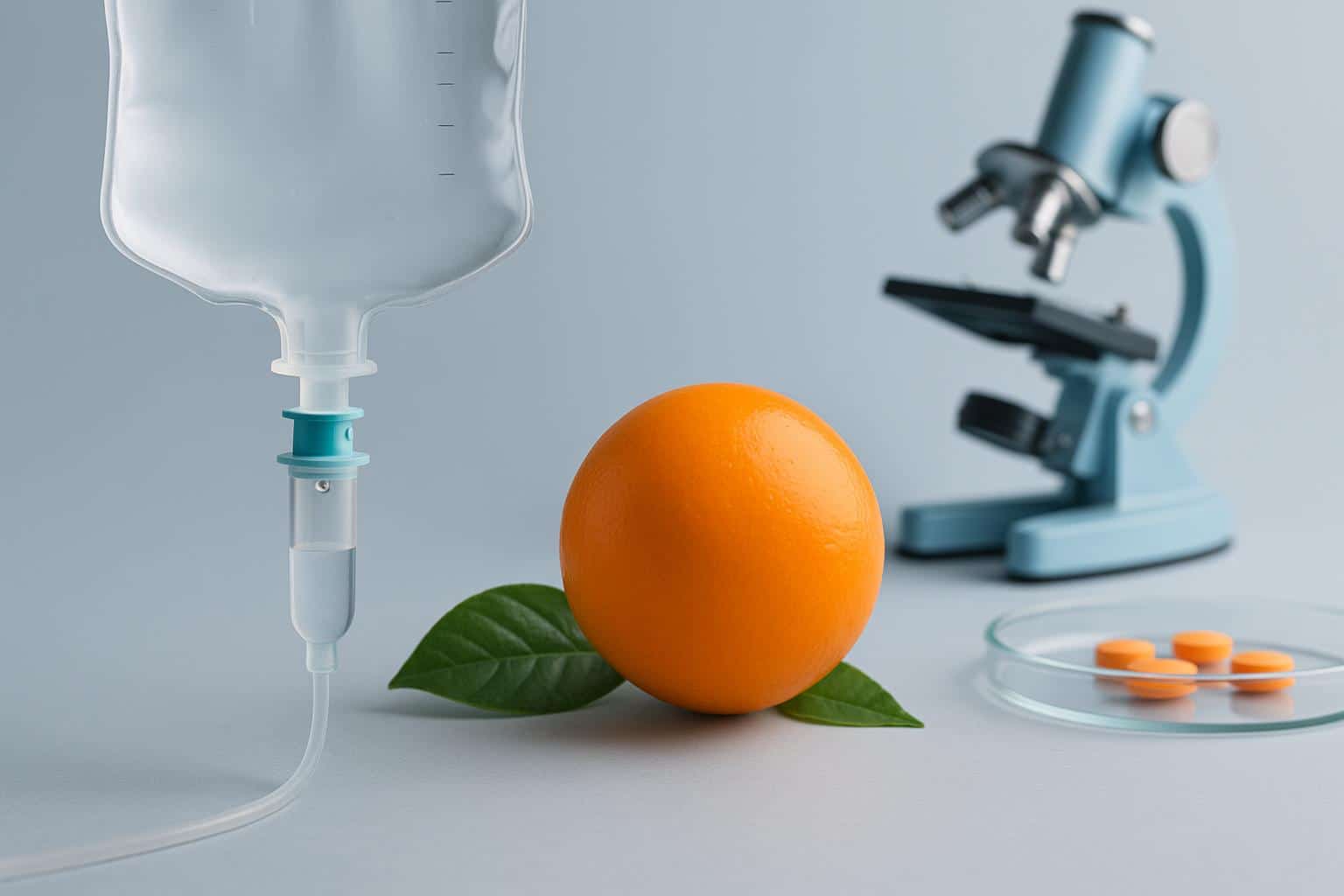
Pharmacokinetics and Bioavailability of Intravenous Vitamin C
Vitamin C absorption following oral intake is tightly regulated by sodium-dependent vitamin C transporters (SVCT1 and SVCT2) in the intestinal epithelium. Studies demonstrate that doses exceeding approximately 200–400 mg per day result in diminishing absorption efficiency, with excess vitamin C rapidly excreted in urine (6,7).
In contrast, intravenous administration bypasses gastrointestinal transport limitations and produces plasma concentrations 30–70 times higher than oral dosing. Pharmacokinetic studies have shown that plasma levels exceeding 10–20 mM can be achieved transiently following high-dose intravenous infusion, a concentration range associated with distinct biochemical effects (7).
This pharmacological distinction underpins much of the contemporary research interest in IVC.
Redox Biology and Mechanistic Insights
At physiological concentrations, vitamin C functions primarily as an antioxidant, scavenging reactive oxygen species (ROS) and protecting cellular structures from oxidative damage. However, at pharmacologic plasma levels achievable only through intravenous delivery, vitamin C may exert context-dependent pro-oxidant effects, particularly in extracellular environments (6).
From a mechanistic standpoint, several biochemical research overviews have examined how supraphysiological ascorbate concentrations influence extracellular hydrogen peroxide generation, immune cell signaling, and endothelial stability. One such biochemical research overview discusses these interactions strictly within experimental and translational research contexts, without proposing clinical protocols or medical recommendations.
Pro-oxidant Effects and Cellular Selectivity
High plasma ascorbate concentrations can generate hydrogen peroxide (H2O2) in extracellular fluid. In vitro and preclinical models suggest that certain pathological cells—particularly cancer cells with compromised antioxidant defenses—may be more susceptible to oxidative injury under these conditions, whereas normal cells maintain protective enzymatic capacity (1,2).
Immune and Inflammatory Modulation
Vitamin C plays a regulatory role in immune cell differentiation and function. Experimental and clinical studies indicate that IVC may influence neutrophil chemotaxis, macrophage phagocytosis, and lymphocyte proliferation, while simultaneously modulating pro-inflammatory cytokines such as IL-6 and TNF-α (5).
These effects are particularly relevant in disease states marked by immune exhaustion and cytokine dysregulation.
Intravenous Vitamin C in Critical Illness and Sepsis Research
Sepsis represents a state of systemic inflammation, endothelial dysfunction, and oxidative injury. Multiple randomized and observational studies have examined the effects of intravenous vitamin C in critically ill patients, often in combination with thiamine and corticosteroids.
Several investigations have reported improvements in surrogate markers, including reduced vasopressor requirements, improved endothelial integrity, and modulation of inflammatory biomarkers (11,14). However, large randomized trials and meta-analyses have produced mixed results regarding mortality outcomes, highlighting heterogeneity in dosing, timing, and patient populations (1,15).
Current evidence suggests that IVC remains an active area of investigation, rather than an established standard of care.
Oncology-Focused Research on Intravenous Vitamin C
The role of IVC in oncology has been explored primarily as an adjunctive research intervention rather than a standalone approach. Laboratory studies demonstrate that pharmacologic ascorbate concentrations can influence tumor metabolism, disrupt hypoxia-inducible factor-1α (HIF-1α) signaling, and alter glycolytic pathways associated with the Warburg effect (1).
Clinical studies have primarily focused on quality-of-life parameters, including fatigue, inflammation, and chemotherapy-associated oxidative stress. While some trials report improved patient-reported outcomes, survival benefits have not been consistently demonstrated across controlled studies (1,2).
As such, intravenous vitamin C remains investigational within oncology research frameworks.
Cardiovascular and Endothelial Considerations
Oxidative stress contributes significantly to endothelial dysfunction, atherosclerosis, and ischemia-reperfusion injury. Vitamin C has been shown to enhance nitric oxide bioavailability, reduce lipid peroxidation, and improve endothelial responsiveness in experimental models (19).
Preliminary clinical studies suggest that IVC may transiently improve vascular compliance and inflammatory markers in high-risk populations. However, long-term cardiovascular outcome data remain limited, and further controlled trials are needed to clarify clinical relevance.
Neurological and Neurodegenerative Research Context
Neurodegenerative diseases such as Alzheimer’s disease, Parkinson’s disease, and multiple sclerosis are associated with chronic oxidative stress and neuroinflammation. Vitamin C participates in neurotransmitter synthesis and neuronal antioxidant defense, making it a molecule of interest in neurobiology research (20).
Observational studies have linked higher plasma vitamin C levels with cognitive resilience in aging populations, while preclinical models suggest potential neuroprotective effects under conditions of oxidative injury. Evidence specific to intravenous administration, however, remains preliminary and largely experimental.
Metabolic Health and Inflammatory Disorders
Chronic metabolic conditions such as type 2 diabetes and obesity are characterized by low-grade systemic inflammation and increased oxidative stress. Experimental studies indicate that vitamin C may influence insulin signaling pathways, glucose transport, and inflammatory cytokine expression (21,22).
Clinical investigations examining intravenous vitamin C have reported improvements in oxidative stress biomarkers and inflammatory indices, though durable metabolic outcomes require further validation.
Safety Considerations in Research Settings
Intravenous vitamin C is generally well tolerated in controlled research environments, but safety considerations remain important:
- Renal function: High doses may increase oxalate burden, particularly in individuals with impaired kidney function (32).
- G6PD deficiency: Screening is recommended due to the risk of hemolysis at high plasma concentrations (1).
- Iron overload: Vitamin C enhances iron absorption, warranting caution in hemochromatosis (20).
These factors underscore the importance of clinical oversight in investigational contexts.
Beyond clinical outcomes, a growing body of literature has focused on the biochemical and pharmacokinetic properties of vitamin C under non-physiological exposure conditions. Independent research summaries published by SemaxPolska have reviewed these mechanisms from a molecular and systems-biology perspective, emphasizing redox regulation, endothelial interactions, and immune signaling pathways without addressing clinical application or therapeutic use.
Summary
Intravenous vitamin C occupies a unique position in biomedical research due to its pharmacokinetic properties, redox biology, and immune-modulating effects. While mechanistic and early clinical studies suggest potential relevance across oncology, critical care, metabolic health, and neurodegeneration, current evidence supports its role primarily as an investigational compound rather than a standardized medical intervention.
Ongoing randomized trials and mechanistic studies continue to refine understanding of dosing strategies, patient selection, and long-term outcomes.
Disclaimer
This article is intended for informational and educational purposes only. It summarizes findings from the scientific literature and does not constitute medical advice, treatment recommendations, or product promotion. Clinical decisions should always be made by qualified healthcare professionals based on regulatory-approved therapies.
References
1. Riordan H. The Riordan Protocol for Intravenous Vitamin C (IVC) in the Adjuvant Treatment of Cancer: IVC as a Chemotherapeutic and Biological Response Modifier. The Orthomolecular Treatment of Chronic Disease, edited by AW Saul, Basic Health Publications, Inc. 2014:750-66.
2. Hiedra R, Lo KB, Elbashabsheh M, Gul F, Wright RM, Albano J, et al. Use of intravenous vitamin C in patients with COVID-19: a case series. Expert Rev Anti Infect Ther [Internet]. 2020 Dec 1 [cited 2025 Feb 2];18(12):1259-61.
3. Lamontagne F, Masse MH, Menard J, Sprague S, Pinto R, Heyland DK, et al. Intravenous Vitamin C in Adults with Sepsis in the Intensive Care Unit. N Engl J Med [Internet]. 2022 Jun 23 [cited 2025 Feb 2];386(25):2387-98.
4. Carpenter K.J. The history of scurvy and vitamin C. Cambridge University Press; 1988Apr 29.
5. Jacob RA. Introduction: Three Eras of Vitamin C Discovery. In: Harris JR, editor. Subcellular Biochemistry [Internet]. Boston, MA: Springer US; 1996 [cited 2025 February 2]. pp. 1-16. (Harris JR, editor. Subcellular Biochemistry; vol. 25).
6. Hickey S, Roberts HJ, Miller NJ. Pharmacokinetics of oral vitamin C. J Nutr Environ Med [Internet]. 2008 Jan [cited 2025 Feb 2];17(3):169-77.
7. Padayatty SJ, Sun H, Wang Y, Riordan HD, Hewitt SM, Katz A, et al. Vitamin C Pharmacokinetics: Implications for Oral and Intravenous Use. Ann Intern Med [Internet]. 2004 Apr 6 [cited 2025 Feb 2];140(7):533.
8. Paulsen G, Cumming KT, Hamarsland H, Børsheim E, Berntsen S, Raastad T. Can supplementation with vitamin C and E alter physiological adaptations to strength training? BMC Sports Sci Med Rehabil [Internet]. 2014 Dec [cited 2025 Feb 2];6(1):28.
9. Evans LW, Zhang F, Omaye ST. Vitamin C supplementation reduces exercise-induced oxidative stress and increases peak muscle strength. Food and Nutrition Sciences. 2017 Aug 2;8(8):812-22.
10. Doseděl M, Jirkovský E, Macáková K, Krčmová LK, Javorská L, Pourová J, Mercolini L, Remião F, Nováková L, Mladěnka P, Oemonom. Vitamin C – sources, physiological role, kinetics, deficiency, use, toxicity and determination. Nutrients. 2021 Feb 13;13(2):615.
11. Li YR, Zhu H. Vitamin C in sepsis intervention: from redox biochemistry to clinical medicine. Mol Cell Biochem [Internet]. 2021 Dec [cited 2025 Feb 2];476(12):4449-60.
12. Pullar JM, Carr AC, Vissers M. The role of vitamin C in skin health. Nutrients. 2017 Aug;9(8):866.
13. Naidu KA. Is Vitamin C in Human Health and Disease Still a Mystery? An Overview. Nutr J [Internet]. 2003 Aug 21 [cited 2025 Feb 2];2(1):7.
14. Kashiouris MG, L’Heureux M, Cable CA, Fisher BJ, Leichtle SW, Fowler AA. The emerging role of vitamin C in the treatment of sepsis. Nutrients. 2020 Jan 22;12(2):292.
15. Xu C, Yi T, Tan S, Xu H, Hu Y, Ma J, Xu J. Association of oral or intravenous vitamin C supplementation with mortality: a systematic review and meta-analysis. Nutrients. 2023 Apr 12;15(8):1848.
16. Wilson JX. Mechanism of action of vitamin C in sepsis: Ascorbate modulates redox signaling in endothelium. BioFactors [Internet]. 2009 Jan [cited 2025 Feb 2];35(1):5-13.
17. He Z, Li X, Yang H, Wu P, Wang S, Cao D, Guo X, Xu Z, Gao J, Zhang W, Luo X. Effects of oral vitamin C supplementation on liver health and related parameters in patients with nonalcoholic fatty liver disease: a randomized clinical trial. Frontiers in nutrition. 2021 Sep 14;8:745609.
18. Traber MG, Buettner GR, Bruno RS. The relationship between vitamin C status, the gut-liver axis, and the metabolic syndrome. Redox biology. 2019 Feb 1;21:101091.
19. Morelli MB, Gambardella J, Castellanos V, Trimarco V, Santulli G. Vitamin C and cardiovascular disease: an update. Antioxidants. 2020 Dec 3;9(12):1227.
20. Kocot J, Luchowska-Kocot D, Kiełczykowska M, Musik I, Kurzepa J. Does vitamin C influence neurodegenerative diseases and mental disorders? Nutrients. 2017 Jun 27;9(7):659.
21. Gonzalez MJ, Miranda-Massari JR, Olalde J. Vitamin C and mitochondrial function in health and exercise. In Molecular Nutrition and Mitochondria 2023 January 1 (pp. 225-242). Academic Press.
22. Chen H, Karne RJ, Hall G, Campia U, Panza JA, Cannon RO, et al. High-dose oral vitamin C partially replenishes vitamin C status in patients with type 2 diabetes and low vitamin C status but does not improve endothelial dysfunction or insulin resistance. Am J Physiol-Heart Circ Physiol [Internet]. 2006 Jan [cited 2025 Feb 2];290(1):H137-45.
23. Peake JM. Vitamin C: the effects of exercise and training demands. International Journal of Sport Nutrition and Exercise Metabolism. 2003 Jun 1;13(2):125-51
24. Lewis N, Hodgson A, Khanbhai T, Sygo J, Mazur J, Smith C, Catterson P, Pedlar C. Rise of intravenous nutrition products among professional team sports athletes: reasons to be concerned? British Journal of Sports Medicine. 2022 Nov 1;56(21):1204-5.
25. Burri BJ, Jacob RA. Human metabolism and the requirement for vitamin C. ANTIOXIDANTS IN HEALTH AND DISEASE SERIES. 1997 May 5:341-66.
26. Padayatty S, Levine M. Vitamin C: the known and the unknown and Goldilocks. Oral Dis [Internet]. 2016 Sep [cited 2025 Feb 2];22(6):463-93.
27. Wacker DA, Burton SL, Berger JP, Hegg AJ, Heisdorffer J, Wang Q, Medcraft EJ, Reilkoff RA. Evaluating vitamin C in septic shock: a randomized, controlled trial of vitamin C monotherapy. Critical Care Medicine. 2022 May 1;50(5):e458-67.
28. Cameron E. Protocol for the use of vitamin C in the treatment of cancer. Medical hypotheses. 1991 Nov 1;36(3):190-4.
29. Olczak-Pruc M, Swieczkowski D, Ladny JR, Pruc M, Juarez-Vela R, Rafique Z, Peacock FW, Szarpak L. Vitamin C Supplementation for the Treatment of COVID-19: A Systematic Review and Meta-Analysis. Nutrients. 2022; 14: 4217 [Internet]. 2022.
30. Xu F, Wen Y, Hu X, Wang T, Chen G. Potential use of vitamin C in preventing kidney damage in patients with COVID-19. Diseases. 2021 Jun 28;9(3):46.
31. Honore PM, Spapen HD, Marik P, Boer W, Oudemans-van Straaten H. Dosing vitamin C in critically ill patients with special attention to renal replacement therapy: a narrative review. Annals of intensive care. 2020 Dec;10:1-8.
32. Canavese C, Petrarulo M, Massarenti P, Berutti S, Fenoglio R, Pauletto D, Lanfranco G, Bergamo D, Sandri L, Marangella M. Long-term low-dose intravenous vitamin C administration leads to plasma calcium oxalate supersaturation in hemodialysis patients. American journal of kidney diseases. 2005 Mar 1;45(3):540-9.
