


You pick up your phone for something simple and resurface 45 minutes later, anxious and overstimulated. That’s doomscrolling, and it thrives on infinite feeds that never deliver a natural stopping point. A growing class of apps is pushing back with short, engaging experiences designed to give your brain a win instead of a whirlwind.
The average social media user now spends more than two hours per day inside feeds, according to global figures compiled by DataReportal, while psychologists have linked heavy news exposure to elevated stress and disrupted sleep. The antidote isn’t just “more willpower.” It’s replacing bottomless content loops with finite tasks that deliver novelty, mastery, or calm in a few minutes.
Why Replacement Habits Often Beat Pure Restraint Online
Behavioral scientists often recommend substitution over suppression: make the habit easier to swap than to stop. A University of Pennsylvania study found that limiting social media to 30 minutes per day reduced loneliness and depression, suggesting that even modest, intentional changes shift outcomes. The right apps add structure, giving you clear goals and built-in “stop cues” so sessions end without a fight.
The best alternatives tend to share three traits:
- They are finite (a level, a puzzle, a chapter).
- They emphasize creation or learning over passive consumption.
- They minimize algorithmic pulls that trigger “just one more swipe.”
Engaging, Finite Alternatives You Can Actually Finish
- Radio Garden: Spin a 3D globe dotted with stations and jump into live radio from Reykjavik to Kigali. Swapping visuals for audio reduces the stimulus storm of video feeds, and station-hopping scratches the novelty itch without a scroll bar. It’s free with an optional ad-free upgrade on iOS and Android.
- NYT Games: Daily puzzles like Wordle, Connections, the Mini Crossword, and Spelling Bee deliver tight, self-contained challenges. A session lasts minutes, offers a clear finish line, and rewards streaks that feel healthier than algorithmic “engagement.” Some games are free, with a subscription for full access on iOS and Android.
- Seterra or GeoGuessr: If maps are your thing, these geography staples turn curiosity into a game. Seterra drills capitals, flags, rivers, and regions with hundreds of timed quizzes. GeoGuessr drops you onto a random street in Street View and asks you to pinpoint your location. Both are inherently finite and satisfy the itch to explore without a social feed.
- Elevate: Bite-size brain training that targets focus, memory, math, and reading speed. Short, adaptive exercises make progress measurable and keep your session bounded. There’s a free tier and subscriptions for deeper analytics on iOS and Android.
- Drops: A five-minute language workout that leans on visuals and swipes to build practical vocabulary in 45+ languages. The fixed session length helps you quit while you’re ahead—and return tomorrow.
- Libby: Your local library in your pocket. Borrow ebooks and audiobooks for free, download for offline reading, and let the chapter break replace the endless feed. Audiobooks also convert commute or chores into intentional, screen-light time.
- Happy Color or I Love Hue: Low-stakes coloring and palette puzzles deliver flow without friction. The absence of social metrics or comment threads makes it easier to stop when a page or level is complete.
- Tayasui Sketches or Procreate Pocket: Even rough doodles satisfy the “create over consume” principle. Ten minutes with a pencil brush can be more restorative than 10 minutes of rage-bait headlines.
Build Digital Guardrails That Gently Nudge You Away
On iOS, Screen Time lets you set app limits, schedule downtime, and silence notifications from the worst offenders. Android’s Digital Wellbeing offers similar controls, including app timers and focus modes. Small frictions—an extra tap, a code, a wait—often break the automatic open-close loop that fuels doomscrolling.
“Interruption” utilities such as one sec or Opal insert a mindful pause before a social app launches, while full blockers like Freedom can lock down feeds during vulnerable windows (late night, post-work slump). Researchers in habit formation note that raising the “activation energy” even slightly can meaningfully reduce compulsive behavior.
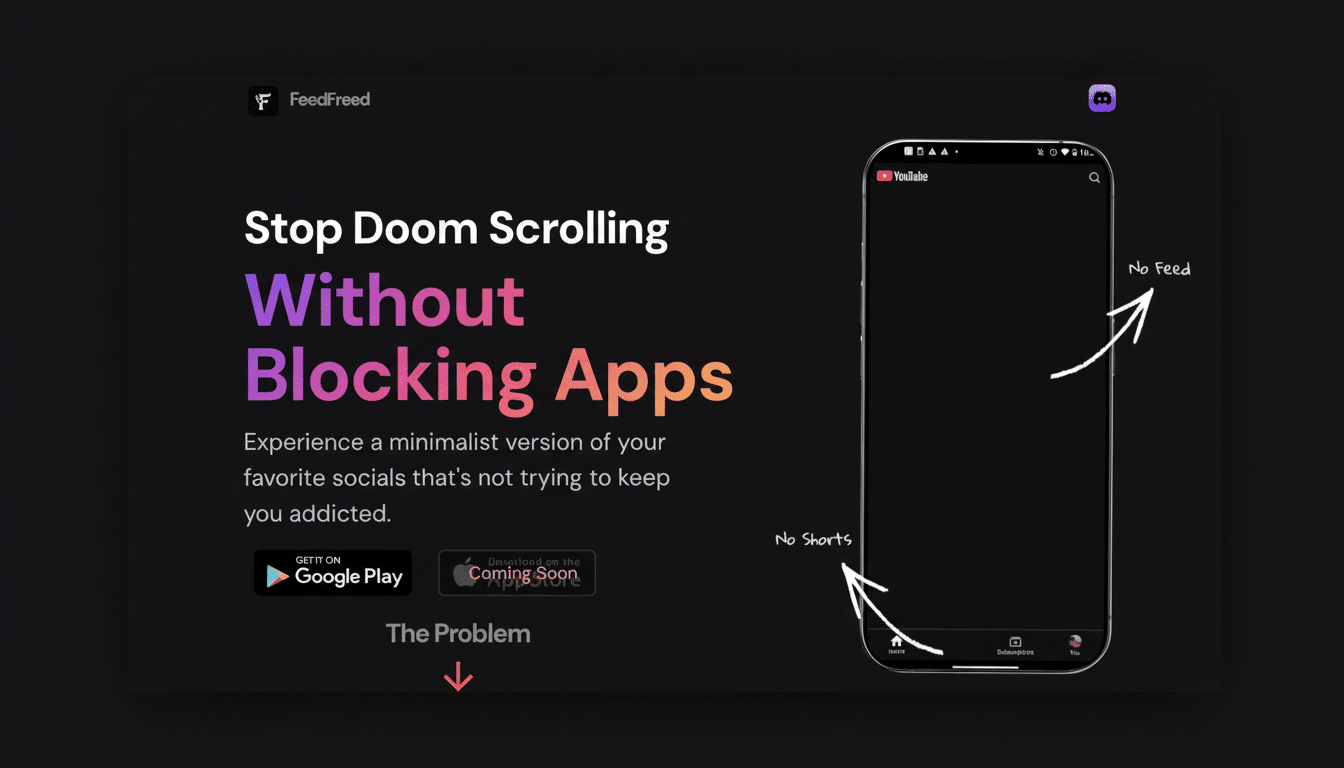
Rearrange your home screen so the alternatives sit where your thumb usually goes and social apps live in a folder off the dock. Consider a shortcut that opens a substitute app when you tap an old habit icon—a clever hack that transforms impulse into intent.
A Five-Minute Playbook To Break The Cycle
Pick two alternatives: one active (puzzle, language, sketch) and one passive (radio, audiobook). Put them on your dock. Set a 10-minute limit on your most tempting app and enable a pause prompt. The next time boredom beckons, open your replacement first and commit to one finite session. Repeat tomorrow. Tiny, repeatable wins build the new loop.
Doomscrolling preys on our wiring for novelty and threat. You won’t outmuscle it with grit alone, but you can outdesign it. Swap the endless feed for an activity that ends—and gives you something back.
Sources for context: DataReportal’s global social media usage reports, Stress in America findings from the American Psychological Association, and peer-reviewed research on reduced social media use and mental health from the University of Pennsylvania.
