


Honor’s new Magic V6 arrives like a time skip for foldables. After extended hands-on time at MWC in Barcelona, the impression is unmistakable: this device resets expectations for thinness, crease management, durability, and battery life, making recent US-bound foldables from Samsung and Google feel a generation behind.
Design and Display Leave No Visible Crease
The Magic V6 nails the essentials of a book-style foldable: it’s strikingly compact at 9.0mm folded (4.1mm unfolded) and 224g, so it pockets like a regular slab. That alone narrows one of the primary adoption barriers. Display Supply Chain Consultants has repeatedly flagged crease visibility and bulk as top user concerns, and Honor tackles both head-on.
- Design and Display Leave No Visible Crease
- Battery and Charging Rewrite the Rulebook
- Durability Takes a Step Beyond Expectations
- Power, Cameras, and Practicality in Daily Use
- Multitasking That Feels Mature and Reliable
- Why This Puts Pressure on US Foldables Right Now
- Availability and the Big Catch for US Buyers
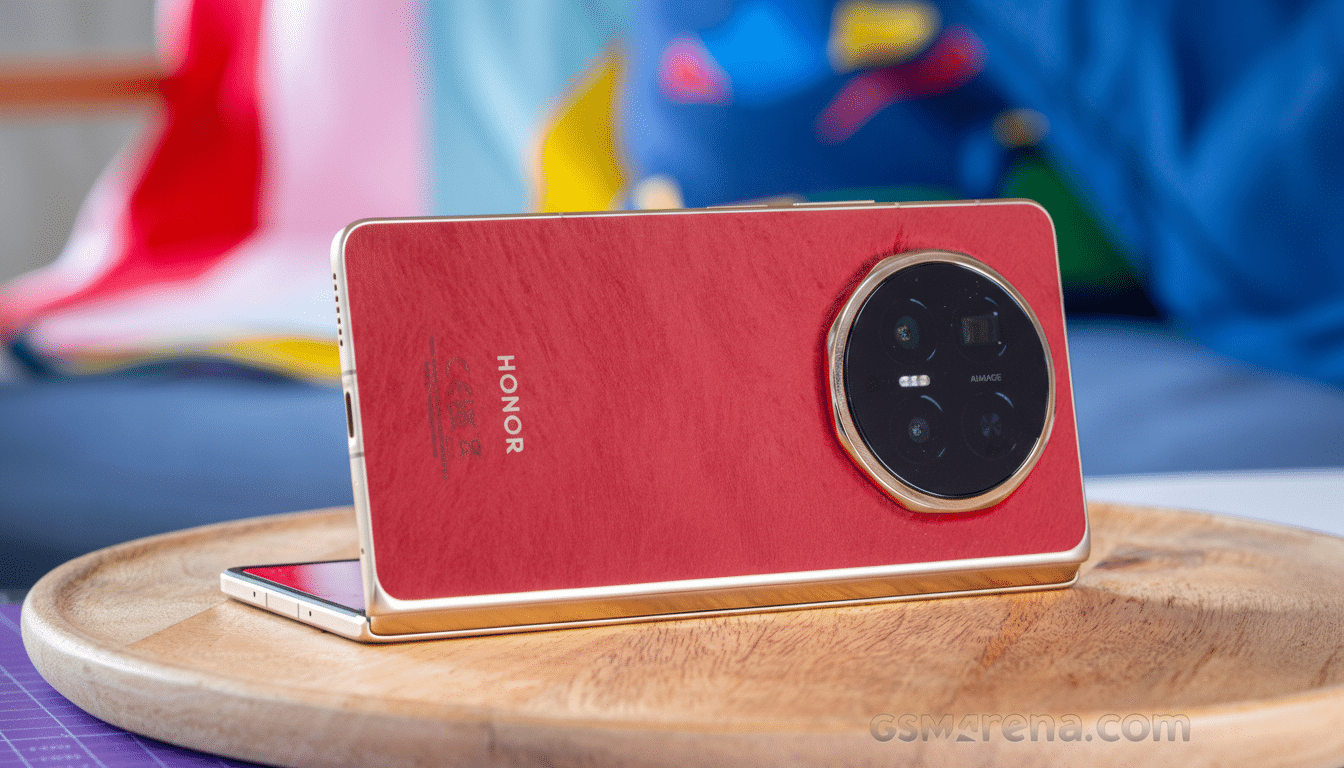
The hinge is the quiet star. It doesn’t lock at every angle, but the inner panel is virtually crease-free to the eye and fingertip. Compared with the persistent groove on the latest Galaxy Z Fold and Pixel Pro Fold, the V6’s panel looks and feels more like a single sheet of glass. The finish helps the premium feel too: the red variant sports a soft, suede-like back with a detailed pattern and tasteful gold accents. It’s bold without tipping into gaudy, a welcome departure from the safe black-and-silver rut.
Battery and Charging Rewrite the Rulebook
The spec that changes the conversation is the 6,660mAh battery. On a device this thin and light, that’s astonishing. For context, Samsung’s comparable Fold line sticks around 4,400mAh, while Google’s larger, heavier Pro Fold sits near 5,015mAh. In early use, the Magic V6 comfortably cleared a full workday plus a long evening and still looked fresh the next morning; with lighter days, two-day endurance is realistic.
Charging is equally aggressive: 80W wired and 66W wireless. In a US market where many flagships linger at 25–45W wired and slower wireless rates, these numbers translate into real convenience. Counterpoint Research has noted that charging speed is a growing purchase driver in premium Android segments; the V6 leans into that trend without ballooning the chassis.
Durability Takes a Step Beyond Expectations
Honor secured IP68 and IP69 ingress protection, a rare combination for a foldable. IP68 covers dust resistance and submersion, while IP69 addresses high-pressure water jets as defined in IEC/ISO standards. Until very recently, even IP68 was a novelty in this category. Bringing both ratings to a hinge-based device suggests meaningful sealing and materials work, not just marketing polish.
Hinge longevity claims were not the focus of Honor’s briefing, but the lack of visible crease and the tight folding radius indicate careful layer stacking and a robust teardrop architecture. That should help reduce mechanical stress over time, a pain point for early adopters of first- and second-wave foldables.
Power, Cameras, and Practicality in Daily Use
Under the hood sits Qualcomm’s latest top-tier silicon paired with 16GB of RAM and 512GB of storage in the unit tested. The phone feels instant: app launches, multitasking moves, and UI animations snap with the sort of effortlessness you expect from a no-compromise flagship.
The rear trio—a 50MP main, 64MP periscope telephoto, and 50MP ultrawide—delivered crisp, contrasty shots in mixed indoor light during our demo period. The periscope lens in particular gives the V6 a reach advantage over many foldables that compromise on zoom. It’s too early for a verdict, but imaging looks competitive at the very top end.
Multitasking That Feels Mature and Reliable
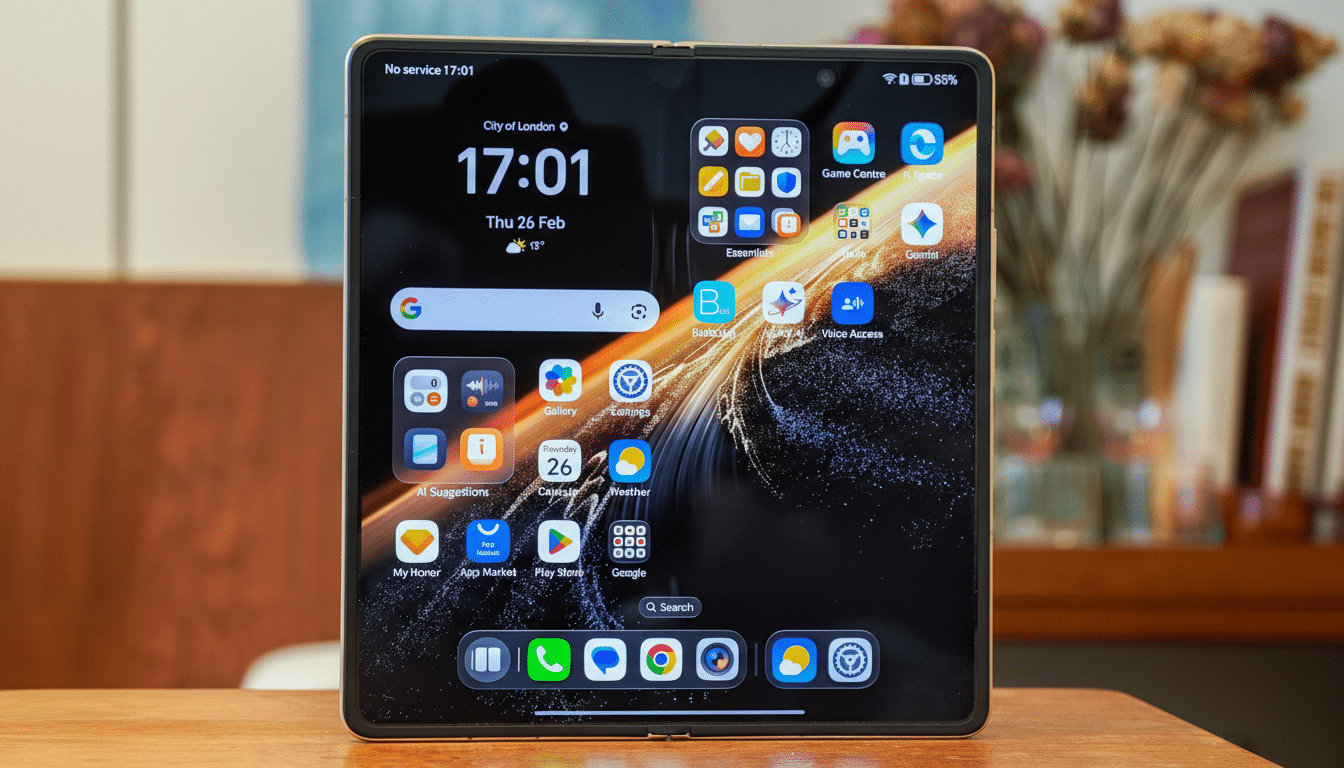
On software, the V6 behaves like a device designed around large-screen work. App continuity from cover to inner display was seamless in our tests, split-screen layouts were predictable, and floating windows were quick to summon and dismiss. It sounds basic, but reliability in these routines is where many foldables stumble; here, it felt polished rather than experimental.
Why This Puts Pressure on US Foldables Right Now
IDC and DSCC both estimate that global foldable shipments have already cleared the 20 million-unit mark and continue to climb. As the category matures, the bar is moving from “can it fold” to “does it outclass a slab.” On that metric, Honor’s formula—big battery, fast charging, near-creaseless panel, flagship cameras, and real water resistance—exposes where US-focused models are treading water: modest batteries, conservative charging, and creases that still shout “prototype.”
It’s not that Samsung and Google aren’t improving; they are. But the Magic V6 shows how quickly the leadership baton can pass when a brand solves multiple pain points at once. If anything will push US-bound devices to accelerate, it’s competition like this.
Availability and the Big Catch for US Buyers
Honor says the Magic V6 launches in China first, with wider international availability to follow. A US release remains unlikely. That’s the asterisk on an otherwise standout showing: the foldable that most convincingly advances the state of the art may not be sold through US channels.
Even so, the message lands. If the Magic V6 is the blueprint for 2026-era foldables—sleeker, tougher, longer lasting—then the next wave of US flagships has work to do. The future isn’t just thinner and lighter; it’s better across the board, and Honor just offered a convincing preview.
