


Google has unveiled Nano Banana 2, an upgraded image generator that now defaults across Gemini’s Create Image experience and folds in two capabilities previously reserved for the Pro tier. The release targets three perennial pain points in AI art—subject consistency, instruction following, and text legibility—while promising sharper visuals and broader output controls.
What’s New in Nano Banana 2 for Image Generation
According to Google, Nano Banana 2 maintains character and object consistency at a scale that matters for real projects: up to five distinct characters and 14 objects in a single workflow. That means storyboard panels, product shots, or educational sequences can carry recognizable elements frame to frame without constant re-prompting.
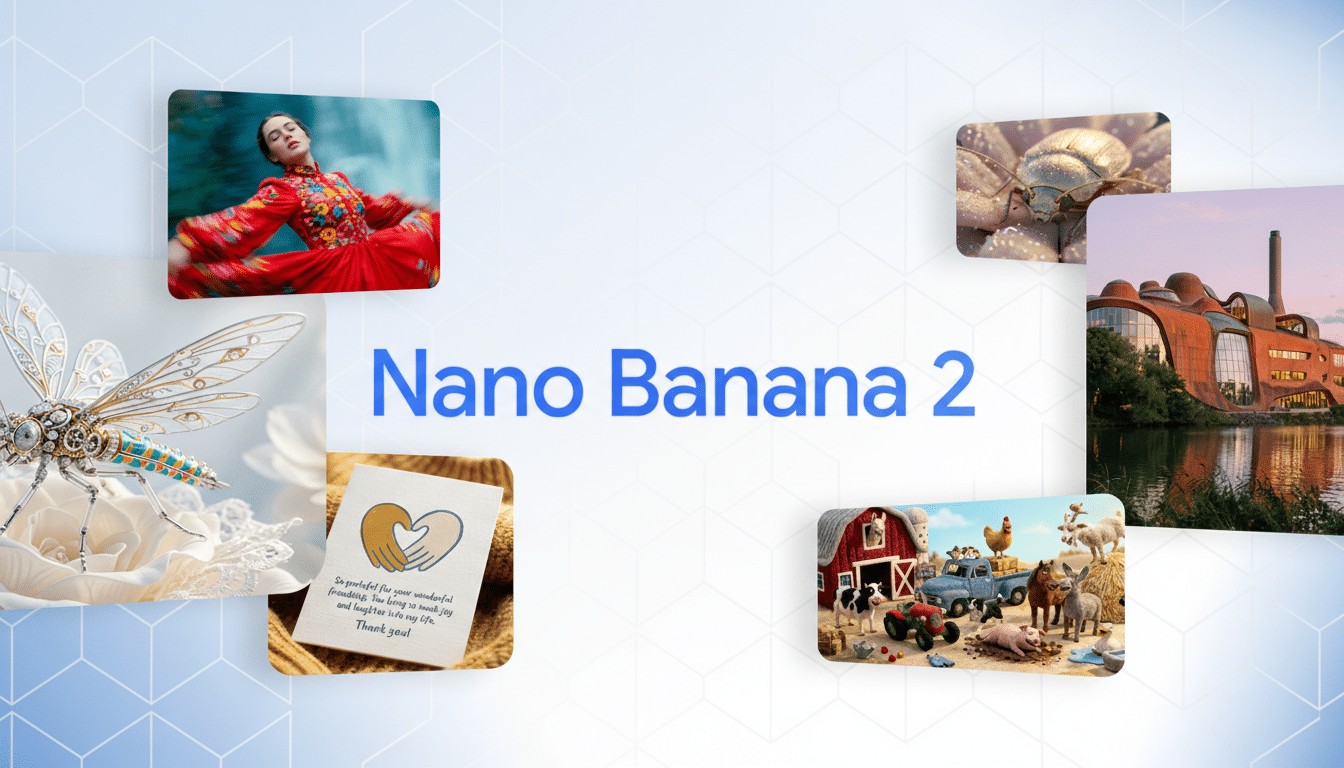
The model also tightens adherence to prompt details, a known differentiator among top image systems. In practice, better instruction following reduces those “almost right” results—fewer missed color cues, props, or layout constraints—saving revisions and compute cycles.
Image quality gets a lift, too. Outputs feature more natural lighting, richer textures, and improved micro-detail. Creators can target common aspect ratios such as 1:1, 16:9, and 9:16, and scale resolution from 512 pixels up to 4K, which covers everything from social tiles to display signage without juggling external upscalers.
Two Pro-Level Capabilities Come Downmarket
Google says Nano Banana 2 inherits two headline features from its Pro sibling: advanced real-world knowledge and markedly better text rendering. The knowledge upgrade is designed to ground visuals in current information and web imagery, particularly useful for infographics, diagrams, and data-first creative where context matters.
Text inside images—traditionally a weak spot across the industry—now lands with fewer typos and improved clarity, and the system can translate on-image text to support multilingual assets. This brings Nano Banana 2 closer to the text reliability seen in premium tools, a space where OpenAI’s DALL·E 3 and Midjourney’s recent versions have pushed standards by tightening prompt alignment and typography fidelity.
For marketers and product teams, the trickle-down is significant: campaign visuals, localized posters, or annotated explainers no longer require a Pro license to avoid garbled type or outdated references. It won’t eliminate manual proofing, but it eases the heaviest lift.
Impact on Creative Workflows and User Access Options
Nano Banana 2 is now the default generator in the Gemini app’s Create Image tab. If you still need the Pro model, you can generate with Nano Banana 2 first, then choose “Redo with Pro” from the three-dot menu—a small but noticeable change that adds a step for Pro-centric users.
Availability spans the Gemini app, AI Mode, Google Lens, AI Studio, Google Cloud, Flow, and Google Ads. The new model does not require a paid subscription, though paid tiers typically expand rate limits and enterprise features. Google lists Gemini plan pricing from $8 per month to $250 for high-volume and organizational use, positioning Nano Banana 2 as a broadly accessible default with a clear path to upgrade when needed.
Pragmatically, defaulting to the new model should reduce friction for most creators—especially those producing social content or educational visuals—while Pro remains the safety valve for razor-specific brand typography or art direction.
Quality Gains With Practical Caveats and Limitations
Early signals suggest text rendering is cleaner but still not flawless in edge cases like dense paragraphs, stylized fonts, or curved baselines—scenarios where Pro-level diffusion stacks and post-processing still excel. And while the added real-world knowledge can speed infographic creation, teams should continue to verify facts and attributions, aligning with guidance from organizations like NIST’s AI Risk Management Framework that emphasize human validation in data-rich outputs.
Google says outputs continue to be governed by its safety policies across Gemini surfaces, with content checks intended to limit harmful or deceptive use. In brand environments, that will dovetail with existing review workflows around legal approvals, accessibility, and localization QA.
Where It Fits in the Current Competitive Landscape
Nano Banana 2’s pitch mirrors a broader industry move: bring premium capabilities to the default tier to widen adoption, then reserve specialist control and highest-fidelity typography for pros. It places Google’s image stack squarely against Midjourney for art direction, OpenAI for instruction precision, and Adobe’s Firefly for enterprise guardrails and brand integration.
The difference here is distribution. By making Nano Banana 2 the out-of-the-box generator across Gemini and adjacent Google products, the company can influence everyday creative points—search-to-social workflows, quick ad variants, and on-device concepting—where speed and “good enough” quality often determine tool choice.
Bottom line: Nano Banana 2 meaningfully tightens Google’s default image experience with better consistency, more faithful prompts, and legible on-image text, while keeping Pro in reserve for the most exacting briefs. For most teams, that’s the right default—less fiddling, faster iteration, and fewer blockers between concept and publish.
