


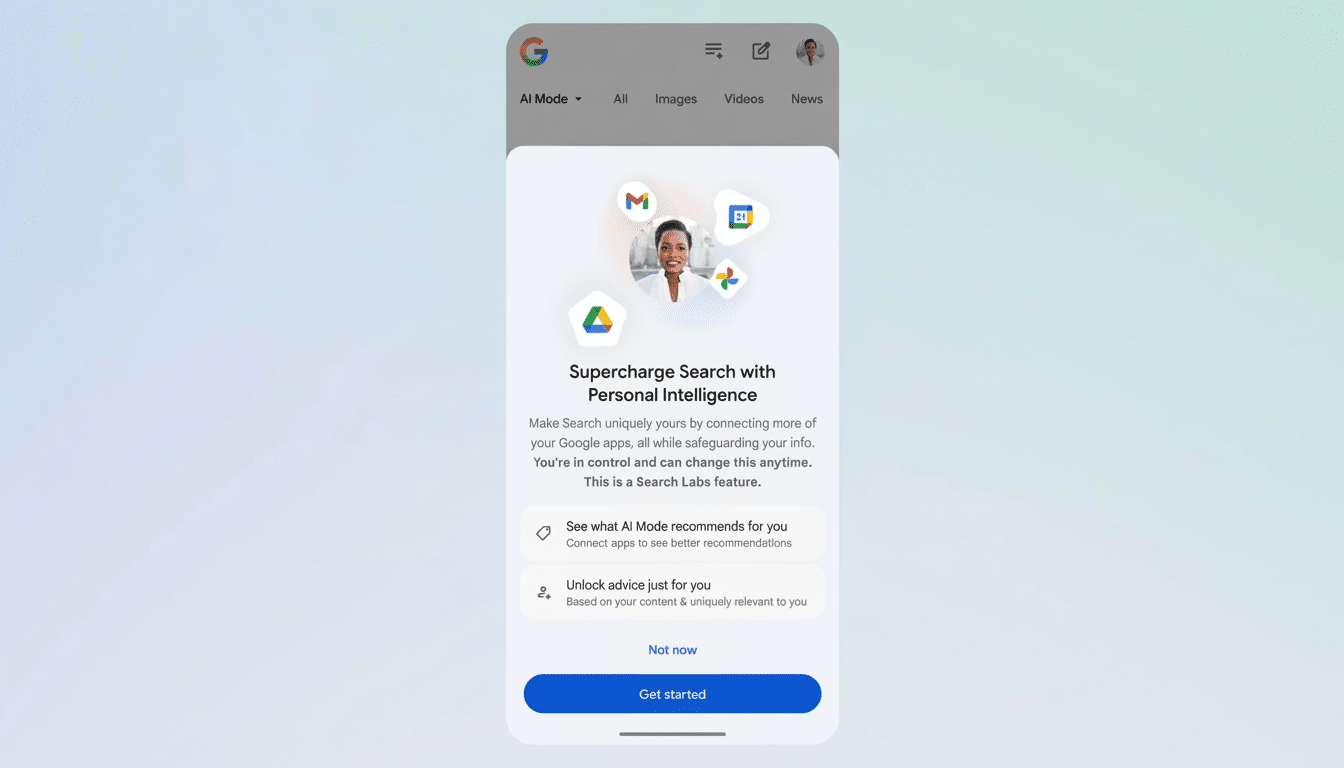
Google is rolling out Personal Intelligence to all users in the United States, bringing its context-aware assistant features to AI Mode in Search, the Gemini app, and Gemini in Chrome. The capability, previously limited to paying customers, lets Google’s AI tailor answers by securely referencing information from services like Gmail and Google Photos when users choose to connect them.
The expansion signals Google’s push to make its flagship AI feel genuinely useful in everyday scenarios—recalling details you’d otherwise dig up yourself—while keeping controls in the user’s hands. Personal Intelligence is off by default and requires explicit opt-in.
- What Personal Intelligence Does Across Google Apps
- Where Personal Intelligence Shows Up and Who Gets It
- Privacy and Control: Opting In and Managing Connections
- Why It Matters for Everyday, Context-Aware Assistance
- Competitive Context Among Apple, Microsoft, and Google
- What to Watch Next as Adoption and Trust Take Shape
What Personal Intelligence Does Across Google Apps
At its core, Personal Intelligence grounds Gemini’s responses in your own context. Ask about a pair of sneakers you loved and the assistant can identify the model from a receipt in Gmail, then surface similar options available nearby. Planning a weekend away? It can combine your hotel confirmation with travel photos to craft a tailored itinerary that aligns with your family’s tastes.
In Chrome, the feature brings shopping suggestions that reflect recent purchases and style cues. If you’ve just bought gold-toned shoes, expect recommendations for bags or accessories that match, down to the hardware details. And in Search’s AI Mode, you can skip the back-and-forth of supplying context; the assistant can reference your opt-in signals to offer a head start, like proposing all-weather tires after spotting your road-trip photos and car model in your email receipts.
Where Personal Intelligence Shows Up and Who Gets It
Personal Intelligence is available in AI Mode in Search immediately and is rolling out in the Gemini app and Gemini in Chrome for free-tier accounts in the U.S. Google says these experiences are for personal Google accounts only; business, enterprise, and education accounts under Workspace are not included in this wave.
That scope matters. Gmail and Google Photos each serve well over a billion people, and Chrome remains the primary browser for many U.S. users, according to independent measurements from firms that track web usage. Making personalization optional yet broadly accessible could significantly expand day-to-day engagement with Gemini.
Privacy and Control: Opting In and Managing Connections
Google emphasizes that Personal Intelligence is opt-in and off by default. Users choose if and when to connect services like Gmail and Google Photos, and they can disconnect at any time. The company says Gemini does not train directly on your email or photo libraries; instead, learning is limited to the prompts you type and the assistant’s responses. In plain terms, the model can consult your data to answer a request when you’ve allowed it, but your inbox and photo archive are not swept into the training corpus.

This approach lands squarely in a moment of heightened scrutiny. Surveys from the Pew Research Center show Americans remain cautious about how companies collect and use their data, and U.S. regulators have warned AI providers to be transparent and minimize risks. Clear labeling, reversible controls, and granular permissions will be table stakes for adoption at scale.
Why It Matters for Everyday, Context-Aware Assistance
General-purpose chatbots are handy, but they become indispensable when they understand your context—what you bought, where you’re going, who you’re meeting, and what you like. Personal Intelligence takes steps in that direction, reducing the cognitive load of gathering details across apps and accounts. That shift could turn occasional AI dabblers into daily users, especially for tasks like planning trips, managing returns, organizing receipts, and reconciling expenses.
Usability experts at organizations like Nielsen Norman Group have long noted that systems which remember user context reduce friction and improve task completion. If Google can keep the privacy trade-offs clear and respectful, the utility boost from context-aware answers may prove compelling for mainstream users.
Competitive Context Among Apple, Microsoft, and Google
Big Tech is converging on the same idea with different guardrails. Apple has highlighted private, on-device context for its assistant features, while Microsoft anchors Copilot to the Microsoft Graph for work data. Google’s move targets the consumer heartland first, with Workspace notably excluded for now. The race isn’t just about model quality; it’s about who can safely leverage personal context to deliver results that feel like magic without crossing red lines.
What to Watch Next as Adoption and Trust Take Shape
Key signals to track: how many users opt in, the frequency of repeat use, and whether context-aware suggestions lift engagement in Search and Chrome. Also watch how Google separates assistance from advertising in personalized scenarios; the company has long maintained that Gmail content is not used for ad targeting, and clarity here will shape trust.
For now, the message is simple: if you want an assistant that remembers relevant details so you don’t have to, Personal Intelligence is arriving across Google’s core consumer surfaces—by invitation of the user, not by default.
