


Samsung’s latest flagship just scored a decisive win for on-the-go privacy. The Galaxy S26 Ultra’s new Flex Magic Pixel OLED has been independently verified by UL Solutions to dramatically cut visibility from side angles, turning shoulder-surfing into a far tougher task without adding a bulky privacy filter.
Independent Test Confirms Extreme Off-Axis Dimming
According to UL Solutions, the panel retains just 3.5% of its on-axis brightness at a 45-degree angle, and 0.9% or less at 60 degrees. Put simply, someone peeking from a typical side angle sees roughly one-thirtieth the brightness, and at steeper glances it drops to under one-hundredth—figures that are far beyond what we see on conventional smartphone displays, which often hold around 40% brightness off-axis.
- Independent Test Confirms Extreme Off-Axis Dimming
- How Samsung Achieved the Privacy Effect in Its OLED Display
- What the Numbers Mean in Daily Use and Real Life
- Power Efficiency and Overall Display Quality Impact
- Why Independent Verification Matters for Buyers
- What Comes Next for Privacy Screens in Smartphones
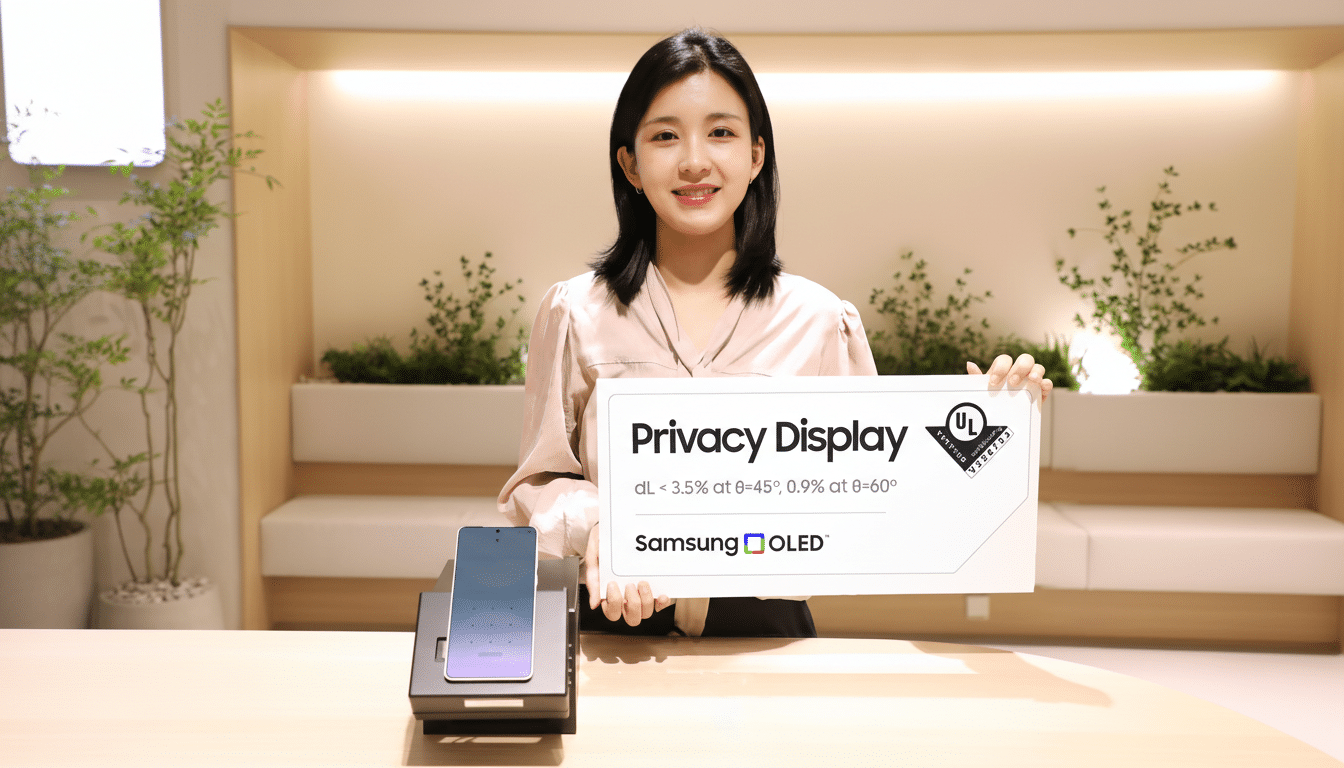
This isn’t a marketing demo; it’s a third-party verification from a globally recognized testing and certification organization. For professionals who handle sensitive information in public spaces, the difference between 40% and 3.5% is the difference between legible text and an unusable gray blur.
How Samsung Achieved the Privacy Effect in Its OLED Display
Samsung Display says it re-engineered the Black Matrix—the structure that separates red, green, and blue subpixels at micrometer scales—into a multi-layer light-blocking system. Instead of letting light scatter laterally, the new stack channels more photons straight toward the viewer while sharply attenuating off-axis leakage.
The privacy layer is integrated into Samsung Display’s polarizer-free OLED platform, branded LEAD 2.0. Removing a traditional polarizer can boost brightness and reduce internal reflections, improving power efficiency. By folding the Flex Magic Pixel privacy control into that platform, Samsung aims to deliver both discretion and day-to-day efficiency rather than forcing a trade-off.
Samsung Display also notes it has filed around 150 patents since 2020 tied to the materials, optics, and pixel architectures behind this approach—a sign the company anticipates wide deployment beyond a single hero device.
What the Numbers Mean in Daily Use and Real Life
In a packed train, café, or airplane, side glances usually fall between 30 and 60 degrees. At those angles, the S26 Ultra’s screen becomes exceptionally hard to parse for anyone not directly in front of it. On-screen email previews, 2FA codes, banking apps, and confidential documents benefit most because text is the first casualty of off-axis dimming.
Unlike clip-on privacy filters that also dull the screen face-on, this implementation targets lateral light spread inside the OLED stack. The goal is to maintain a normal viewing experience for the user while making shoulder-surfing impractical. Early measurements center on brightness retention; color shift and contrast off-axis generally travel with brightness, so the overall legibility drop should be even more pronounced for bystanders.
Power Efficiency and Overall Display Quality Impact
Polarizer-free OLED architectures typically improve optical efficiency because fewer layers absorb or reflect light before it reaches the viewer. That can translate into brighter peak highlights or lower power draw for the same luminance. With LEAD 2.0, Samsung is positioning privacy as an additive benefit rather than a compromise. For battery life, fewer wasted photons mean fewer watts spent to achieve a given nit level.
There are practical considerations. Tighter off-axis control narrows the effortless “shared viewing” cone. If you often huddle around a phone to watch video or collaborate on photos, you may need to square up to the display more deliberately. For most users, though—especially in enterprise, healthcare, or finance environments—the privacy gain is the bigger win.
Why Independent Verification Matters for Buyers
UL Solutions’ verification gives IT teams and security-conscious buyers a clear, repeatable metric for off-axis visibility rather than relying on subjective impressions. Independent lab data tends to carry weight in enterprise procurement, where bring-your-own-device programs increasingly ask for demonstrable protections beyond biometrics and on-device encryption.
Hardware-level privacy also reduces reliance on aftermarket screen films that can trap dust, add glare, or degrade touch response. It’s a cleaner solution that can be managed at the panel level across fleets of devices.
What Comes Next for Privacy Screens in Smartphones
Samsung isn’t naming future partners, but the verification will likely accelerate interest among other Android manufacturers. Industry chatter already points to additional flagships evaluating built-in privacy this cycle. For now, the Galaxy S26 Ultra has a legitimate first-mover advantage—and a concrete spec to back it up: 3.5% at 45 degrees, 0.9% at 60 degrees or more, verified by an independent lab.
If adoption spreads, we could see privacy metrics become a standard line item on spec sheets, much like peak brightness or PWM frequency. The takeaway today is simple: the S26 Ultra’s display doesn’t just look good head-on—it’s engineered to look like almost nothing at all from the side.
