


The Food and Drug Administration has approved atezolizumab, sold as Tecentriq, with fluoropyrimidine-and-oxaliplatin chemotherapy after surgery for people with stage III colon cancer whose tumors have deficient mismatch repair, or dMMR. The Oct. 8 decision makes an immune-checkpoint inhibitor available in an adjuvant setting, intended to lower the chance that cancer returns after a tumor has been removed.
The indication is narrow but clinically consequential: it applies to a molecularly defined subset of stage III colon cancers, not to all patients with the disease. In the randomized ATOMIC trial, the combination improved disease-free survival compared with chemotherapy alone. Whether the regimen ultimately extends overall survival remains unresolved because those data were not mature in later reporting.

What the FDA approved
According to the FDA approval announcement, intravenous atezolizumab may be used with a fluoropyrimidine and oxaliplatin in adults and children ages 2 and older with stage III dMMR colon cancer after surgery. The agency also approved a subcutaneous product, atezolizumab and hyaluronidase-tqjs, marketed as Tecentriq Hybreza, with the same chemotherapy backbone for patients 12 and older who weigh at least 40 kilograms, or about 88 pounds.
Mismatch repair is a tumor characteristic identified through laboratory testing. The approval means that test result now determines whether a patient with resected stage III colon cancer is eligible for this specific postoperative treatment. It does not mean that every stage III tumor should receive atezolizumab, or that a dMMR result alone settles the treatment decision.
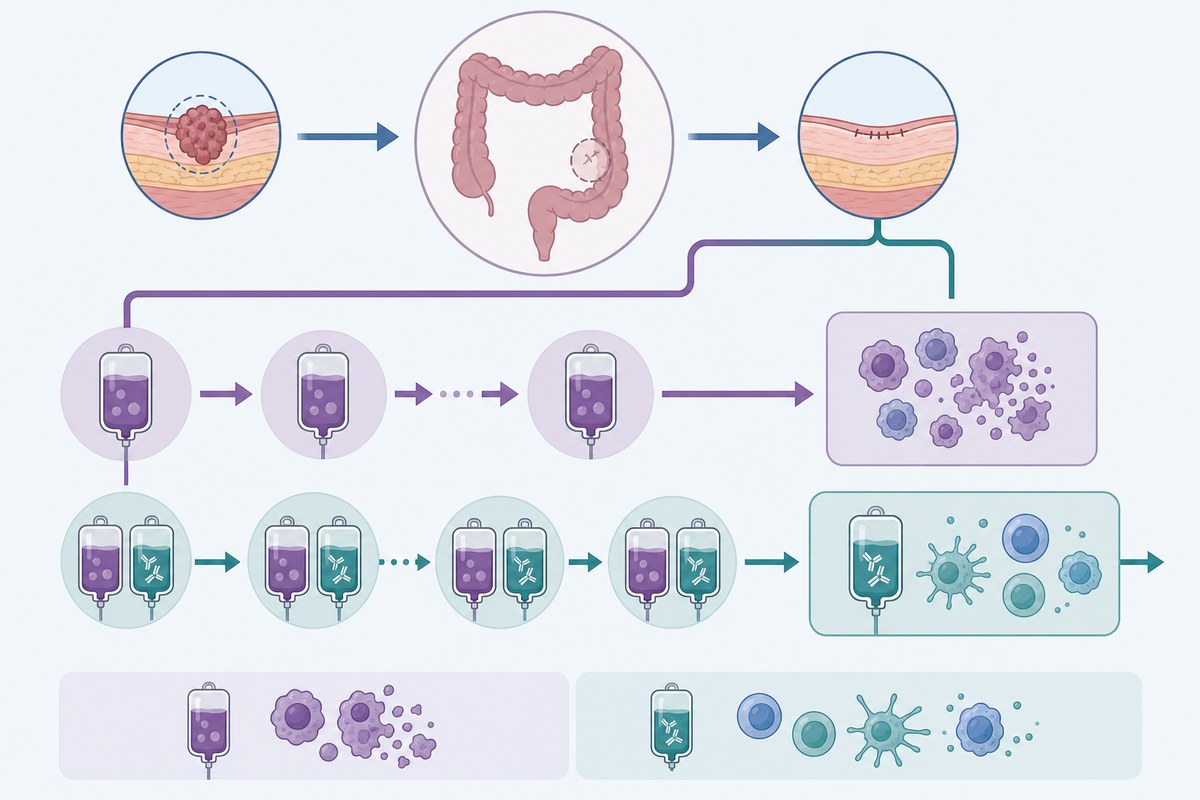
Atezolizumab blocks PD-L1, a protein involved in restraining immune responses. In this regimen, it is added to chemotherapy rather than replacing it. Patients in the pivotal study received 12 cycles of mFOLFOX6 chemotherapy with atezolizumab, followed by six months of atezolizumab alone; the comparison group received 12 cycles of mFOLFOX6 alone.
What the ATOMIC trial found
The regulatory decision drew on ATOMIC, also called ML39057 or NCT02912559, a multicenter, randomized, open-label phase 3 study. The trial listing describes a comparison of FOLFOX-based chemotherapy with or without atezolizumab in patients with resected stage III dMMR colon cancer. The FDA said 712 people enrolled: 711 adults and one pediatric participant.
Patients were assigned in equal numbers to the two treatment strategies. The principal outcome was investigator-assessed disease-free survival, a measure of the time until cancer recurrence, death or another defined event. The FDA reported a hazard ratio of 0.50 for the atezolizumab regimen, with a 95% confidence interval from 0.35 to 0.73 and a p value of 0.0001. In the context of this trial, that indicates a substantially lower rate of disease-free-survival events in the combination group during follow-up.
The hazard ratio should not be read as meaning that half of patients were cured, or that each individual patient’s risk will be cut in half. A more intuitive time-specific comparison came from a Mayo Clinic account of the study: three-year disease-free survival was 86.3% with atezolizumab plus chemotherapy and 76.2% with chemotherapy alone. That is an absolute difference of 10.1 percentage points at three years.
Neither group had reached a median disease-free-survival time at the FDA analysis, a sign that longer observation will be needed to describe durability more fully. The randomized design supports a causal conclusion about the regimen’s effect on the trial’s disease-free-survival endpoint among the patients studied. It does not, by itself, establish a mature overall-survival benefit.
Benefits come with a longer, more complex course
The new approach adds six months of immunotherapy after the chemotherapy portion ends. It also adds the potential harms associated with a checkpoint inhibitor. The FDA prescribing information warns about immune-mediated adverse reactions, infusion-related reactions, complications involving allogeneic hematopoietic stem-cell transplantation and embryo-fetal toxicity.
Safety data require some care in interpretation because reports have used different measures at different analysis points. Later coverage of the trial results reported more grade 3 or 4 adverse events overall with the combination than with chemotherapy alone. Earlier meeting reporting focused on treatment-related grade 3 or 4 events, which is not the same safety category and should not be compared as though it were directly interchangeable.
For patients and oncology teams, the practical question is therefore not simply whether the regimen reduced recurrence-related events in the study. It is how to weigh that benefit against additional treatment time, immune-related toxicities, pre-existing health conditions and the feasibility of monitoring during therapy.
Important gaps in the evidence
ATOMIC was open-label, meaning patients and clinicians knew which regimen was being used. That design can introduce potential bias in follow-up and in investigator-assessed outcomes, although random assignment reduces many other sources of bias. Longer follow-up is also needed to clarify overall survival and the persistence of the disease-free-survival advantage.
The pediatric labeling also extends further than the trial’s direct pediatric evidence. The intravenous formulation is approved from age 2, but the pivotal study included only one pediatric participant; the trial listing describes eligibility beginning at age 12. The FDA announcement does not explain on its page how evidence was extrapolated to younger children. The subcutaneous formulation has its own narrower boundary: age 12 or older and at least 40 kilograms.
At the 2025 American Society of Clinical Oncology meeting, trial investigator Frank A. Sinicrope described the findings as establishing a new standard treatment, according to coverage by The ASCO Post. The FDA action now provides a labeled option, while the eventual overall-survival results will help define how durable the benefit is after surgery.

