


The traditional sales funnel comprises the stages a customer goes through after contacting your company: the initial greeting and key question, the process of reaching the goal, the closing and resolution, and the post-resolution action that leads to the user’s commitment to the company. All these actions should be carried out smoothly; however, what often happens is that because they are performed manually, errors or frequent delays can occur. One solution to this is the use of AI, which creates dynamic and automated funnels for business success.
AI, and especially AI for sales, is a technology that has revolutionized the way companies create their sales strategies. It offers a real benefit to companies worldwide, as it provides personalized conversations 24/7, fast and precise actions, data organization and information processing, lead qualification and conversion, and integration with other tools that allow for greater scalability.
- Stage 1: AI-Driven Lead Generation
- Stage 2: Intelligent Lead Qualification
- Predictive lead scoring models
- Behavioral tracking and intent analysis
- Prioritizing high-conversion prospects
- Stage 3: Personalized Nurturing at Scale
- AI-powered email and messaging sequences
- Dynamic content personalization
- Trigger-based engagement workflows
- Stage 4: AI-Optimized Closing Strategies
- Conclusion: Post-Sale Automation and Retention
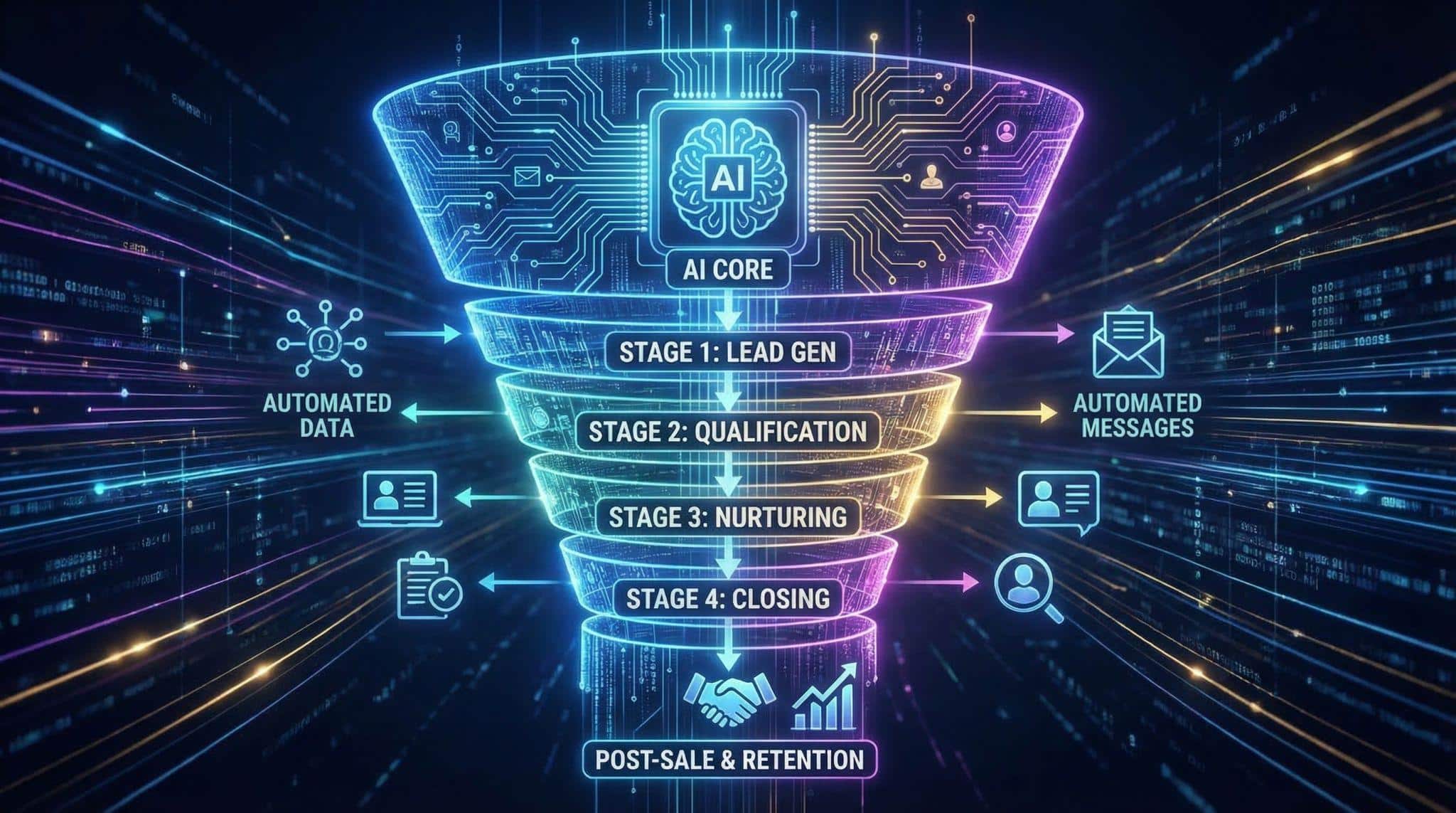
In general, it’s an excellent choice for any type of business, so today we’ll tell you how to build a powerful sales funnel powered by AI. Let’s get started!
Stage 1: AI-Driven Lead Generation
The first stage of the funnel is always the most crucial, as it’s what will help you attract the most customers seamlessly. When you integrate it with artificial intelligence, you can manage a greater number of leads thanks to all its strategies:
Smart audience targeting
Each customer group is different and requires special attention; otherwise, we won’t achieve the desired effect of making them feel valued and connected to your brand. To do this in the best possible way, the AI agent manages intelligent segmentation, processing conversations tailored to each audience type.
Automated lead capture systems
In addition to automatically segmenting your leads, it can also capture them strategically. It creates engaging welcome messages that highlight the company’s interest in its customers, as well as real-time messages that maintain the interest of every user.
Data enrichment and segmentation
At the start of each conversation, customers provide basic data that will later help companies enrich their conversations and strengthen the relationship. Now, what the AI agent does to nurture this information gathering is segment and manage it to create a suitable profile for developing the service the customer needs.
Stage 2: Intelligent Lead Qualification
The second stage of the funnel involves capturing and properly qualifying each potential customer who contacts your company. When you perform this action intelligently, you can create this type of management smoothly and strategically without worrying about human error. Let’s see how it’s designed.
Predictive lead scoring models
To better understand customer intentions and capture them from the beginning, AI agents work with predictive scoring models. This means they operate in conjunction with machine learning and AI to analyze historical data and automatically assign a probability of conversion.
Behavioral tracking and intent analysis
Customers will take a specific action depending on their desires. To confirm their interest in your company and their likelihood of continuing the buying process, the best thing the AI agent can do is closely track their behavior and thoroughly analyze their intentions.
Prioritizing high-conversion prospects
All customers are valued equally; however, not all of them complete the final purchase. Many get stuck halfway through or are simply comparing options with competitors. Taking this into account, the AI agent prioritizes prospects with a high conversion rate, thus ensuring increased production.
Stage 3: Personalized Nurturing at Scale
Once you’ve engaged with your customers initially and successfully captured them, the next step is to nurture them in a personalized and scalable way, so they want to complete the process with your company. We showed you the things you can include with AI.
AI-powered email and messaging sequences
The classic never dies, even for a new technology like an IA for sales. For that, you never let go of email and text messaging, because they are reliable channels for clients and companies. The thing that AI does is to improve it by automating sequences and personalizing interactions 24/7.
Dynamic content personalization
The content you provide to your company can’t be just any content; it must align with your customers’ tastes and their actual needs. Therefore, to design engaging actions that capture your customers’ interest, you can develop dynamic personalization to nurture and incentivize customer loyalty.
Trigger-based engagement workflows
There are a lot of technologies behind the IA funnel, especially ones that can engage workflows to produce optimized sales conversations. For example, you can work with an AI agent tool, a system that:
- Automates conversations across channels
- Qualifies leads in real time
- Triggers personalized follow-ups
- Updates CRM records automatically
Meet Kommo’s Shopify AI agent: Your smart selling assistant
Stage 4: AI-Optimized Closing Strategies
For the final stage of the funnel, you can create AI-optimized closing strategies. This means you can implement intelligent and personalized procedures that boost customer loyalty. Here are some examples:
Real-time sales recommendations
When a customer is making a purchase, there are sometimes other products that would be a perfect fit for their profile, but they don’t see them or aren’t ready to buy them. The best approach in these cases is to manage real-time sales recommendations so they can acquire an additional product.
Shortening the sales cycle with predictive insights
Sales cycles can sometimes become long and tedious when the representative doesn’t fully understand the customer’s needs. The best thing you can do is shorten the sales cycle by using predictive information that determines what the user truly requires.
Conclusion: Post-Sale Automation and Retention
The final step you need to manage in your sales funnel is post-sales retention. This means maintaining customer loyalty and ensuring they feel comfortable with your company and motivated to continue buying. In these cases, you can create: AI-powered onboarding workflows, upselling and cross-selling recommendations, and customer lifetime value optimization.
Ultimately, once you integrate your AI agent into your sales funnel, you build a powerful and advanced strategy that allows you to increase customer interest. This is your moment to create your perfect sales process, so don’t wait any longer and get your AI sales tool.

