


Astronomers have captured one of the rarest sights in planetary science: a newborn solar system coming together in real time. Around a young star called WISPIT 2, researchers have directly imaged not one but two giant planets forming within a sprawling disk of gas and dust—an observational milestone that offers an unusually clear test of how worlds like Jupiter arise and reshape their nurseries.
The team reports the discovery in The Astrophysical Journal Letters, confirming the second planet with a combination of high-contrast imaging and precision spectroscopy. The system now joins PDS 70 as only the second known case where multiple giant planets are actively assembling in the same disk.
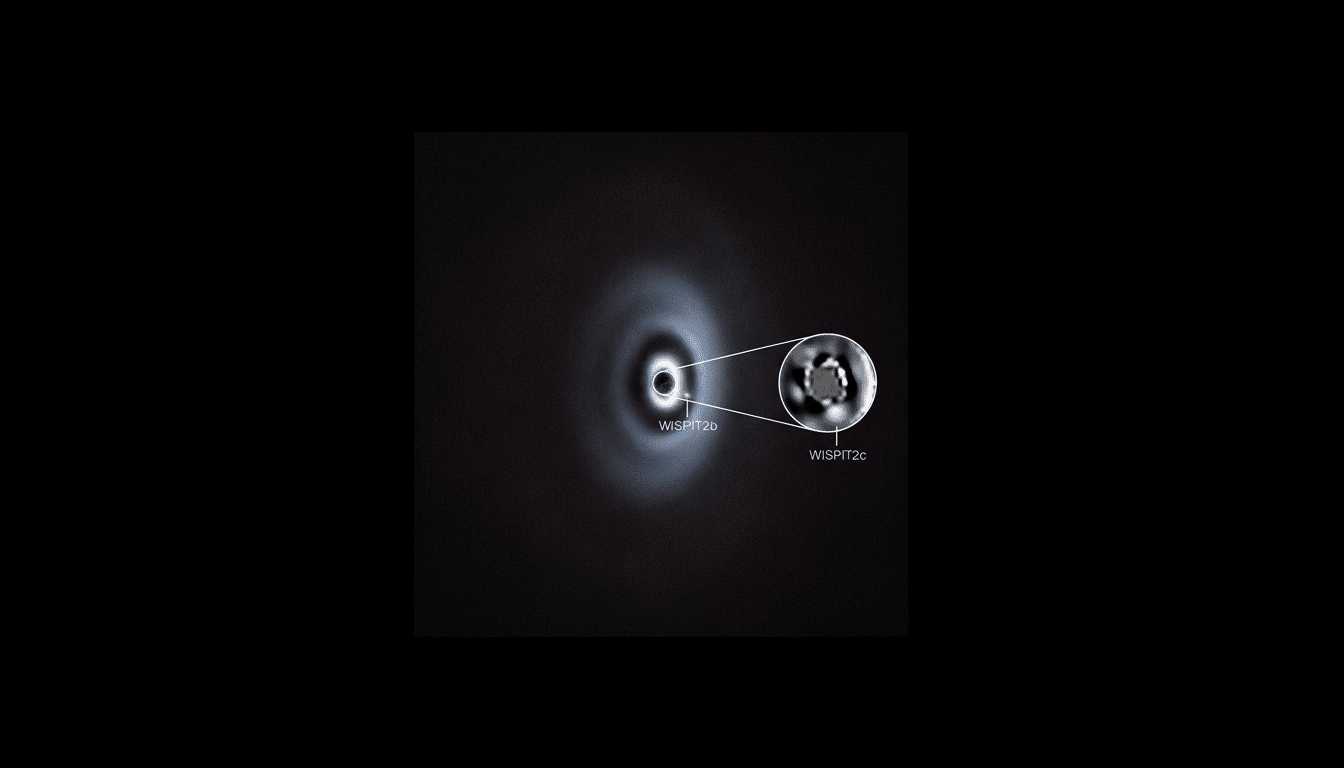
Twin Protoplanets Emerge In WISPIT 2 Disk
WISPIT 2, a roughly 5‑million‑year‑old star, is encircled by a bright, structured disk marked by rings, gaps, and a central cavity—classic signatures of ongoing planet formation. Nested in that disk are two young gas giants: WISPIT 2b, about five times Jupiter’s mass, and WISPIT 2c, roughly ten times Jupiter’s mass, according to the study’s authors.
Their orbits sit at strikingly different distances. The outer planet lies about 57 astronomical units (AU) from the star, while the inner world hugs closer at around 14 AU. For comparison, Neptune orbits our Sun at 30 AU, underscoring how spread out this nascent system is and how forcefully such massive planets can sculpt their surroundings.
Lead author Chloe Lawlor of the University of Galway emphasized that WISPIT 2 presents a sharp snapshot of an early stage our own solar system once passed through—an opportunity to test long-standing theories with direct, time-resolved data instead of computer models alone.
Direct Imaging Opens A Rare Window on Planet Formation
Most of the more than 5,500 confirmed exoplanets have been found indirectly, either by watching them dim their stars or tug on them. Directly resolving a planet against the glare of its star is far tougher; only a small fraction of known exoplanets have been imaged this way, and fewer still are caught in the act of forming.
That’s why systems like WISPIT 2 and PDS 70 loom so large. They allow scientists to move beyond inference and measure the light from the planets themselves—probing temperatures, chemical fingerprints, and accretion processes that are otherwise hidden. The European Southern Observatory (ESO) has been central to this progress, leveraging its flagship instruments to isolate faint planetary signals within luminous disks.
Spectroscopy Confirms The Planetary Nature Of WISPIT 2c
To verify WISPIT 2c, the team used SPHERE on ESO’s Very Large Telescope to first spot the candidate, then applied the GRAVITY+ instrument on the VLT Interferometer to dissect its light by wavelength. The resulting spectrum revealed carbon monoxide—an expected atmospheric tracer in hot, young gas giants—helping rule out a transient dust clump or a coincident background object.
Follow-up measurements show the object moving consistently with the system, strengthening the case that it orbits WISPIT 2. This combination of high-contrast imaging and interferometric spectroscopy is rapidly becoming the gold standard for confirming young planets embedded in bright, structured disks.
Shaping The Birthplace Of Worlds In The WISPIT 2 Disk
The WISPIT 2 disk features multiple bright rings and sharp gaps—morphologies widely interpreted as the handiwork of planets clearing paths and corralling dust. ALMA’s DSHARP survey previously revealed similar ring-and-gap patterns across many young disks, suggesting that planet-disk interactions are commonplace and begin astonishingly early.
Intriguingly, several young systems appear to host giant planets tens of AU from their stars, hinting at a “just-right” zone where conditions foster runaway growth of massive worlds. The pattern is not yet definitive, but WISPIT 2’s architecture meshes with the idea that certain distances offer the optimal balance of cool temperatures, abundant solid material, and gas supply for building giants quickly.
The authors also flag a smaller, narrower gap farther out in the disk—a potential sign of a third, lower-mass planet, possibly in the Saturn range, that has yet to be directly detected. If confirmed, WISPIT 2 would graduate from a twin birth to a crowded nursery shaping into a complex planetary family.
What Comes Next For This Newborn Planetary System
Because the planets are young and hot, they glow brightly in infrared wavelengths, making them prime targets for continued monitoring. GRAVITY+ can track subtle orbital motion and accretion signatures over the next few years, while instruments on the James Webb Space Telescope may probe the disk’s chemistry and dust grain properties in unprecedented detail.
Looking ahead, ESO’s Extremely Large Telescope should push deeper, measuring temperatures, metallicities, and possibly weather patterns in worlds like WISPIT 2c. Precise chronologies—how quickly mass is added, how rings migrate, how gaps widen—will help adjudicate between competing formation pathways such as core accretion and disk instability.
For now, WISPIT 2 stands as a rare and vivid case study: two super‑Jupiters carving lanes in a luminous disk, caught in the short window when planets are still hot from formation and rewriting the architecture of a young solar system. With every new epoch of observations, astronomers are effectively reading the opening chapters of planetary history in real time.

