


Learning American Sign Language just got significantly more affordable. A 100-hour ASL Master Class Bundle is now available for about $35, roughly 82% off its usual list price, placing a comprehensive, CPD-accredited curriculum within easy reach for first-time learners and anyone ready to build real conversational skills.
Why this ASL Master Class deal stands out right now
For the cost of a single in-person lesson in many cities, you get lifetime access to a structured program that moves from the alphabet and numbers into everyday dialogue, storytelling, and practical scenarios. Broken down, the price works out to around $0.35 per hour of instruction, a rare value in a category where subscriptions and paywalls are the norm.
- Why this ASL Master Class deal stands out right now
- What the 100-hour ASL learning bundle actually covers
- Learning ASL in a flexible format that fits real life
- Why building ASL communication skills really matters
- Who this ASL learning bundle is really best suited for
- Bottom line: a strong, affordable starting point for ASL
The package’s CPD accreditation signals that the material is designed with professional-development standards in mind. That won’t replace formal interpreter credentials, but it does add rigor for educators, healthcare staff, frontline workers, and anyone who needs reliable, repeatable training they can reference over time.
What the 100-hour ASL learning bundle actually covers
The curriculum starts with essentials: the manual alphabet, numbers, greetings, and foundational vocabulary you’ll use every day. From there, lessons explore ASL grammar—facial expressions and other non-manual signals, time-topic-comment structure, classifiers, spatial referencing, and how to ask and answer questions naturally.
Later modules focus on real-world contexts such as directions, weather, shopping, work, and healthcare visits, plus situational sign choices that mirror how Deaf signers actually communicate. The bundle also includes specialized tracks like ASL for babies and toddlers (a helpful bridge for early communication) and a set of scuba diving hand signals. While dive signals aren’t ASL, their inclusion offers clear, safety-critical gestures for underwater contexts.
An introductory e-book rounds out the experience with history, etiquette, and cultural notes—important for understanding that ASL is a distinct language with its own grammar and Deaf cultural foundations, not a signed version of English.
Learning ASL in a flexible format that fits real life
The training is designed for self-paced, mobile or desktop study, so short, frequent sessions are easy to slot into a busy day. Cognitive science favors that approach: distributed practice and retrieval exercises tend to outperform marathon cramming for language retention. Build a quick routine—15 to 30 minutes daily—and you’ll see steady progress without burnout.
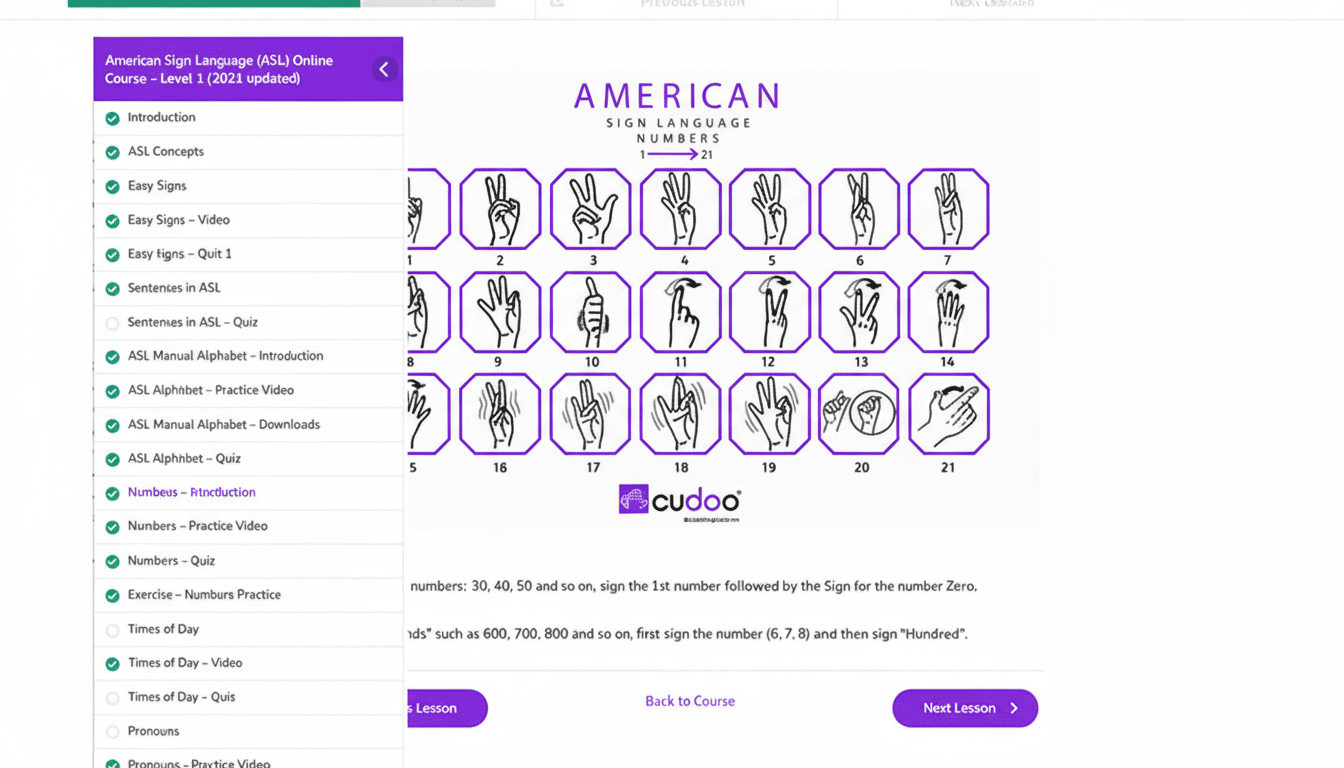
Scenario-based clips—ordering coffee, navigating a store aisle, checking in for an appointment—help you map vocabulary to real interactions. Expect plenty of repetition from different angles, which is crucial for mastering ASL’s visual-spatial features like location, movement, and role shift in narratives.
Why building ASL communication skills really matters
American Sign Language is one of the most-studied languages on U.S. campuses, consistently ranking among the top five in Modern Language Association enrollment surveys. That interest reflects a broader need: the National Institute on Deafness and Other Communication Disorders reports that millions of U.S. adults experience some degree of hearing difficulty, and accessible communication can reduce barriers in schools, clinics, and customer-facing settings.
For professionals, fluency can open doors to roles that serve Deaf and hard-of-hearing communities. The Bureau of Labor Statistics notes ongoing demand for interpreters and translators over the next decade, and groups like the Registry of Interpreters for the Deaf provide the certification pathways for those who want to pursue the field formally. A foundational bundle like this gets you started but should be paired with practice, feedback, and Deaf community engagement to reach true proficiency.
Who this ASL learning bundle is really best suited for
Beginners who prefer structured lessons over uncurated videos will appreciate the step-by-step build of vocabulary and grammar. Parents and caregivers can use the early-communication modules to reduce frustration around daily routines. Educators and healthcare workers gain practical phrases and etiquette that make classrooms and clinics more inclusive. And service-industry staff can pick up the basics needed for clear, respectful interactions.
Note that ASL differs from Signed Exact English, and regional variations exist. The course’s cultural notes and etiquette guidance help you navigate those nuances, but the most valuable complement to any online class is real conversation—local meetups, Deaf community events, or tutoring—where you’ll internalize pace, facial grammar, and natural variation.
Bottom line: a strong, affordable starting point for ASL
At $35 for roughly 100 hours of CPD-accredited lessons, this ASL Master Class Bundle offers a low-risk, high-value on-ramp to a language that can immediately make everyday interactions more inclusive. If you’ve been waiting for a clear, affordable starting point, this price and format make it easy to begin signing—and to stick with it.

