


Apple has unveiled a new generation of MacBook Pro powered by the M5 Pro and M5 Max chips, signaling another step in its rapid Apple Silicon cadence. The company is touting major gains in AI throughput, graphics, and storage speed, alongside a quieter change customers will notice immediately: higher starting prices offset by more generous base storage.
In a parallel move, Apple raised the entry price of the previously released 14-inch MacBook Pro with M5 by $100, now starting at $1,699, while doubling base storage to 1TB. For the new Pro-tier notebooks, the 14-inch M5 Pro starts at $2,199 and the 16-inch at $2,699, each up $200 versus comparable M4 Pro models. The M5 Max systems begin at $3,599 for 14-inch and $3,899 for 16-inch. Apple’s positioning is clear: more headroom for pro workflows out of the box, but at a premium.
Specs and Configurations for Apple’s New MacBook Pro
The 14-inch MacBook Pro with M5 Pro ships with a 15-core CPU and 16-core GPU; the 16-inch variant scales to an 18-core CPU and 20-core GPU. Both base configurations pair 24GB of unified memory with 1TB of storage. Stepping up to M5 Max brings an 18-core CPU and a 32-core GPU in both sizes, with 36GB of memory and 2TB of storage standard. These defaults reflect how often creative projects quickly outgrow last year’s entry specs.
Apple says the SSD subsystem is now twice as fast, which has real implications for video caches, large project loads, and compiles. In practical terms, faster scratch and media drives reduce the “hurry up and wait” moments that often gate pro productivity as much as raw CPU or GPU compute.
AI Performance Gains and Pro Workflows on M5 Chips
Apple is emphasizing on-device AI acceleration across both chips. Company figures claim up to 4x the AI performance versus equivalent M4 configurations and up to 8x compared with the first-generation M1 systems. On the M5 Pro, Apple cites as much as 7.8x faster AI image generation than M1 Pro and up to 3.7x over M4 Pro, plus up to 6.9x faster large language model prompt processing than M1 Pro and up to 3.9x over M4 Pro. For 3D rendering, Maxon Redshift workloads are said to be up to 5.2x quicker than M1 Pro and up to 1.4x beyond M4 Pro.
The M5 Max targets heavier pipelines: Apple reports up to 8x faster AI image generation than M1 Max and up to 3.8x versus M4 Max. Video effects in Blackmagic DaVinci Resolve Studio can see up to 5.4x gains over M1 Max and up to 3x over M4 Max, while AI video-enhancement in Topaz Video can improve by up to 3.5x compared with M4 Max. For gaming, Apple quotes up to 1.6x higher performance with ray tracing in titles such as Cyberpunk 2077: Ultimate Edition on M5 Pro versus M4 Pro. As always, independent testing by labs and reviewers will be key to validating these claims across real projects.
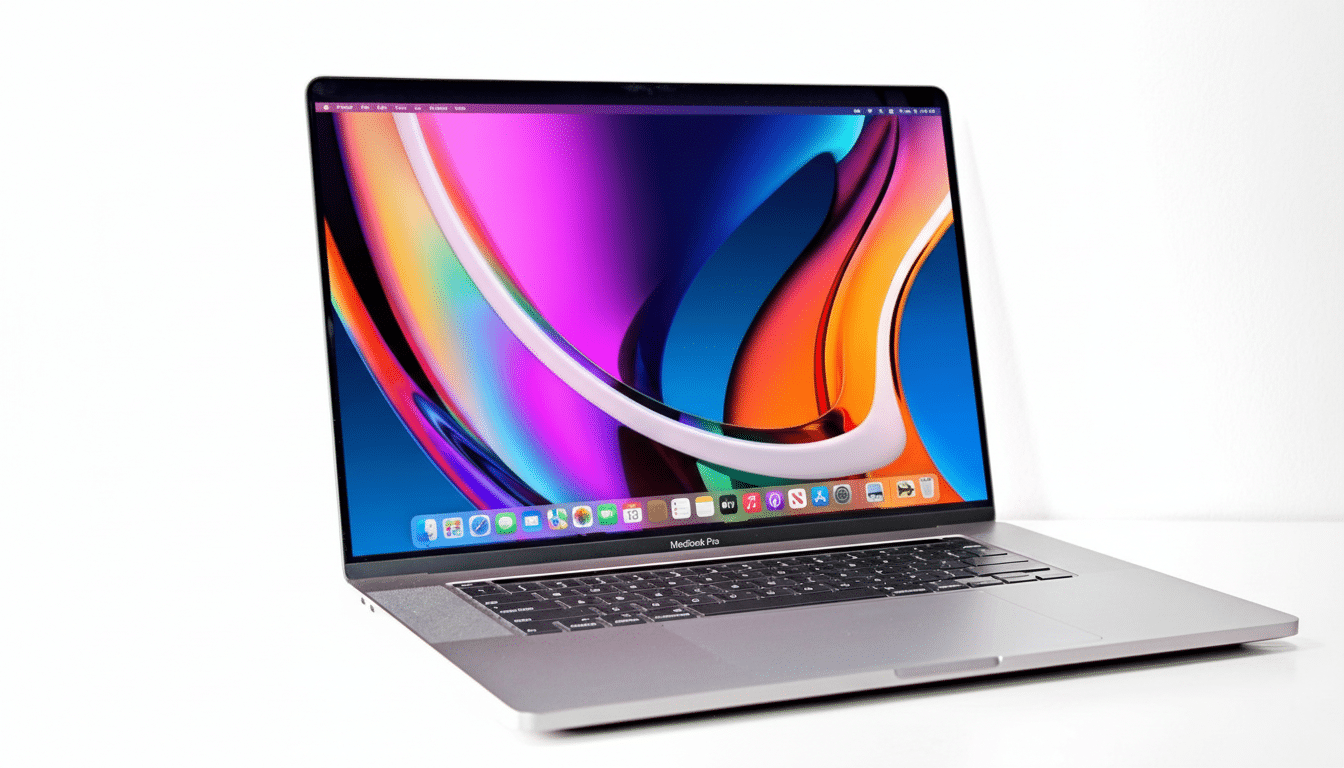
What matters day to day is how these gains compress time on common tasks: batch image generation and upscaling without cloud roundtrips, multi-node color grades on 8K timelines, Redshift and Metal-accelerated 3D previews that hold higher frame rates, and faster local LLM iterations when prototyping features. For teams wary of shipping assets or prompts to external servers, stronger on-device AI throughput is more than a spec—it’s a workflow shift.
Connectivity, Storage Improvements, and Battery Life
Beyond compute, Apple is introducing its N1 wireless chip to improve Wi‑Fi and Bluetooth performance and reliability—a welcome upgrade for offices dense with devices and for creators who rely on low-latency peripherals. The company also reiterates up to 24 hours of battery life, a figure that, if it holds in mixed pro use, remains a differentiator against similarly powerful mobile workstations.
The baseline move to 1TB on Pro models and 2TB on Max configurations acknowledges the reality of modern asset sizes. High-bitrate ProRes, multi-cam RAW, and complex Unreal or Unity projects quickly overwhelm 512GB. Starting higher curbs the need for external scratch drives on day one, even if many studios will still lean on fast NVMe arrays.
Pricing Changes and the Current Market Context
Raising prices while boosting base specs is a calculated bet. The MacBook Pro competes against premium Windows creator laptops—think XPS 16, ThinkPad P1, and Razer Blade configurations—that often bundle high-wattage discrete GPUs. Apple’s answer continues to be efficiency, unified memory, and rapidly growing Metal and on-device AI performance. For buyers, the calculus comes down to the software stack: if your pipeline favors DaVinci Resolve, Final Cut Pro, Logic, Redshift on Metal, and native AI tools, these M5 systems may return time savings that justify the uplift.
Bottom Line for Buyers Considering the New Models
The new MacBook Pro with M5 Pro and M5 Max aims squarely at creators and developers who value sustained performance, faster local AI, and longer battery life in a portable chassis. Apple’s performance projections—spanning image generation, LLM prompts, 3D rendering, video effects, and even ray‑traced gaming—paint a clear picture of where the platform is headed. If Apple’s numbers hold up in independent reviews, this will be the most compelling jump for pro users since the transition to M1—just budget for the higher entry point.
