


Apple’s March showcase is moving fast, and the company isn’t waiting for the stage to drop news. In the hours leading up to its “special Apple Experience,” Apple has already unveiled new MacBook Pro and MacBook Air models with M5 silicon, a refreshed M4 iPad Air, and an entry iPhone 17e that raises the baseline for storage and features. Here are the key announcements and what they mean for buyers and pros following along in real time.
Everything Announced So Far at Apple’s March Event
Apple’s MacBook Pro lineup moves to M5 Pro and M5 Max, boosting CPU and graphics performance and leaning into on‑device AI with a larger Neural Engine. The MacBook Air jumps to the M5 as well, bringing faster storage and wireless upgrades while holding onto its winning thin‑and‑light design.
- Everything Announced So Far at Apple’s March Event
- MacBook Pro with M5 Pro and M5 Max: Specs and Pricing
- MacBook Air with M5: Performance, storage, and price
- iPad Air with M4 brings faster AI and accessory support
- iPhone 17e raises the floor with A19 and 256GB base
- Why The Wireless And I/O Upgrades Matter
- Availability and what to watch next after announcements
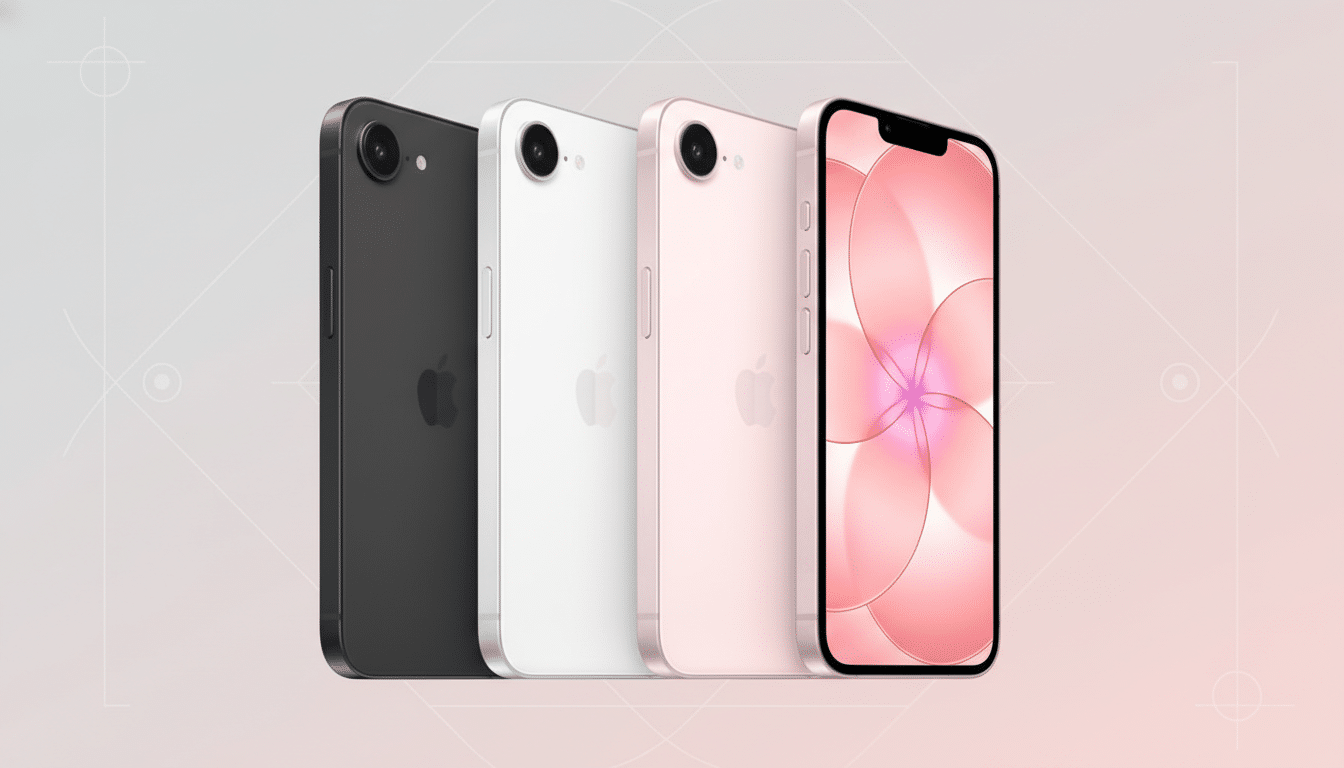
The iPad Air advances to M4, slotting closer to Pro‑class capability for creative and productivity apps, and the iPhone 17e arrives as a more capable entry phone with an A19 chip, 48MP camera, and a doubled base storage of 256GB.
MacBook Pro with M5 Pro and M5 Max: Specs and Pricing
The new 14-inch and 16-inch MacBook Pro models center on Apple’s latest Fusion architecture, unifying CPU, GPU, and Neural Engine on a single SoC to minimize memory copies and latency. Configurations scale up to an 18-core CPU, with higher‑core GPUs designed to accelerate 3D rendering, code builds, and media pipelines.
Connectivity also gets a leap: Wi‑Fi 7 and Bluetooth 6 arrive via Apple’s N1 wireless platform, and Thunderbolt 5 expands I/O headroom for external storage and high‑resolution displays. For context, Intel’s Thunderbolt 5 spec enables up to 80 Gbps bandwidth with 120 Gbps for display‑intensive bursts, which should translate to smoother multi‑monitor workflows.
Memory ceilings climb to 64GB on M5 Pro and 128GB on M5 Max, and every configuration now starts with a 1TB SSD. Pricing starts at $2,199 for the 14-inch M5 Pro and $2,699 for the 16-inch, while M5 Max models begin at $3,599 and $3,899, respectively.
MacBook Air with M5: Performance, storage, and price
The latest MacBook Air keeps its fanless, ultraportable design while adopting a 10‑core CPU and 10‑core GPU M5 chip, plus 16GB of unified memory as standard. Apple also doubles the base storage to 512GB with faster SSD speeds, which addresses a longstanding bottleneck for photo libraries and code projects alike.
Wi‑Fi 7 and Bluetooth 6 arrive here too, and Apple says battery life still reaches up to 18 hours. Support for two external displays returns, which has become a must for remote and hybrid work setups. Pricing begins at $1,099 for 13‑inch and $1,299 for 15‑inch models.
iPad Air with M4 brings faster AI and accessory support
iPad Air moves to M4 with an 8‑core CPU, 9‑core GPU, and a 16‑core Neural Engine aimed at on‑device AI tasks in iPadOS. This matters for features like background object selection in photos and real‑time transcription, which run faster and more privately when processed locally.

N1 wireless enables Wi‑Fi 7, Bluetooth 6, and Thread for smart home compatibility, while cellular models adopt Apple’s C1X modem for improved efficiency. Accessory support spans Apple Pencil Pro, Apple Pencil (USB‑C), and Magic Keyboard. Prices hold at $599 for 11‑inch and $799 for 13‑inch variants.
iPhone 17e raises the floor with A19 and 256GB base
Apple’s new entry iPhone 17e brings the A19 chip with a six‑core CPU, four‑core GPU with hardware‑accelerated ray tracing, and a 16‑core Neural Engine. The 6.1‑inch Super Retina XDR OLED display is paired with a single 48MP Fusion camera designed to capture richer detail and night shots without juggling multiple lenses.
MagSafe and Qi2 wireless charging are on board, along with the C1X modem. The base model now starts at 256GB for $599 and comes in black, white, and soft pink. Counterpoint Research has noted that Apple’s entry‑tier devices often serve as powerful switcher magnets; a higher storage floor makes that pitch stronger for buyers who live in photos and messages.
Why The Wireless And I/O Upgrades Matter
Wi‑Fi 7 (IEEE 802.11be) brings wider channels and Multi‑Link Operation that can reduce latency and stabilize throughput in congested apartments and offices. Creators syncing gigabytes to cloud drives or streaming ProRes will feel the difference more than a synthetic benchmark might suggest.
Thunderbolt 5’s bandwidth lift opens the door to faster NVMe arrays and cleaner multi‑display setups for color work or development dashboards. Combined with larger unified memory pools, that’s meaningful for local AI inference, where models benefit from high memory bandwidth and zero‑copy access between the CPU, GPU, and Neural Engine.
Availability and what to watch next after announcements
Preorders are opening across the lineup with retail availability to follow. Apple is staging in‑person “Experience” sessions in New York, London, and Shanghai, with demos expected to highlight AI‑assisted creative workflows across macOS and iPadOS.
If you’re deciding where to spend, the short version is this: pick MacBook Pro for sustained performance and larger memory ceilings, MacBook Air for maximum portability with fewer tradeoffs than before, iPad Air for a capable tablet that now edges closer to Pro territory, and iPhone 17e if you want modern silicon, a 48MP camera, and 256GB at an aggressive price. We’ll continue tracking announcements as Apple’s event unfolds.
