


You know the awkward bit with column radiators: the colour choice feels like pure décor, yet it changes how the whole room reads.
This column radiator colour guide UK compares anthracite, black, and white finishes, so you can pick a shade that suits the room and still hits your target BTUs.
- Key Takeaways
- Overview of Column Radiators (Column radiator colour guide UK basics)
- What are column radiators and how do they work?
- What are the main features of column radiators?
- Anthracite Column Radiators
- What makes anthracite radiators modern and stylish?
- Which rooms are best suited for anthracite radiators?
- Black Column Radiators
- How do black radiators create a bold and sophisticated look?
- What are the best spaces for black radiators?
- White Column Radiators
- Room-by-room choices and sizing checks
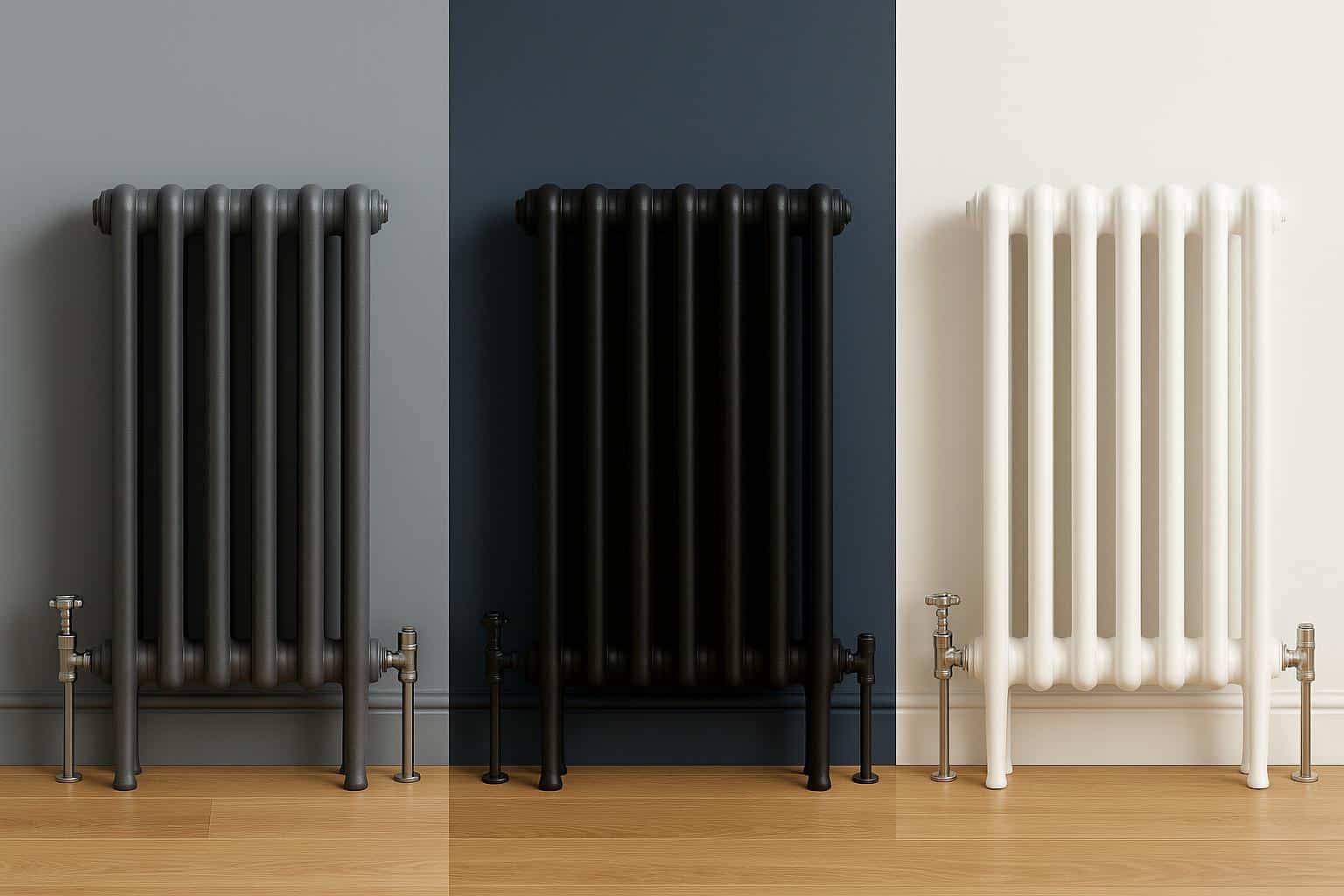
Start with the BTU calculator from Planet Radiators, then use this guide to choose a finish that works with your paint, flooring, and metalwork.
We will cover what each colour does visually, the best room matches, and the sizing checks that stop a “great looking” radiator from feeling underpowered.
Key Takeaways
- BTU output varies far more by size and column count than by colour. For example, manufacturer specs for popular 600×785mm, 3‑column models often list roughly 3,200 to 3,500 BTU at the UK-standard ΔT50 test condition, so treat any “one size fits all” number with caution.
- Colour has a tiny impact on performance once the radiator is factory finished. A 2025 trade feature in Homebuilding notes the difference between matt black and other matt colours is typically about 1%, so base your choice on the room’s style and maintenance needs, not efficiency myths.
- Check the rating condition, not just the headline BTUs. Outputs are commonly shown at ΔT50 (the common comparison point for UK radiators), and they can drop sharply at lower-flow systems, so always compare like-for-like if you are planning for a heat pump.
- Quick room matching: Anthracite column radiators UK tend to suit busy kitchens and open-plan living spaces, black column radiators UK are strongest as a feature in halls and offices, and white column radiators UK stay the easiest choice for bright kitchens and bathrooms.
Overview of Column Radiators (Column radiator colour guide UK basics)
Column radiators heat your room in two ways: they warm the air that moves around them (convection) and they also radiate heat from their surface.
In practice, that means the shape (height, width, and how many columns) is what drives most of the real-world comfort, not whether the paint is anthracite, black, or white.
If you are comparing products, make sure you are comparing the same output standard. Industry guidance around BS EN 442 commonly uses ΔT50 as the UK comparison point, which helps you compare like-for-like across brands.
Quick conversion for specs: 1 watt of radiator output equals about 3.412 BTU/h, so you can sanity-check BTUs vs watts if a listing only shows one unit.
- Output: BTUs (and watts) at the stated ΔT rating.
- Projection: How far the radiator sits from the wall, especially for hallways.
- Controls: Whether you will fit a TRV or a smart thermostatic head for room-by-room comfort.
What are column radiators and how do they work?
A column radiator uses vertical tubes grouped into “columns” (often 2 to 6) to create a larger surface area than a flat panel of the same footprint.
Hot water flows through those tubes, the metal warms up, and heat spreads into the room across a lot of evenly heated surface.
The biggest choice is usually space vs output: more columns generally give you more heat for the same height and width, but they also project further into the room.
- Measure your usable wall: include skirting, sockets, and door swing clearance.
- Check your pipe position: matching existing pipe centres can save you time and plumbing cost.
- Choose your orientation: horizontal models suit under windows, vertical models suit narrow walls in hallways.
- Size with a calculator: use a BTU tool (like Planet Radiators) as a starting point, then pick the nearest output up, because it is easier to turn a radiator down than to force an undersized one to cope.
If a radiator starts gurgling or has cold spots, bleeding it can help. If the problem returns, your system may need balancing or sludge treatment, so it is worth asking a heating engineer to check the wider circuit rather than blaming the radiator finish.
What are the main features of column radiators?
Column radiators are popular in UK homes because you can get strong heat output without resorting to a very deep, finned panel radiator.
Typical ranges include compact low-height options (useful under windows) and tall vertical designs that reclaim wall space in corridors.
Most retailers let you filter by height, width, number of columns, and output in watts or BTU, which is exactly how you should shortlist.
| Feature to compare | What it affects | What to do in practice |
|---|---|---|
| ΔT rating shown (ΔT50 vs lower-temperature ratings) | How “real” the BTU number is for your system | Match the listing to your intended flow temperature, and look for both ΔT50 and low-temperature outputs if you are planning a heat pump |
| Column count (2 to 6) | Output and wall projection | If you are tight on space, go taller before you go deeper |
| Finish type (matt, satin, gloss, textured) | Fingerprints, cleaning, and how light hits the radiator | Choose textured or satin in busy zones, and gloss where you want wipe-clean simplicity |
You will often see anthracite listed as RAL 7016, with black and white offered in various standard RAL shades depending on the manufacturer.
Warranty periods vary by brand and range, but five years is common on many steel column radiators, with longer cover available on some premium lines.
Anthracite Column Radiators
Anthracite column radiators UK are the easy “modern classic”. They give you the depth and contrast of a dark radiator, without the hard edge of pure black.
They also suit the way many UK renovations already use anthracite on window frames and external doors. Several UK window and door colour guides list Anthracite Grey (RAL 7016) as a staple shade, which makes matching finishes across a home much simpler.
What makes anthracite radiators modern and stylish?
Anthracite sits in a sweet spot: it looks deliberate, yet it does not dominate the room.
Most anthracite finishes you will see online are variants of RAL 7016, sold as matt, satin, gloss, or a lightly textured coat.
- For a clean, architectural look: pair anthracite with off-white walls and black or brushed steel valves.
- For warmer schemes: anthracite works well with oak, walnut, and warm greys because it anchors the palette without looking stark.
- For busy family spaces: a satin or textured anthracite finish tends to disguise small marks better than a high-gloss surface.
Style shortcut: treat anthracite as a “bridge colour” between black accents (handles, lighting) and lighter walls.
If you want the radiator to blend rather than feature, place it on a darker wall tone. If you want it to look intentional and premium, place it on a light wall and match the valves.
Which rooms are best suited for anthracite radiators?
Anthracite is a strong all-rounder for UK homes because it balances practicality with a modern finish.
The key is to choose the right shape for the room first, then decide if anthracite should be a feature or a supporting element.
- Best radiator colour for kitchen UK: Anthracite works well against white, cream, or wood cabinetry, and it is forgiving in a room where splashes and scuffs happen. If your kitchen is small, consider a vertical anthracite column radiator on a narrow wall to keep cabinetry runs clear.
- Living rooms: Choose a wider horizontal model if you have the wall space, because it spreads warmth more evenly across seating areas.
- Best radiator colour for hallway UK: Anthracite is often the safest “dark” choice for hallways because it adds contrast without making a narrow space feel like a tunnel. A tall vertical radiator can help you keep clear walkways.
- Best radiator colour for bedroom UK: Anthracite can look calm and grown-up in bedrooms with warm neutrals, but pick a softer finish (matt or satin) to avoid a harsh look under bedside lighting.
On outputs, treat any single BTU figure as model-specific. For example, common 600×785mm, 3‑column radiators are often listed around 3,239 to 3,475 BTU at ΔT50, while a 600×1010mm, 4‑column can be listed around 5,500 to 5,800 BTU at the same ΔT50 condition, depending on the range.
Black Column Radiators
Black column radiators UK are the boldest option in this guide. Done well, they look intentional and high-end, especially in spaces with strong lines and good lighting.
What matters most is finish choice. Matt and textured blacks tend to look richer and hide everyday marks better than a high-gloss black in busy zones.
On heat output, the colour itself is rarely the deciding factor. A UK heating retailer FAQ notes that factory powder-coated colours do not meaningfully change heat output, while DIY repainting with multiple coats can start to affect performance.
How do black radiators create a bold and sophisticated look?
Black reads as a feature, so it works best when you repeat it elsewhere in the room.
You do not need to go full monochrome. Small details are enough to make the radiator feel “designed in”.
- Match the metalwork: Black valves and pipe sleeves stop the installation looking like an afterthought.
- Balance with texture: Timber, rattan, boucle, and matte paint finishes keep black from feeling cold.
- Use lighting to your advantage: Wall lights and lamps create soft highlights on the columns, which helps the shape look premium.
- Pick the right sheen: Textured or satin black is often easier to live with in family homes than a mirror-gloss finish.
What are the best spaces for black radiators?
Black is at its best where you want a focal point or a “frame” effect.
- Best radiator colour for hallway UK (feature look): A vertical black column radiator can look striking against a warm white wall, particularly if you have a runner and black accents in frames or lighting.
- Home offices: Black works well with darker desks, shelving, and screens, so the radiator visually disappears while still feeling deliberate.
- Living rooms: Use black when the radiator sits on a feature wall or near a fireplace breast, where a bold object feels natural.
- Bathrooms with a monochrome scheme: Black can look sharp, but it shows limescale more readily than white in hard-water areas, so plan on more frequent wiping.
If you are choosing between black and anthracite, think about contrast. Black is a statement; anthracite is a controlled, softer version of the same idea.
White Column Radiators
White column radiators UK are the simplest way to keep your heating looking “built in”. In many homes, white still matches skirting, ceilings, and window trim, so the radiator becomes visually quiet.
White is also the easiest colour for bright, hygiene-focused rooms, which is why it stays popular in kitchens, bathrooms, and utility areas.
Many manufacturers specify white using standard RAL shades such as RAL 9016 (often called Traffic White) or RAL 9010 (a warmer white), so it is worth checking the spec if you are colour-matching paint or cabinetry.
Why are white radiators classic and versatile?
White works because it does not compete with anything else in the room.
If you plan to repaint or change furniture later, a white radiator rarely forces you into a new palette.
- For smaller rooms: White keeps the walls feeling more open, because the radiator does not visually “cut” the wall into blocks.
- For period properties: White suits traditional mouldings, cast-iron-inspired styling, and painted woodwork.
- For maintenance: A good powder-coated white finish cleans up easily with a soft cloth, and it tends to hide dust better than a glossy black in strong daylight.
Which rooms suit white radiators best?
White is usually the safest choice in rooms where you want brightness and a clean backdrop.
- Best radiator colour for kitchen UK (clean and bright look): White helps a kitchen feel larger, especially if your cabinets and walls are light. If you cook a lot, consider a slightly warmer white (where available) so small marks are less obvious.
- Bathrooms: White towel radiators stay popular because they blend with sanitaryware and keep the room looking fresh.
- Best radiator colour for bedroom UK (calm and low-contrast): White is the easiest way to keep bedrooms restful, particularly if you use layered neutrals and soft textiles.
- Hallways and landings: If your trim is white, a white radiator usually looks intentional and tidy without needing extra styling.
If you like the idea of white but want a more “designer” look, choose a column design with chunkier sections. The shape gives you the impact, while the colour keeps the room light.
Room-by-room choices and sizing checks
If you want a quick decision, pick the colour based on what the room needs to do, then validate the size with your BTU number.
For temperature targets, the MCS heat load calculator reference data (derived from CIBSE guidance) commonly uses 21°C for living spaces and 22°C for bathrooms, which is a useful baseline for sizing. For health and comfort in colder weather, UK government winter guidance also suggests heating rooms you use most to at least 18°C.
| Room | Best colour choice (most homes) | Why it works | Practical sizing note |
|---|---|---|---|
| Kitchen | White or anthracite | White keeps it bright, anthracite hides scuffs and ties in with darker hardware | Cooking moisture can drive condensation on cold surfaces, so avoid undersizing and use a TRV to keep temperature steady |
| Hallway | Anthracite or black | Dark tones add structure in transitional spaces and look good as vertical features | Vertical radiators are useful where wall width is limited, but check projection so it does not pinch the walkway |
| Bedroom | White (safe) or anthracite (moody) | White stays calm and flexible, anthracite adds a hotel-like feel with the right lighting | If you sleep cooler, you may not need a huge radiator, but keep enough output to bring the room up quickly on cold evenings |
| Living room | Anthracite or black (feature wall), white (blend-in) | Living rooms handle stronger contrast well because you have more furnishings to balance the radiator | Compare BTUs at the same ΔT rating, especially if your boiler runs lower flow temperatures for efficiency |
| Bathroom | White (most versatile) or black (monochrome schemes) | White matches sanitaryware, black looks sharp but can show limescale | Bathrooms are often sized to a higher target temperature than other rooms, so check the BTU requirement carefully |
Conclusion
Once you see radiators as part heat source, part “wall furniture”, the choice between anthracite, black, and white gets much easier.
Use this column radiator colour guide UK to decide the look first, then confirm the size with your BTUs so the room feels right on the coldest days.
As a final check, confirm the ΔT rating shown on the product listing, match the finish to your room’s wear and tear, and choose valves that suit how you actually live in the space.
- Anthracite: Modern, forgiving, and great for kitchens, living rooms, and hallways.
- Black: Best as a statement in halls and home offices, especially with matching valves.
- White: The clean classic for kitchens, bathrooms, and lighter bedrooms.
- Next step: Run your room through the Planet Radiators BTU calculator, then pick a size that meets or slightly exceeds the target.
FAQs
1. Which colour works best in a living room, Anthracite vs Black vs White column radiators?
Dark grey, often called anthracite, gives a modern, cosy feel and hides small marks. White keeps the room light and airy. Black adds drama, but you need strong decor to balance it.
2. Are white column radiators best for bathrooms?
Yes. White blends with tiles and reflects light, so the space feels clean and bright.
3. Is black practical in a kitchen?
Black hides grease splashes better than white, but it can show dust and fingerprints. It does not cut heat output, that is a myth; choose black if you want a bold look.
4. How should I pick a colour for small rooms or open-plan spaces?
In small rooms pick white or light tones to boost light and make the space feel larger. For open-plan use one colour across all column radiators to link zones, or pick anthracite for contrast and test a sample first.

