


Android travelers finally have a native way to put their Bluetooth trackers to work when an airline misplaces a bag. Google is rolling out a secure location-sharing feature in its Find Hub app that lets users generate a unique link for a tagged suitcase and hand that location data directly to participating carriers—closing a long-standing gap between consumer trackers and airline baggage systems.
How the new sharing tool works in Android’s Find Hub
Within the Find Hub app, users select the missing item and tap “share item location” to create a one-time URL. That link can be pasted into an airline’s mobile app or a web form during a baggage claim. The page shows the bag’s last-seen and recently-seen locations as detected by the crowdsourced Android network, helping agents pinpoint whether a suitcase is still at the origin airport, stuck at a transfer point, or already on its way.
- How the new sharing tool works in Android’s Find Hub
- Airlines on board at launch for Find Hub link sharing
- Why this matters for lost and delayed checked bags
- Privacy and safety safeguards built into Find Hub links
- How it compares with iPhone AirTag sharing workarounds
- What travelers should do now to prepare for lost luggage

To balance visibility with safety, the link automatically expires after seven days, and sharing stops as soon as the owner’s phone detects the bag is back in proximity. That means airline staff get just enough access to help route the bag home without indefinite tracking privileges. The feature supports Find Hub–compatible tags, which broadcast encrypted Bluetooth signals picked up passively by nearby Android devices.
Airlines on board at launch for Find Hub link sharing
Google says more than 10 airlines are already accepting Find Hub links as part of their standard recovery workflow. The initial roster includes AJet, Air India, China Airlines, the Lufthansa Group (Lufthansa, Austrian Airlines, Brussels Airlines, and Swiss International Air Lines), Saudia, Scandinavian Airlines, and Turkish Airlines, with more partners expected.
Operationally, the shared link can be attached to a passenger’s baggage file—often managed via systems such as SITA’s WorldTracer—so agents across stations see the same live breadcrumb trail. That aids triage: a bag that just pinged in the arrival hall calls for a local sweep, while one last seen at a hub may need interline coordination or customs clearance before the next flight.
Why this matters for lost and delayed checked bags
Despite major industry investments, mishandled luggage remains a stubborn pain point. The latest SITA Baggage IT Insights report puts the global mishandled-bag rate at roughly 6.9 per 1,000 passengers. That figure translates into millions of wayward items a year—and countless hours on customer service lines—especially during disruptions and tight connections.
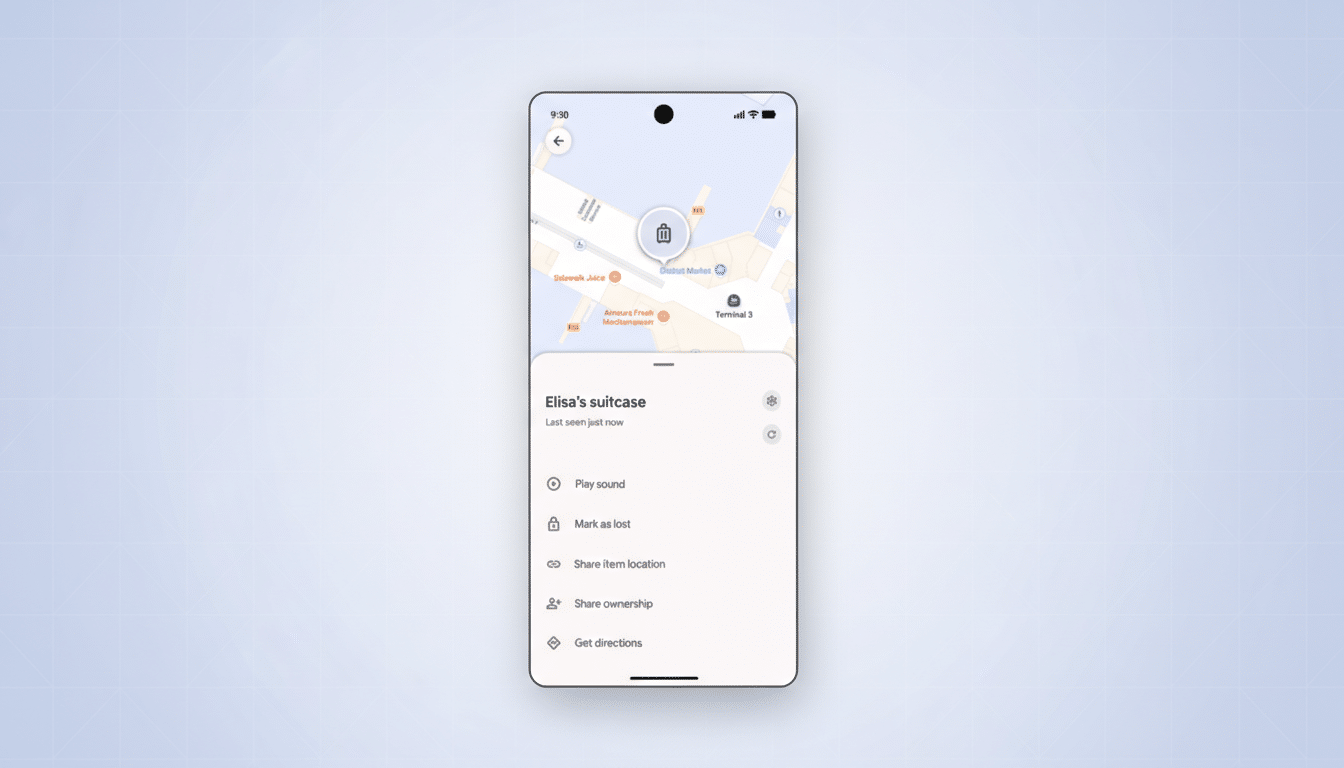
Consumer trackers have already proven their value informally, with passengers using them to nudge airlines toward the right carousel or remote storeroom. The difference now is process: by embedding a standardized, time-limited link into the claim, agents gain real-time context without relying on screenshots or back-and-forth messaging. In practical terms, that can shave days off recoveries that once waited on the next scan or a manual inventory sweep.
Privacy and safety safeguards built into Find Hub links
Location sharing through Find Hub is intentionally narrow. Airlines see item locations, not the owner’s phone data or identity beyond what the baggage claim already contains. The automatic seven-day expiration reduces lingering exposure, and sharing shuts off the moment the device detects reunion with the bag. Android also supports unwanted-tracker alerts, part of a broader cross-platform push to deter misuse of Bluetooth tags by notifying people if an unknown tracker is moving with them.
For carriers, the structure helps satisfy internal compliance teams: no logins to manage, no permanent device IDs to store, and a clear audit trail attached to a claim. For travelers, it provides a clean opt-in that can be revoked at any time by deleting the share link.
How it compares with iPhone AirTag sharing workarounds
iPhone users have long leaned on AirTags and ad hoc sharing—sending screenshots or screen recordings to airline agents. Android’s new flow formalizes the handoff: a secure URL tied to an active case, built for airline tooling. Given that Android powers a majority of smartphones worldwide, according to StatCounter and IDC estimates, the move could normalize tracker-assisted recoveries for a far larger slice of travelers and markets.
What travelers should do now to prepare for lost luggage
- Attach a Find Hub–compatible tracker to each checked bag and register it before flying.
- If a bag goes missing, file a claim in the airline’s app or at the counter and include your Find Hub share link alongside the airline’s bag tag number.
- Keep the tracker’s battery fresh, add a visible name tag to the suitcase, and snap a quick photo before check-in to aid identification.
- If your carrier isn’t on the initial list, share the link in a chat with customer support or ask the agent to attach it to your file—many stations can still use it informally.
After years of passengers doing the detective work on their own, Android’s airline-sharing feature brings the bag’s location into the official recovery pipeline. It won’t prevent every mishap, but it gives airlines and travelers a common live map—and in the messy world of baggage logistics, that shared view is often the difference between a long wait and a quick reunion at the carousel.
