


Astronomers have identified an extraordinarily pristine star whose chemistry appears to be the undiluted ash of one of the universe’s first stellar explosions. The object, dubbed PicII-503, resides in the ultra-faint dwarf galaxy Pictor II and preserves an elemental fingerprint that points to a single, feeble supernova in the cosmic dawn.
The finding, reported in Nature Astronomy, offers a rare laboratory for testing how the first stars forged the ingredients that later built galaxies, planets, and eventually life. Scientists describe such relics as time capsules, because their atmospheres lock in the yields of long-vanished events that telescopes cannot observe directly.
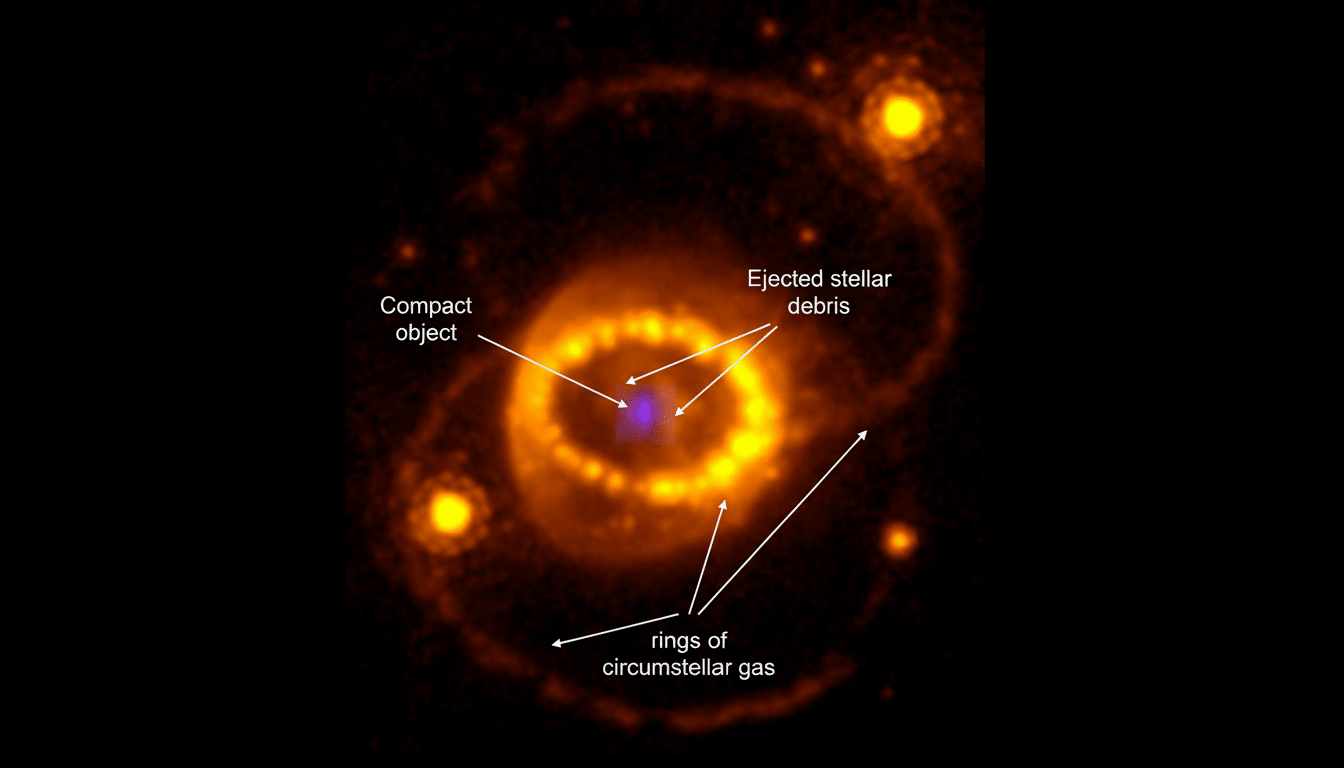
A Fossil From The Universe’s First Explosions
PicII-503 is chemically extreme. It contains less iron than roughly 1/40,000 of the Sun’s level and similarly depleted calcium, yet it is relatively rich in carbon. That unusual mix is the calling card of a “faint” primordial supernova, where the blast was so weak that heavy elements like iron fell back into the collapsed remnant while lighter elements such as carbon escaped into space.
Located about 600,000 light-years away in the constellation Pictor, the star likely formed more than 10 to 12 billion years ago from gas tainted by just that one early stellar death. Because it shows almost no evidence of later enrichment, its atmosphere preserves the elemental recipe of the very first rounds of nucleosynthesis beyond hydrogen and helium.
Why This Star Stands Apart From Similar Ancient Finds
Ultra–metal-poor stars with similarly scant iron are known in the Milky Way halo, but PicII-503 is a standout: it sits outside our galaxy, inside a tiny satellite of a satellite—Pictor II orbits the Large Magellanic Cloud, which in turn orbits the Milky Way. That setting makes the case especially compelling for a single-progenitor origin and strengthens the link between early dwarf galaxies and the first enrichment events.
Researchers led by Stanford University’s Anirudh Chiti argue that the star’s composition is the clearest evidence yet of a low-energy, first-generation supernova shaping a later star’s birth without substantial contamination from subsequent explosions. As an observational benchmark, it tightens constraints on explosion energies, mixing, and yields in simulations of the earliest stars.
How Researchers Found PicII-503 In A Distant Dwarf Galaxy
The team identified promising candidates using the U.S. Department of Energy’s Dark Energy Camera on the National Science Foundation’s Víctor M. Blanco 4-meter Telescope in Chile, part of the NSF’s NOIRLab program. Photometric screening is an efficient way to flag stars that might be extremely iron-poor, after which targeted spectroscopy can quantify detailed abundances.
Pictor II is among the ultra-faint dwarf systems revealed over the past decade by deep sky surveys. These galaxies host sparse, ancient stellar populations, making them fertile ground for “stellar archaeology.” PicII-503 emerged from this search as an outlier: extraordinarily primitive and chemically consistent with formation from one weak supernova’s ejecta.
Clues To Galaxy Building From Ultra-Faint Dwarfs
The discovery supports a broader picture in which small, early galaxies seeded the chemical evolution of larger ones. Over billions of years, systems like Pictor II were cannibalized, contributing their oldest stars and unique chemistries to growing galaxies, including the Milky Way. Finding such a pure relic beyond our galaxy demonstrates that these building blocks retained early-universe signatures.
Notably, PicII-503 lies far from its host galaxy’s center. That placement hints that the most ancient, chemically pristine stars may preferentially inhabit the outskirts of dwarf galaxies—a valuable cue for future searches seeking the faintest chemical imprints of the first stars.
What Comes Next For Probing The Universe’s First Stars
Because even NASA’s James Webb Space Telescope cannot yet isolate individual first-generation stars at high redshift, nearby fossils like PicII-503 are essential. Each one provides precise abundance ratios—carbon, iron, calcium, and more—that modelers can use to test supernova physics at the dawn of time.
New wide-field surveys and deeper spectroscopy will expand the sample. Facilities linked to NOIRLab and upcoming campaigns such as the Rubin Observatory’s Legacy Survey of Space and Time are poised to uncover more candidates. As Chris Davis of NSF’s NOIRLab has noted in describing this field, such finds amount to cosmic archaeology—unearthing rare stellar relics that preserve the fingerprints of the universe’s first stars.
For now, PicII-503 stands as a remarkably intact shard of the early cosmos, a star formed from the ashes of a single, gentle explosion that helped write the first chemical chapter of the universe.

