


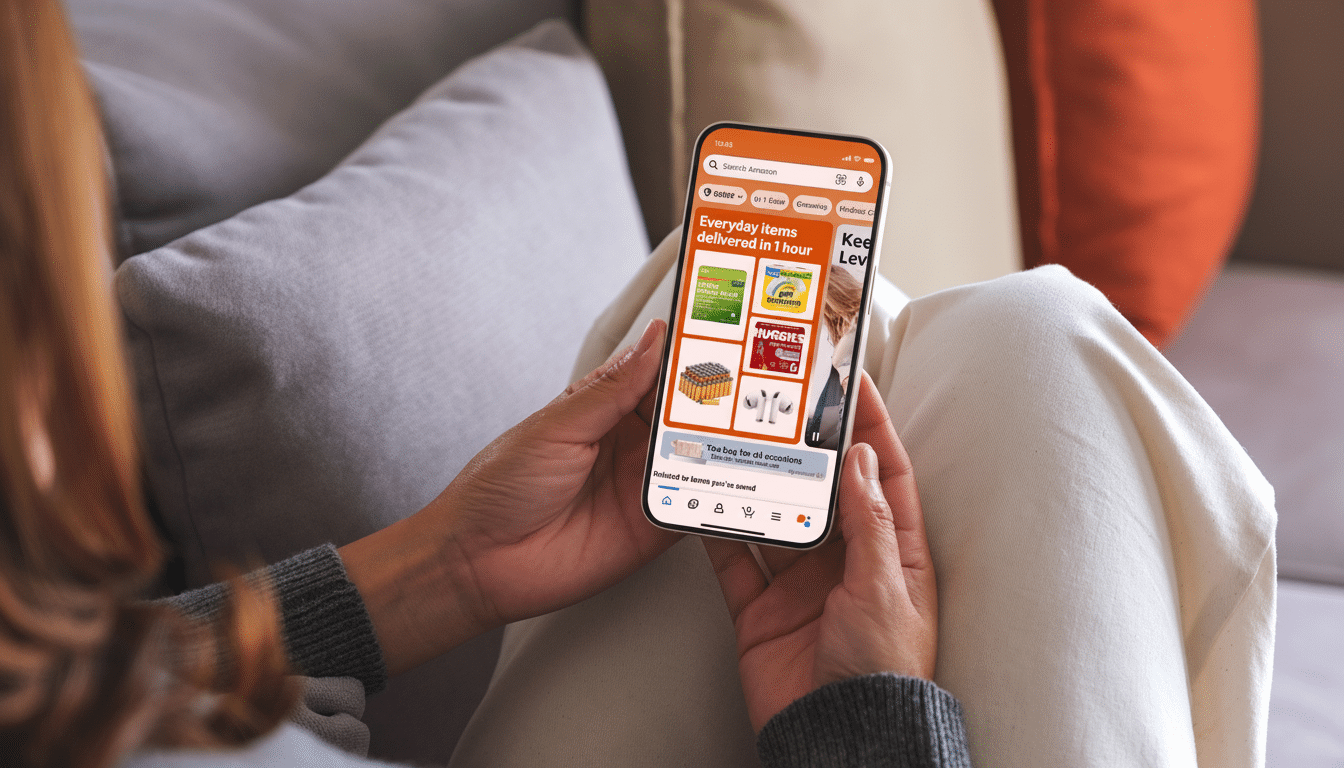
Amazon is rolling out ultra-fast delivery choices in the United States, introducing new 1-hour and 3-hour options that appear directly on eligible product pages in the app and on the site. The move targets the rapid-commerce turf staked out by Instacart, DoorDash, and Uber Eats while extending Amazon’s same-day infrastructure into shorter, predictable delivery windows.
The company says more than 90,000 items are initially eligible, spanning everyday essentials and popular general merchandise. Prime members will pay $9.99 for 1-hour and $4.99 for 3-hour delivery, while non-Prime customers face $19.99 and $14.99 fees, respectively. Availability will scale across hundreds of cities for 1-hour and more than 2,000 cities and towns for 3-hour.
- What Amazon Is Rolling Out With New 1-Hour And 3-Hour Delivery Options
- Where The Service Is Live Across US Cities And Towns
- Pricing And Prime Positioning For Ultra-Fast Delivery
- How It Stacks Up Against Rivals In Quick Commerce
- Operational Playbook And Assortment For Speed
- A Return To Instant With Global Lessons Learned
- What To Watch Next As The Rollout Scales Across Markets
What Amazon Is Rolling Out With New 1-Hour And 3-Hour Delivery Options
Shoppers will see a clear badge next to items that qualify for these windows, along with a new filter to surface only products available in one or three hours. Amazon is also launching a dedicated storefront that consolidates all eligible items, reducing search friction and nudging impulse and last-minute purchases into a single place.
Under the hood, Amazon says the program rides on its existing same-day fulfillment network, not pop-up dark stores. That approach allows the company to tap high-velocity inventory already positioned closer to dense customer clusters and to route orders across its delivery service partners and in-house capacity with minimal retooling.
Where The Service Is Live Across US Cities And Towns
The 1-hour option is launching in parts of major metros such as Los Angeles, Chicago, and Washington, D.C., as well as smaller markets like Des Moines, Boise, and American Fork. The 3-hour window blankets a wider footprint—more than 2,000 cities and towns—aimed at predictable afternoon and evening replenishment rather than pure instant gratification.
Expect coverage to vary by neighborhood and by item, reflecting inventory placement and courier capacity. As with Amazon’s same-day promise, coverage typically deepens as the company tunes assortment and demand patterns market by market.
Pricing And Prime Positioning For Ultra-Fast Delivery
For Prime members, the 3-hour fee undercuts many “rush” surcharges seen in quick-commerce apps, and the 1-hour price sits at the high end but with a far broader catalog than restaurant or grocery-focused rivals. The pricing strategy squarely reinforces Prime’s value proposition: subsidized speed at scale. Consumer Intelligence Research Partners has estimated that U.S. Prime membership exceeds 150 million, making even modest attach rates a meaningful lever for incremental margin and loyalty.
For non-Prime shoppers, the steeper fees function as a conversion funnel. If Amazon can consistently deliver on time within these tight windows, the delta between paying per order and subscribing becomes a persuasive nudge toward Prime—especially for households that already rely on Amazon for weekly essentials.

How It Stacks Up Against Rivals In Quick Commerce
Instacart and DoorDash built demand for sub-two-hour deliveries in groceries and convenience, but their catalogs and fulfillment depend heavily on third-party retailers. Amazon’s bet is different: compress delivery promises on a multi-category, first-party assortment, then weave in marketplace SKUs where feasible. That integrated model enables tighter control over inventory, substitutions, and unit economics.
The key constraint is cost. Multiple analyses, including research from McKinsey, suggest last-mile logistics account for over 50% of total shipping expense. Amazon’s advantage is its dense same-day nodes, regionalized inventory, and forecasting systems that can pre-position high-velocity items closer to demand. The wider the eligible assortment and the higher the drop density, the more palatable the economics become.
Operational Playbook And Assortment For Speed
Expect Amazon to lead with categories where speed materially reduces churn—household essentials, pet supplies, over-the-counter health, tech accessories, and consumables. Those are predictable, repeatable items with favorable pick-and-pack times. The 90,000-item starting set is significant but intentionally curated to maintain service reliability and protect margin while demand ramps.
On the ground, the company can leverage dynamic batching, neighborhood routing, and micro-scheduling to balance 1-hour urgency with 3-hour efficiency. The storefront and app filters do more than aid discovery—they shape demand into time windows and zones where capacity is strongest, a tactic Amazon has refined in same-day operations.
A Return To Instant With Global Lessons Learned
This is not Amazon’s first sprint at instant delivery. The company’s Prime Now service, launched in 2014, offered one-hour drops before being folded into the core app in 2021. In late 2025, Amazon tested a 30-minute option in Seattle and Philadelphia, and internationally it has pushed even faster models—10-minute groceries in India and 15-minute delivery in the United Arab Emirates. The throughline: keep experimenting, but integrate successful formats into the main marketplace where selection and frequency can scale.
What To Watch Next As The Rollout Scales Across Markets
Three signals will reveal traction: how quickly the eligible assortment grows beyond the initial 90,000 items; how broad the 1-hour footprint becomes outside core metros; and whether promotional pricing emerges to stimulate off-peak demand. Also watch the spillover into fresh and pharmacy-adjacent categories, where speed drives repeat behavior.
Amazon’s operations chief for worldwide delivery framed the rollout as a time-saver for increasingly busy households and an added layer of value for Prime. If execution matches the promise, the company won’t just meet the instant-delivery bar—it could reset customer expectations for general merchandise speed across the U.S.
