


Josh Wardle is back with a new brain-twister, and this one isn’t playing nice. Parseword, his follow-up to the cultural juggernaut Wordle, swaps five-letter guesswork for cryptic-style reasoning, asking players to manipulate meanings, sounds, and letter fragments to make connections. The result is a sharper, denser puzzle that feels purpose-built for solvers who crave the aha more than the almost.
What Is Parseword and How the Puzzle Works
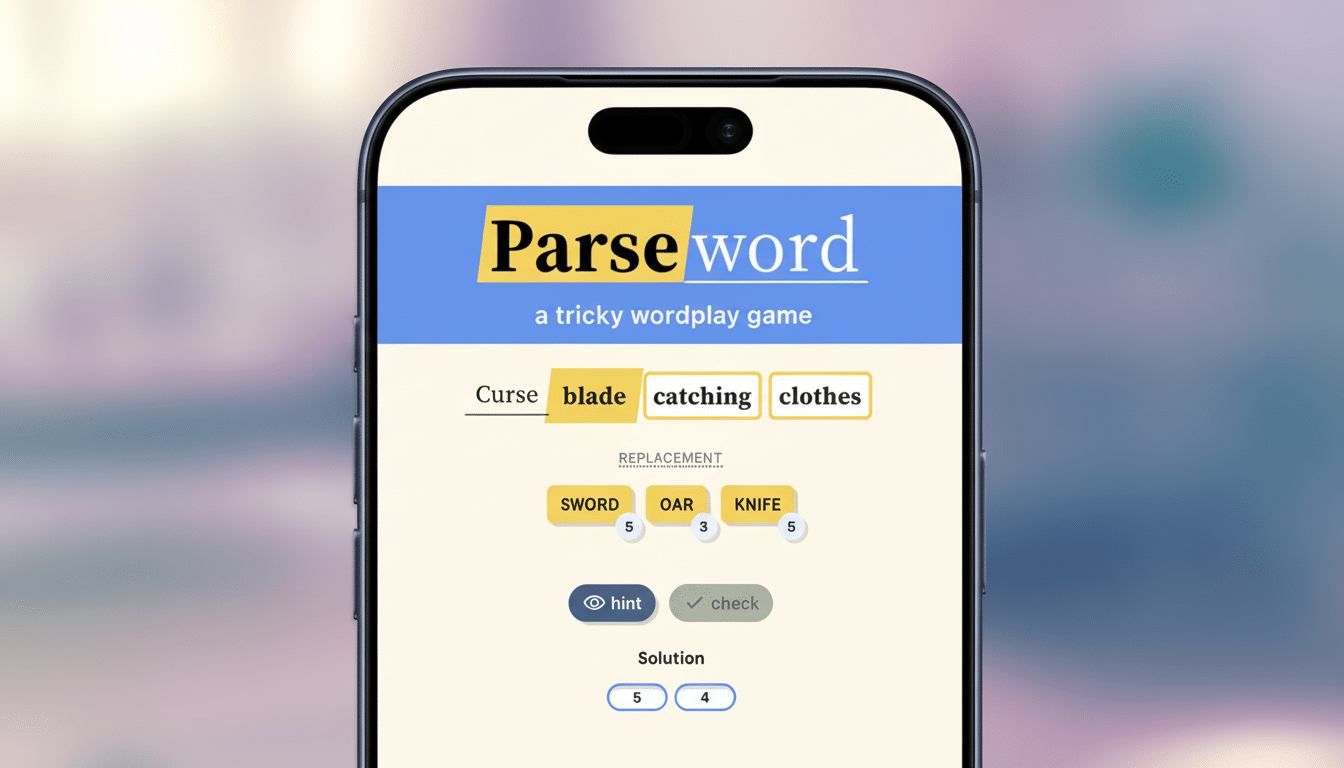
Instead of guessing a hidden word using positional feedback, Parseword lays out words and clues that must be linked through linguistic logic. You might take a root from one term, attach a prefix that changes meaning, or spot a sly homophone that bridges two ideas. Imagine turning “PORT” into “REPORT” by adding “RE,” then pivoting to “DEPORT” through a prefix swap; now apply that lateral movement across an entire network of clues. It’s less about letter slots and more about language as a living, shape-shifting system.
Wardle has built a friendly on-ramp: a guided tutorial and clear feedback when a step is logical but incomplete. Still, this is a cryptic-informed playground. Players familiar with devices like anagrams, containers (a word inside another), reversals, and hidden words will feel at home—eventually.
Why This One Feels Tougher than Wordle for Most Players
Wordle narrows the search space with color-coded constraints. Parseword does the opposite—it opens the dictionary. Each move requires you to consider multiple dimensions at once: definitions, synonyms, morphology, sound-alikes, and word-building mechanics. That multiplies the branching paths and raises the cognitive load.
Psycholinguistics research consistently shows that tasks juggling meaning and form simultaneously (think synonym finding plus letterplay) demand more working memory than single-mode puzzles. That’s why a straightforward five-letter deduction might take a minute, while a cryptic-style step can stall you until a subtle pattern finally clicks.
A quick illustration: a clue might nudge you from “NOTE” to “ANNOTATE” by suggesting “add to note,” then to “NOTATE” by trimming a prefix, and on to “ROTATE” via a one-letter shift indicated by a punny hint. None of these leaps are arbitrary; each is justified by clueing conventions—but recognizing the signal is the trick.
From Wordle to a Deeper, More Demanding Challenge
Wardle’s original hit began as a home project before exploding into a global habit. The New York Times, which acquired Wordle, has reported that the puzzle drew tens of millions of players at its peak and supercharged interest across its Games portfolio. Parseword feels like a deliberate zag: smaller in scope, bigger in depth, designed for solvers who relish craft over streaks.
In an interview highlighted by The New Yorker, Wardle suggested he wanted this release to feel intentional rather than viral lightning in a bottle. That framing shows in Parseword’s pace. It rewards patience and pattern-learning—more artisan workshop than arcade booth.
How to Improve at Parseword with Smart, Simple Habits
Start literal, then pivot. Test the plain-meaning reading first; if it stalls, look for signals that often mark cryptic devices—words like “about,” “inside,” “turn,” “sounds like,” “build,” or “remove.” These can hint at containers, reversals, homophones, or deletions.
Spot the building blocks. Common prefixes and suffixes—re, un, pre, anti, sub, -er, -ness, -able—often anchor legal moves. Likewise, short utility words (art, part, port, portend, report) can morph repeatedly with small edits.
Map possibilities. If a path feels promising but uncertain, note it and branch elsewhere. Skilled solvers keep multiple threads alive, then return once crossings clarify intent. In effect, you’re constructing a mini proof tree and pruning dead branches as feedback accumulates.
Practice pattern recognition. Exposure breeds intuition. British-style cryptic crosswords from outlets like The Guardian or The Times train the exact muscles Parseword flexes—seeing through surface readings and trusting fair-but-sneaky clueing.
A New Chapter for Daily Word Games and Puzzle Fans
Parseword arrives amid a sustained puzzle boom, from Wordle’s daily ritual to newer hits like Connections and an ever-growing appetite for bite-size brain work. But this isn’t just another snack. It’s a reminder that word games can be playful and scholarly at once—less a quick dopamine drip, more a slow-burn eureka.
If Wordle taught millions to love constraint, Parseword invites them to love ambiguity—patiently, cleverly, and one justified leap at a time. For seasoned solvers and curious newcomers alike, it’s a fresh challenge from a creator who understands how to make language feel like an adventure.

