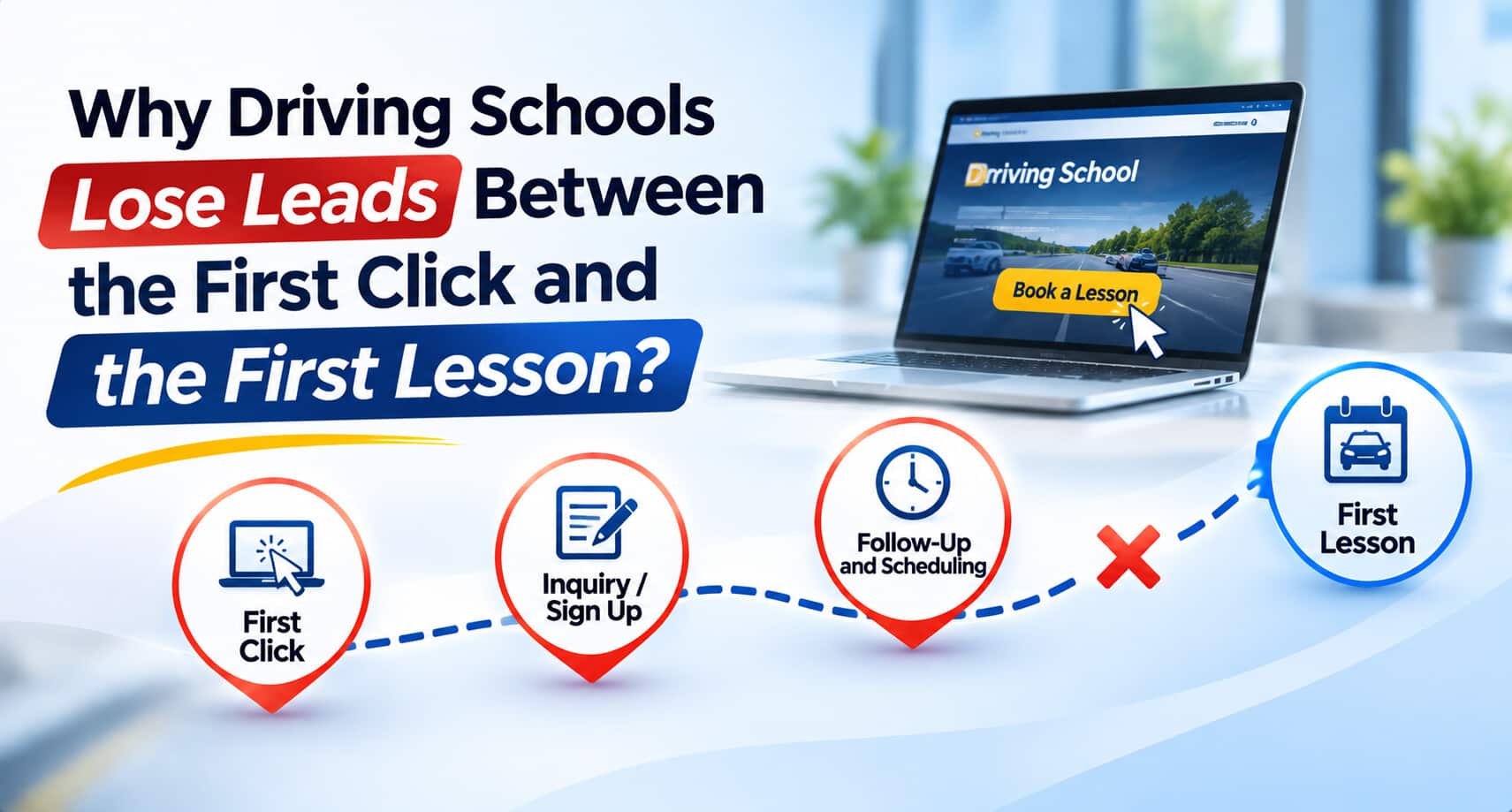
A driving school can rank well, run a steady ad campaign and still see its new-student numbers stay flat. The demand is real. Parents search for driver’s ed close to home, and adults who never learned finally decide this is the year. Many of them click and even reach out. Then, somewhere between that first click and the first lesson, a large share of those driving school leads quietly disappear.
The loss rarely shows up in a report. Owners blame the gap on ad costs, the season or price shoppers, yet most of it happens in steps the school fully controls.
Visibility still matters. A capable website development and digital marketing agency can put a school in front of the right families and build a site that answers questions instead of simply listing programs. But traffic only pays off when every step after the click is built just as carefully.
That part depends on operations. Inquiries, enrollment details, payments and bookings have to move cleanly from one stage to the next, and reliable driving school management software keeps that progress visible instead of scattered across inboxes, notebooks and personal phones.
Here is where leads most often slip away, and what to change at each point.
The Drop-Off Nobody Measures
Most schools track inquiries and enrollments. What happens between them, and between enrollment and the first drive, usually goes unmeasured.
Picture 100 people landing on a school’s website in a month. Perhaps 15 call, text or fill out a form. If replies take a day, a few of those families have already booked elsewhere. A few more start enrolling and stall on the forms. Another one or two pay, see that the first open lesson is four weeks away, and ask for a refund.
The school might end up with six students in a car. None of the others said no. They simply drifted off, and nobody found out why.
The figures are illustrative, but the pattern is common. Each exit is small alone, but together they decide whether marketing spend turns into students.
Websites That Skip the Real Questions
The first exit often happens before any contact. If the site does not answer a visitor’s practical questions quickly, the back button is easier than a phone call.
For driving schools, those questions are predictable:
- What does a full program or lesson package cost?
- How soon could lessons actually start?
- Do instructors pick up from our neighborhood, school or workplace?
- What is needed first, such as a learner’s permit or completed classroom hours?
Sites that hide pricing behind “call for details” lose the visitors who are ready to decide. Slow mobile pages cost leads too.
AI-powered search raises the bar further. When assistants summarize local options before anyone clicks, visitors arrive further along and expect the page to confirm what they already read.
Slow or Generic Replies
Families rarely contact just one school. A parent might send three inquiries in one evening and enroll with whichever school makes the next step easiest. That turns the first reply into a competition, and speed is only part of it.
A fast but generic message, such as “Thanks for reaching out, please call during office hours,” often loses to a slower, useful one that answers the question, gives a realistic start date and offers one clear next step, like a booking link.
After-hours inquiries need a plan of their own. Many parents research after work, when the office is closed and instructors are off the road. An automatic acknowledgment that sets a clear expectation, such as a callback by 10 a.m., keeps the school in the running until a person follows up.
Enrollment That Feels Like Paperwork
Some leads say yes and still never become students. They start enrolling, hit a wall of forms and set it aside for later. Later rarely comes.
The friction is familiar: one long form that asks for everything at once, a PDF that must be printed and signed, a permit number the family does not have on hand, or payment that only works over the phone. Together, they turn a quick decision into a chore.
A better approach is to collect information in stages. Ask only for what is needed to hold a spot, such as the learner’s name, age, contact details and preferred times. Request permit details, signatures and any state forms closer to the first lesson, and let families pay a deposit online the moment they decide.
Nothing the state requires gets skipped. It simply stops landing at the exact moment a family is most likely to hesitate.
No One Owns the Lead
Behind most of these exits sits a quieter problem: once an inquiry arrives, nobody is clearly responsible for it.
In a small school, a new lead might reach the owner’s cell, the office inbox or an instructor’s personal number. The owner assumes the office called back. The office assumes the instructor handled it. A week later, the family has moved on.
The fix starts with one rule. Every inquiry lives in one place, with one person assigned and one next step recorded. Anyone in the office should be able to see who replied, what was promised and when the family last heard from the school.
Connected systems make that rule easy to keep. NewAgeSysIT, for example, builds driving school platforms that link an admin portal, an instructor app and a student app, so an inquiry, its enrollment status and the first booked lesson sit in one record rather than three separate tools. Each platform is shaped around the school’s existing workflow and owned by the school, so the process fits how the office already runs.
If you cannot list every open inquiry and its next step in under a minute, some leads are already slipping.
Two Decision-Makers
Teen driver education adds a twist most service businesses never face. The person who clicks is often not the person who pays.
A teenager may find the school on social media and send the inquiry, while a parent makes the final call and handles payment. If replies reach only the teen, the parent never sees the price or the start date. If they reach only the parent, the teen’s enthusiasm cools while the adults sort out schedules.
Schools that convert well bring both people in early. They ask for a parent’s contact details at the first step, send key details to both, and give parents a simple view of what has been booked. An excited teen with an informed parent is far more likely to reach the first lesson than either one alone.
The Long Wait for Lesson One
Even a paid student can slip away before the first drive. Interest fades quickly when the earliest open slot is weeks out, especially in peak seasons like summer.
Instructor time is limited, so some waiting is unavoidable. How the wait is handled matters as much as its length:
- State realistic start dates on the website and in the first reply, so nobody is surprised after paying.
- Give new students something to start right away, such as an orientation call, an online theory module or a classroom session.
- Keep a short-notice list and offer cancellations to waiting students first.
- Send a brief check-in before the first lesson confirming the time, pickup spot and what to bring.
A student who has already begun learning, even online, is far less likely to walk away than one who has heard nothing since paying a deposit.
Trace Your Last 20 Leads
The fastest way to find your own leak is to work backward from real inquiries instead of guessing.
Pull the last 20 inquiries from every channel. For each one, note four things:
- How long the first reply took.
- Whether that reply answered the question asked.
- Whether the family enrolled, and if not, where the conversation stopped.
- How many days passed between enrollment and the first lesson.
Patterns appear quickly. Weekend inquiries may wait the longest, most drop-offs may follow the price quote, or enrolled students may wait twice as long as you assumed. Each pattern points to one specific fix.
Run the exercise again a month after each change, so you can see whether the fix actually worked.
Keep the Students Who Already Found You
Every lead that reaches your website has already cleared the hardest hurdle: it found you among every other school in town. Losing that family to a slow reply, a confusing form or a silent waiting period wastes the effort and budget that brought them in.
Close the gaps one at a time, starting with whichever one your last 20 inquiries point to. More families will make it from the first click to the first lesson, often without another dollar spent on advertising.