


The U.S. Commerce Department has issued an interim final rule aimed at preventing overseas users from reaching advanced U.S. computing capabilities through remote arrangements at third-country data centers. The action shifts export-control attention beyond the physical shipment of chips and servers, toward the cloud infrastructure and access pathways that can make high-end processing power available across borders.
The Bureau of Industry and Security said Nov. 16 that the measure addresses remote access to advanced U.S. “super intelligence” chips and servers. In its announcement, BIS said advances in cloud computing and related infrastructure had made remote access increasingly possible from data centers outside countries subject to U.S. export restrictions. For chip vendors, cloud operators and data-center customers, the immediate issue is whether controls designed for equipment exports can be enforced when the equipment stays in a third country but the computing work is performed for a restricted user elsewhere.

Rule targets computing access, not just shipments
BIS described the new action as an interim final rule, making it materially different from a policy recommendation or a congressional proposal. The agency’s stated objective is to stop parties from circumventing existing restrictions through remote-computing arrangements involving facilities in third countries.
The public BIS summary does not identify China, Singapore, Nvidia, particular processors or a detailed set of covered jurisdictions. Those particulars should not be inferred from the announcement alone. Bloomberg reporting published by Yahoo Finance said the restrictions seek to prevent Chinese companies from renting Nvidia semiconductors abroad and obtaining processors through Singapore and other countries. That account also reported that the measures could add friction ahead of a planned Xi Jinping-Donald Trump meeting at the APEC summit in Shenzhen.
The difference is more than semantic. A conventional export control can focus on who receives a physical chip or server. A remote-access restriction can require providers to assess who is effectively using computing capacity, where the underlying hardware sits, whether intermediaries are involved and whether an arrangement gives a restricted party the practical benefit of the covered technology. It potentially puts compliance obligations closer to cloud account controls, customer verification, access logs and suspicious-activity escalation.
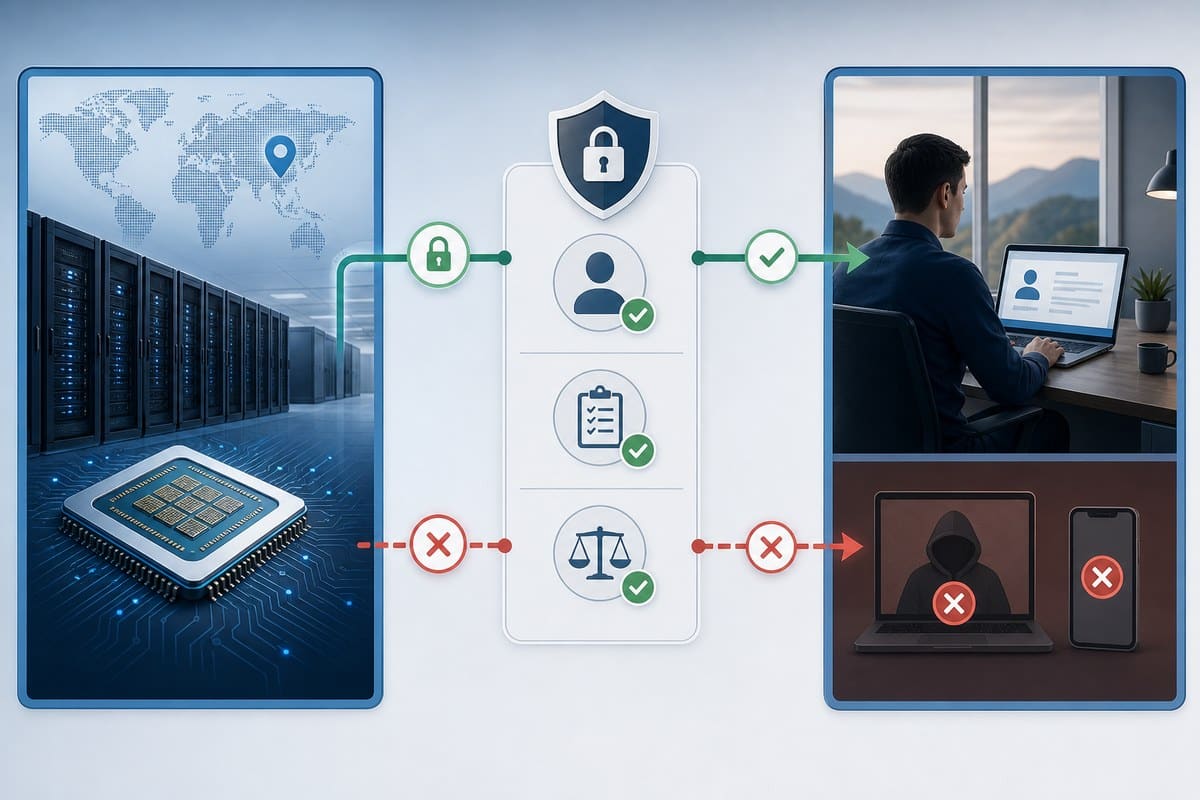
Existing export-control architecture already includes end-use and end-user limits. Part 744 of the Export Administration Regulations contains such controls, including restrictions tied to certain supercomputer and semiconductor-manufacturing end uses under Section 744.23. The interim rule appears to address a route around that framework: computing capability rented or otherwise made available remotely instead of delivered as equipment.
Commission proposes a broader next step
In a separate development, the U.S.-China Economic and Security Review Commission has urged Congress to pursue broader safeguards for export-controlled advanced chips. Its recommendations include requiring tracking technology to help detect diversion of advanced chips to countries of concern, expanding BIS intelligence capacity and establishing a cloud-access model for advanced chips above a threshold set by BIS.
Under that proposed model, eligible users would obtain access through cloud infrastructure rather than receive physical exports of the covered chips. The commission also recommends that licensees use know-your-customer programs and proactively report suspicious activity. The commission says China and Russia continue to circumvent existing U.S. export-control safeguards.
Those recommendations are not enacted law, and they are not part of the Commerce Department’s announced interim final rule. Congress would have to act, or BIS would have to undertake a separate regulatory process, before the commission’s suggested tracking mandate or cloud-rental framework became binding. Still, the overlap in approach is notable: both developments treat control of access to computing capacity as increasingly important alongside control of hardware ownership and location.
A tightening sequence for AI hardware
The remote-access action follows earlier movement in Commerce’s licensing policy. On Jan. 13, BIS announced a revised case-by-case review policy for exports to China of Nvidia’s H200, AMD’s MI325X and comparable semiconductors, subject to the security requirements described in the agency’s January release. That policy concerned applications to export specified hardware; the November rule addresses the possibility that comparable computing capability can be used without an export to the end user.
Taken together, the measures illustrate the commercial pressure point created by AI infrastructure. Semiconductor makers sell processors, server makers assemble systems, and cloud providers monetize capacity over time. A regime that limits remote use can affect each layer differently: vendors may face tighter customer screening and deployment scrutiny, while cloud and data-center operators may bear more of the task of identifying beneficial users and monitoring access after capacity is provisioned.
China’s Foreign Ministry criticized the U.S. use of export controls and said Beijing would take necessary steps to protect its legitimate rights and interests, according to the Bloomberg report. The diplomatic setting remains reported rather than established in Commerce’s notice. What BIS has confirmed is narrower but consequential: the agency is moving to close a perceived gap between restricting advanced American computing hardware and restricting remote access to the output of that hardware.

