


Cognito Therapeutics said its 40Hz light-and-sound stimulation device slowed clinical decline over 12 months among people with mild Alzheimer’s disease in a large randomized trial, but the study as a whole did not meet its primary endpoint. The mixed result is important because it is among the largest reported tests of a noninvasive sensory-stimulation approach for Alzheimer’s, yet the available evidence does not establish the device as an effective treatment.
The company presented results from its 663-participant HOPE trial at the Clinical Trials on Alzheimer’s Disease conference in Boston on Nov. 16, according to a Medical Xpress report published Nov. 18. Cognito said it plans to seek Food and Drug Administration authorization for Spectris for mild Alzheimer’s disease. The device is not FDA-authorized for that use, and no FDA review, peer-reviewed HOPE paper or detailed trial record was available with the announcement.

Reported benefit was confined to mild disease
HOPE was described as a nationwide, randomized, controlled, double-blind trial in which participants received 40Hz, or 40-cycle-per-second, light and sound stimulation through Cognito’s Spectris device. It included 395 people with mild Alzheimer’s and 268 with moderate disease, two groups the company said were specified in advance for analysis.
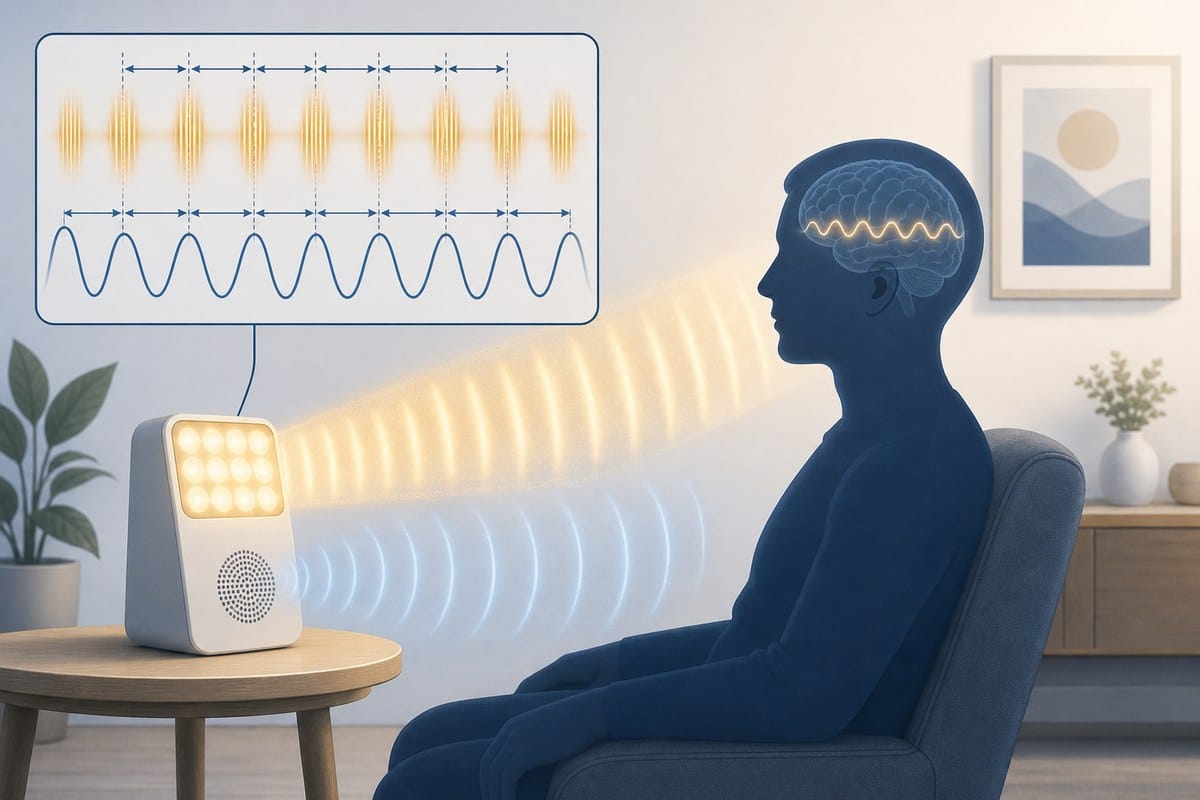
In the mild-Alzheimer’s subgroup, Cognito reported statistically significant differences favoring stimulation over untreated controls on three measures after one year. The company said decline was 56% slower on the Alzheimer’s Disease Cooperative Study Activities of Daily Living scale, 53% slower on its instrumental-activities measure and 47% slower on the Clinical Dementia Rating Sum of Boxes, or CDR-SB. The first two scales assess day-to-day abilities, while CDR-SB combines ratings across cognitive and functional domains.
Those percentages describe relative differences in the rate of decline, not a reversal of Alzheimer’s disease or proof that participants retained all function. The report did not provide the underlying score changes, confidence intervals, p-values or the precise definition of the trial’s overall primary endpoint. It also said some measures in the mild group were not statistically significant, without supplying the complete outcome table.
The moderate-Alzheimer’s subgroup showed no clinical benefit, according to the company’s account. That result means the mild-disease findings should not be extended to people with more advanced disease, a distinction that could be particularly consequential if Cognito proceeds with an application limited to mild Alzheimer’s.
Why a subgroup result and a missed overall endpoint can coexist
There is no inherent inconsistency in an overall trial missing its main endpoint while a prespecified subgroup has positive findings. A treatment effect could be concentrated in one severity group, diluted by no benefit in another group, or assessed differently in the trial-wide analysis. Identifying mild and moderate disease in advance gives a subgroup analysis more scientific weight than an analysis devised after results are known.
Still, the available account leaves major questions unanswered. It does not specify whether the overall endpoint pooled all participants, how outcomes were prioritized, how missing data and dropouts were handled, or what adjustments were made for testing multiple outcomes and subgroups. Those details can materially affect how confidently clinicians, scientists and regulators interpret apparently positive subgroup results.
Cognito also highlighted an analysis of 169 mild-Alzheimer’s participants who used the device at least 70% of the intended time. In that protocol-adherent group, it reported 82% slower decline on each of two daily-function measures, 64% slower decline on CDR-SB and a statistically significant 73% result on another composite measure, iADMARS. Such analyses may help explore whether regular use is associated with better outcomes, but they are narrower than the full randomized mild-disease comparison. People able to adhere consistently can differ from those who cannot, so the figures should not be treated as a stand-alone estimate of the device’s effect without fuller data.
The company reported no unanticipated adverse device effects. That is not the same as a complete safety assessment: the public account did not include the number and type of adverse events, discontinuations or device-related problems. Light-and-sound stimulation may appear less burdensome than an infused medicine, but its safety and practical tolerability still require transparent reporting over the population intended to use it.
A much smaller earlier study cannot confirm HOPE
The announcement follows earlier work from Massachusetts Institute of Technology researchers on the same general 40Hz audiovisual-stimulation concept. That research should not be confused with HOPE. An MIT account of the earlier work describes a five-person, open-label extension study that followed volunteers using daily stimulation for about two years. The study was published in Alzheimer’s & Dementia: The Journal of the Alzheimer’s Association.
That small study found the approach feasible and reported patterns consistent with slower cognitive and biomarker progression in some participants, particularly those with late-onset disease. But it had no concurrently randomized control group; researchers compared participants with matched people in national databases. Only two participants provided follow-up plasma samples. Those features make the findings exploratory and leave open the possibility that differences other than stimulation contributed to the results.
A separate announcement about the five-person study noted possible differences between late- and early-onset Alzheimer’s participants. With only five people, however, those observations cannot show that age of onset predicts response, nor can they demonstrate sex-specific effects. MIT also notes that senior author Li-Huei Tsai co-founded Cognito, a relationship relevant to interpreting the company’s development of the technology.
HOPE’s substantially larger, blinded and controlled design is better suited than the extension study to test whether the stimulation itself causes a clinical effect. But a randomized design does not remove the need to see the full analysis, particularly when the overall primary endpoint was missed. A conference presentation and company-reported summary can identify a potentially important signal; independent scrutiny will require a full report of the trial methods, outcomes and safety data, followed by any FDA assessment of the proposed use in mild Alzheimer’s disease.

