


I spent 13 hours driving from Chicago to Nashville with three flagship phones, three carrier eSIMs, and a data logger running nonstop to answer a simple question: whose 5G network holds up best when you leave the city limits? After more than 1,000 miles and over 120,000 signal readings, the result surprised me. T-Mobile delivered the most consistent 5G coverage on this route, and it wasn’t particularly close.
How We Tested Across Four States On The Road
The test spanned interstates through Illinois, Indiana, Kentucky, and Tennessee. Three identical Google Pixel 10 Pro phones, each with a dedicated eSIM from AT&T, Verizon, and T-Mobile, were mounted side by side and powered continuously by a portable power station to eliminate variance from battery or thermal throttling.
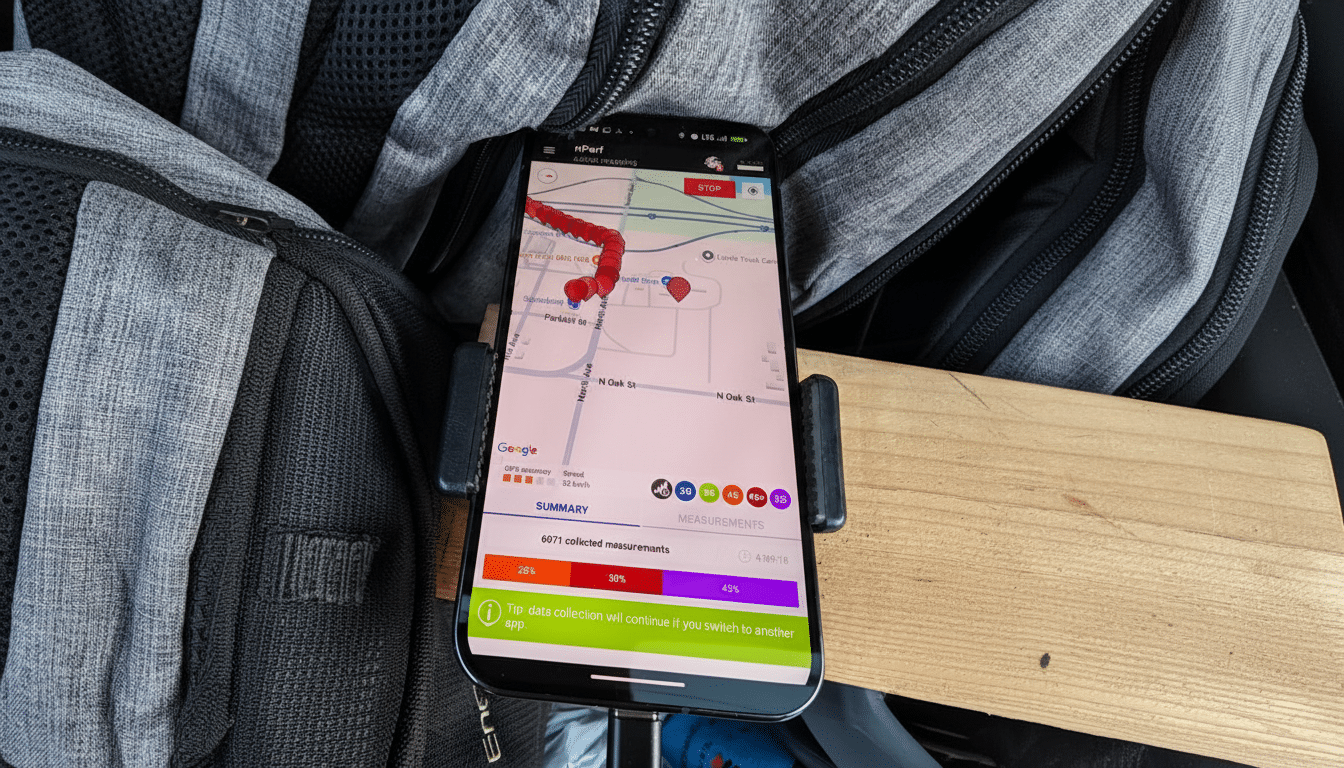
We used nPerf to log connection type, signal bars, and received power (in dBm) roughly 1,500 times per minute while moving. To gauge real-world throughput outside of motion, we stopped about once an hour at rest areas and gas stations and ran controlled speed tests on an iPhone 17 carrying all three eSIMs, cycling through each carrier in identical conditions.
This approach produced two complementary datasets: continuous coverage quality while in motion, and apples-to-apples speed checks during periodic stops where congestion is common.
Coverage Winner And The Numbers Behind The Drive
Across the entire route, T-Mobile registered 5G service 96.2% of the time. That figure includes both standalone (SA) and non-standalone (NSA) 5G sessions. By comparison, Verizon and AT&T posted over 35% 5G availability on this trip, leaning more heavily on LTE in the gaps. All three carriers, however, maintained “usable” signal strength for over 90% of the drive, meaning calls, texts, and basic data generally worked when we needed them.
Signal quality measured in dBm told a similar story. T-Mobile’s mid-band footprint consistently produced strong, mid-range readings that favored stability. Verizon and AT&T oscillated more between excellent and merely serviceable levels, reflecting a mix of newer spectrum deployments and legacy LTE fallbacks.
The Speed Story And A Louisville Standout
Speed tests at hourly stops underscored how location and spectrum use can swing results. Verizon posted the single fastest reading of the trip in Louisville, Kentucky, at just under 4 Gbps down—an eye-popping mmWave or wide-channel C-band moment. Outside of these hotspots, speeds tended to normalize, with T-Mobile often proving steadier from stop to stop, and AT&T showing solid, if less flashy, performance.
A key takeaway: peak speeds are impressive marketing, but sustained availability and consistency matter more on open highway. On that metric, T-Mobile’s footprint translated to fewer drops and more time actually on 5G.
SA vs. NSA And Why It Mattered On This Route
In our logs, only T-Mobile showed sessions using non-standalone 5G alongside standalone 5G. NSA leverages 4G control channels for faster, cheaper rollouts; SA is the endgame, enabling lower latency and 5G-specific features. The presence of both on T-Mobile suggests a mature, layered deployment along this corridor. By contrast, Verizon and AT&T devices in our test did not register NSA connections during the drive, which may reflect local network configuration or firmware behavior on this route rather than a nationwide posture.
For everyday travelers, the distinction is subtle. Latency-sensitive tasks like cloud gaming and remote-control applications benefit most from SA. For maps, music, and messaging, stability beats novelty.
How This Squares With Independent Reports
Our findings line up with trends tracked by third-party analysts. Recent reports from Opensignal and Ookla have consistently credited T-Mobile with leading 5G availability and mid-band reach, while RootMetrics often highlights Verizon’s reliability and peak speeds in many metro areas. AT&T typically posts competitive consistency and strong LTE fallback, which we also observed on the road.
Regulatory data from the FCC and industry trade group CTIA further explain the dynamics: T-Mobile’s early acquisition of 2.5 GHz mid-band spectrum enabled wide-area 5G layers, while Verizon’s heavy C-band and targeted mmWave investment delivers spectacular bursts where capacity demand is highest.
What Drivers Should Expect Next On Interstates
If you stick to interstates, all three networks are now broadly reliable, with a high likelihood of enough signal to navigate, stream, or call for help. If having the 5G icon lit most of the time matters to you, T-Mobile’s odds were best on this route. If you prize the occasional mind-bending speed burst at a stadium or city center, Verizon delivered the most dramatic highs in our test. AT&T offered a steady middle ground, with fewer extremes but dependable service.
Two important caveats: this was one route on specific devices over a limited window, and interstates get priority in build-outs. Rural byways and small-town grids can tell a different story. Time of day, device antenna design, and plan prioritization also play roles you can’t see on a coverage map.
The bottom line from the driver’s seat is encouraging. Six years into the 5G era, highway coverage is maturing fast. On this Midwest-to-South run, T-Mobile owned consistency, Verizon owned the “wow” moment, and AT&T kept the wheels turning—with enough signal across the board to get where we were going without anxiety.
