


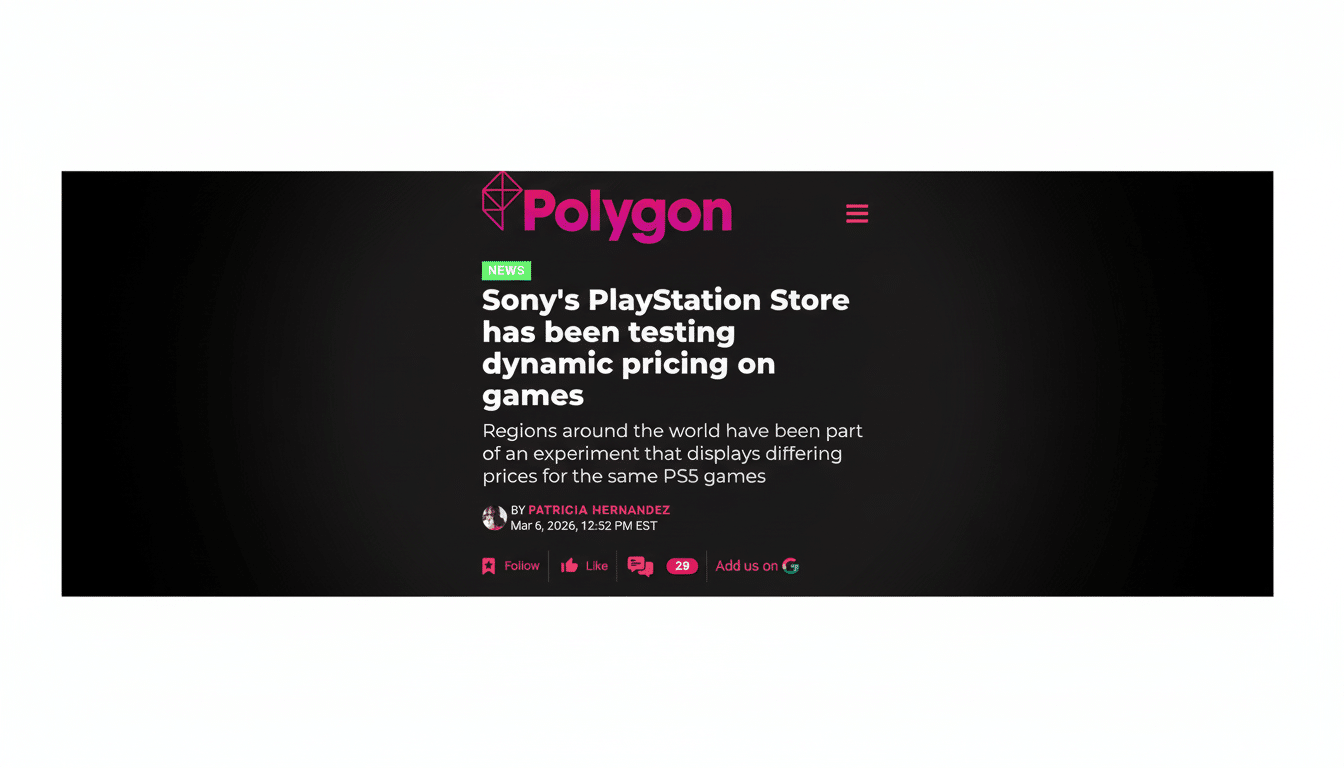
Some PlayStation fans are discovering they paid less—or more—than friends for the same PS5 games. According to price-tracking service PSPrices, Sony is piloting dynamic pricing on the PlayStation Store in select markets, serving individualized discounts on hundreds of titles. The differences are modest but real, topping out at 17.6% in early sightings, and the experiment is not currently active in the US.
What Users Are Seeing in Early Regional Tests
PSPrices reports the test has grown from 30 regions at launch in November 2025 to 68 regions today, affecting more than 150 games. The internal label IPT_PILOT appears in related code, signaling a controlled trial rather than a permanent policy. The discounts do not appear for everyone—two shoppers in the same country may see different prices for the same title when logged in.
In Germany, first-party hits such as Astro Bot, God of War Ragnarök, Marvel’s Spider-Man 2, Gran Turismo 7, and Stellar Blade have shown 12.5% reductions for select accounts, roughly €10 off standard pricing. Third-party games display even wider spreads in some cases, with WWE 2K25 down 17.6% and Warhammer 40,000: Space Marine 2 reduced by 16.6% for certain users. If you compare while signed out or on a friend’s console, you may notice mismatches.
Notably, the trial has skipped the US for now. Industry watchers point to a mix of regulatory caution and the desire to validate outcomes in smaller markets before expanding. Sony has not commented on the pilot.
Why Sony Might Try Personalized Prices on PS5
Dynamic pricing is common in travel and ride-hailing, but rare for premium console games. The appeal is straightforward: lift conversion among fence-sitters without slashing prices for everyone. By tailoring modest discounts to specific user segments—say, infrequent buyers, players new to a franchise, or those with long wishlists—Sony can test price elasticity and nudge purchases that might otherwise be deferred.
There is also the macro trend: Sony’s investor reports show digital sales now account for well over 70% of full-game purchases in recent quarters across PlayStation platforms. When nearly all transactions funnel through a first-party storefront, even a small conversion uptick compounds across a large catalog. A targeted 5% lift in conversions during non-sale periods can have an outsized impact versus blanket promotions that train customers to wait.
Sony already runs segmented promotions—PS Plus subscriber discounts, curated sale events, and email coupons—but those are cohort-based. Per-user pricing directly personalizes the storefront, quietly moving price instead of surfacing a visible, storewide “sale.”
How This Differs From Usual Storewide Discounts
Traditional console discounts are uniform: a publisher sets a regional sale price and everyone sees the same cut. Subscription perks like PS Plus reduce prices for all eligible members. Steam and console stores also use regional pricing tiers to reflect currency and local purchasing power, but again, those apply broadly.
The IPT_PILOT approach appears more granular. Two shoppers in the same market, with the same console and without any add-on subscription, may face different price tags based on account-level signals. For transparency, it will be important that the Store clearly indicates when a price is a personalized offer rather than a universal discount.
The Regulatory and Consumer Backdrop for Pricing
Personalized pricing is lawful in many jurisdictions but comes with strings attached. In the EU, consumer protection updates under the Omnibus Directive require traders to disclose when prices are personalized based on automated decision-making. If profiling is involved, GDPR obligations around transparency and lawful basis also apply. The UK Competition and Markets Authority has cautioned against opaque online pricing practices that can mislead or undermine consumer trust.
Beyond compliance, optics matter. Gamers already navigate launch prices, deluxe editions, add-ons, and periodic sales. If per-user pricing feels arbitrary or punitive—if, for example, loyal buyers consistently see smaller cuts—it could spark backlash. Conversely, if framed as “exclusive offers” with clear labels and predictable patterns, it may land closer to loyalty rewards than stealth price discrimination.
What to Watch Next in Sony’s Dynamic Pricing Pilot
Players can check prices signed in versus signed out, or compare against friends in the same region. Price-tracking services that log storefront changes may miss individualized offers, so anecdotal comparisons will be key. Watch for expansion into additional regions, especially North America, and for any Store messaging that explicitly identifies “personalized” pricing.
Publishers will also be watching. If the pilot proves that small, targeted discounts increase sell-through without harming perceived value, expect broader participation and more sophisticated segmentation. If confusion or regulatory scrutiny grows, Sony could confine the tactic to limited-time offers or specific franchises.
Meanwhile, separate reporting has hinted at a tighter approach to platform exclusivity for Sony’s biggest PS5 titles. Taken together, a dynamic-pricing pilot and a more guarded PC release cadence would underscore a strategy centered on maximizing lifetime value inside the PlayStation ecosystem. For now, the message to players is simple: the price you see might not be the price your friend sees—and that may be by design.

